
Travel to Haridwar: A First-Timer’s Guide to the Gateway to the Gods
A practical, no-fluff guide to Haridwar for first-time visitors — the Ganga aarti at Har Ki Pauri, the hilltop temples of Mansa Devi and Chandi Devi, the bathing ghats and bazaars, where to stay and eat, how to get there, and an easy 2-day plan.
Haridwar is where the Ganga, after rushing down through the hills past Rishikesh, finally spills onto the plains — and where much of India comes to bathe, pray and let go. One of Hinduism’s seven holiest cities and the traditional gateway to the Char Dham, it is a place of temple bells, floating lamps and ghats crowded from dawn. Where Rishikesh leans spiritual-but-adventurous, Haridwar is pure pilgrim energy, ancient and intense.
Haridwar is the holy city where the Ganga leaves the mountains — famous for the evening aarti at Har Ki Pauri, the cliff-top temples of Mansa Devi and Chandi Devi (reached by ropeway), and the once-every-twelve-years Kumbh Mela. A day or two covers it: an aarti, two temple climbs and a wander through the bazaars. Go October to March, base near Har Ki Pauri, and pair it with Rishikesh just 25 km upstream on the same Uttarakhand trip.
Why visit Haridwar
Three reasons Haridwar anchors almost every Uttarakhand pilgrimage — and pulls in first-timers too.
The Ganga aarti
At Har Ki Pauri the dusk aarti is the most famous in India — hundreds of lamps set afloat at Brahmakund, the spot where a drop of the nectar of immortality is said to have fallen. Bells, fire and chanting, with the river carrying the light downstream.
Temples in the hills
Mansa Devi and Chandi Devi crown the hills on either side of town, each reached by a short ropeway, with the ancient Maya Devi Shakti Peeth down in the old quarter. A half-day of cable-car temple-hopping with valley views.
Gateway to the gods
Haridwar — literally the door to Hari — is the traditional starting point for the Char Dham yatra and the road into Garhwal. It is the threshold where the plains end and the Himalayan pilgrimage begins.
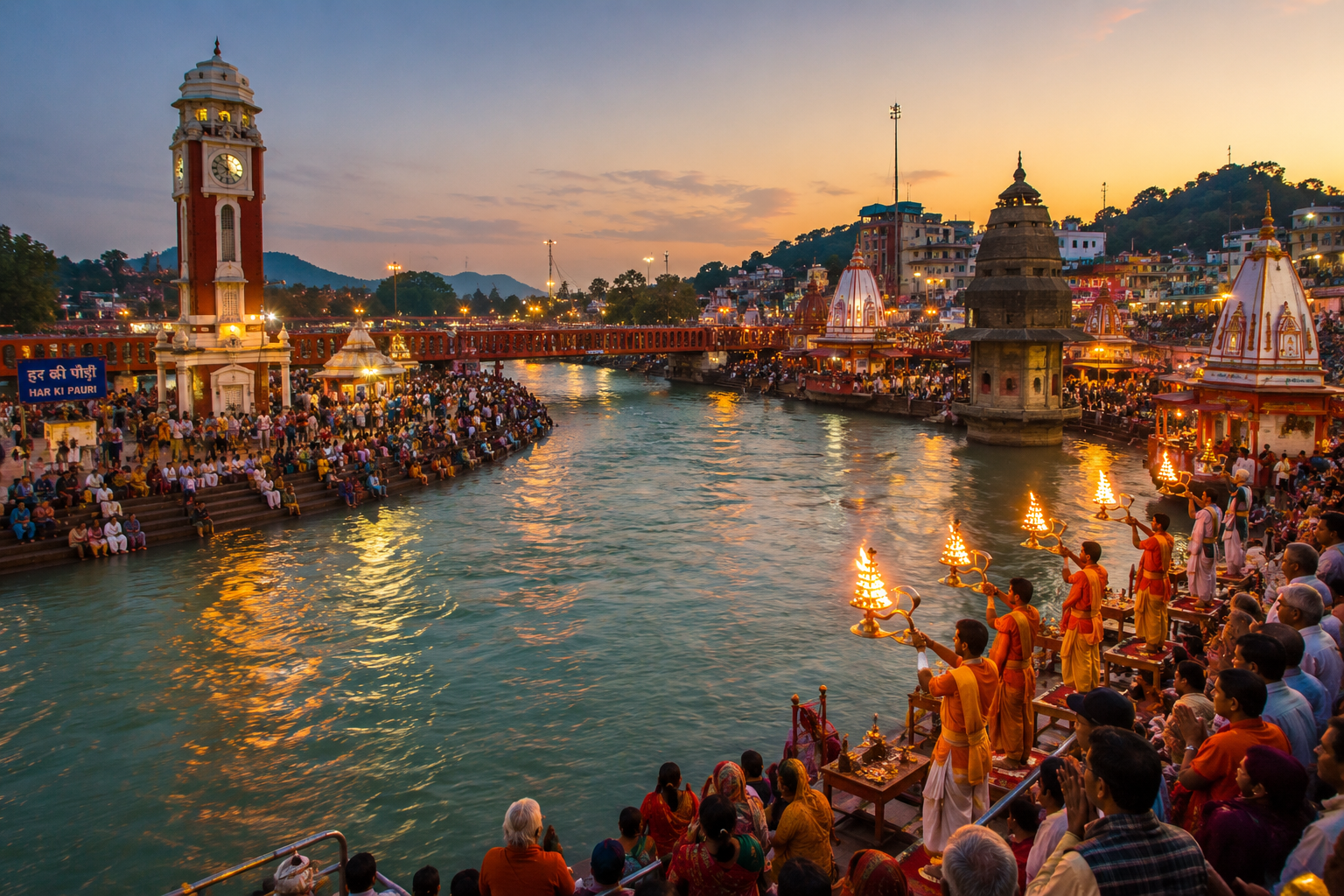
The evening aarti at Har Ki Pauri, where lamps are set afloat on the Ganga at dusk.
When to go
October to March (best): cool, clear and comfortable — the ideal window for ghats, aarti and temple climbs without the heat or the heaviest crowds.
February to March: pleasant spring days, often timed with festivals; Maha Shivratri and the spring melas bring colour and bustle.
April to June: hot and dusty on the plains, though the river keeps the ghats a touch cooler in the mornings and evenings.
July to September (monsoon): the Ganga runs high and brown; July brings the enormous Kanwar Yatra, when saffron-clad pilgrims flood the town and roads. Lush but extremely crowded.
Haridwar is strictly vegetarian and alcohol-free within the holy precincts. During the Kanwar Yatra (July) and the Kumbh / Ardh Kumbh, crowds and restrictions multiply — wonderful to witness, hard to navigate.
Top things to do in Haridwar
From the dusk aarti to ropeway temples, here is what fills a day or two on the Ganga.
Ganga aarti at Har Ki Pauri
The signature Haridwar experience. As the sun sets, priests swing tiered lamps, the crowd sets leaf-boats of marigold and flame onto the water, and the whole ghat sings. Arrive early, find a step near Brahmakund, and keep valuables close.
Mansa Devi by ropeway
Ride the Udan Khatola cable car up Bilwa Parvat to the wish-granting goddess Mansa Devi. Tie a thread for a wish, then take in the bird’s-eye view over the town, the ghats and the river splitting around its islands.
Chandi Devi on Neel Parvat
Across the valley, a second ropeway (or a stiff walk) climbs to Chandi Devi, one of the area’s revered Siddh Peeths. Pair it with Mansa Devi on a combined ticket for a half-day of temples and ridge-top views.
Maya Devi Temple
One of the oldest temples in Haridwar and a Shakti Peeth, tucked into the old town near Har Ki Pauri. A quieter, atmospheric stop that predates much of the modern pilgrimage city around it.
Bharat Mata Mandir & the ashram belt
The multi-storey Bharat Mata (Mother India) temple sits among the ashrams of the Sapt Sarovar area, each floor themed around the nation’s heroes, saints and sacred geography. A short ride from the centre and easy to combine with the riverside ashrams.
Bazaars & a Rajaji safari
Browse Bara Bazaar and Moti Bazaar for rudraksha, puja items, brassware and sweets, then — if you have a spare morning — drive out to Rajaji National Park on the edge of town for elephants, deer and birdlife.
What to eat in Haridwar
This is a vegetarian, alcohol-free pilgrim town — think hearty puri-sabzi breakfasts, street chaat and old-school sweet shops.
Aloo puri & kachori
The quintessential Haridwar breakfast — puffed puris with a spiced potato curry, or flaky kachoris, eaten standing at a market stall for almost nothing.
Classic puri-sabzi houses
Long-running thali and puri-sabzi spots like Hoshiyar Puri and Mohan Puri Wala have fed pilgrims for generations — simple, generous North Indian veg plates.
Pede, khurchan & chaat
Mathura-style milk pede, sheets of khurchan, jalebi and a plate of tangy chaat — the sweet-and-savoury street snacking the bazaars do best.
Lassi & kulhad chai
A thick, chilled lassi in summer or a clay-cup of ginger chai any time of year — the easy refreshment between temple climbs and ghat walks.
Don’t arrive expecting meat, fish or a cold beer — Haridwar is strictly vegetarian and dry. Lean into the puri-sabzi, chaat, sweets and lassi instead.
Where to stay
Pick your scene: an ashram or dharamshala for the full pilgrim experience, a hotel near Har Ki Pauri for the aarti, or a quieter resort on the outskirts.
Ashram or dharamshala
Simple, inexpensive rooms run by ashrams and trusts, often steps from the river. Basic and rule-bound, but the most immersive — and budget-friendly — way to stay.
Hotel by Har Ki Pauri
A mid-range hotel within walking distance of the main ghat means you can stroll to the aarti and back without fighting for an auto. The most convenient pick.
Riverside resort
Spa hotels and resorts on the quieter fringes trade the bustle for pools, gardens and calm — handy if you are pairing Haridwar with Rishikesh.
How to get to Haridwar & around
Haridwar is one of the best-connected pilgrim towns in north India — and compact enough to cover on foot and by e-rickshaw.
Stay within walking distance of Har Ki Pauri and you can reach the aarti on foot — saving time and auto fares on the most congested evening of your trip. Buy a combined Mansa Devi + Chandi Devi ropeway ticket if you plan to do both.
A simple 2-day plan
Two unhurried days that cover the ghats, the aarti and the hilltop temples.
Ghats, old town & aarti
Spend the morning along the ghats and through the bazaars, stopping at the ancient Maya Devi temple. Rest through the afternoon heat, then claim a spot for the evening Ganga aarti at Har Ki Pauri — the highlight of any Haridwar visit.
Practical tips that actually help
Get to the aarti early
Har Ki Pauri fills fast — arrive 30–45 minutes before sunset for a spot near the water.
Mind your belongings
The ghats get tightly packed at aarti time; carry only what you need and keep phones and wallets secure.
Dress modestly
This is a holy city — cover shoulders and knees at temples and ghats, and remove shoes where asked.
Carry cash
Stalls, ropeway queues and small temples are cash-first, though UPI is widely accepted too.
Plan around Kanwar Yatra
In mid-July the town is overwhelmed by pilgrims — magical to see, but tough for a relaxed first visit.
Respect the current
The Ganga is fast and cold even at the ghats — bathe only at the railed, supervised sections.
Mistakes first-time visitors make
- Treating it as a quick stop. Many rush through on the way to Rishikesh — but Haridwar earns at least one evening for the aarti and a morning for the temples.
- Arriving during Kanwar Yatra unprepared. Mid-July sees enormous pilgrim crowds and road restrictions; plan around it unless that is what you have come for.
- Skipping the ropeway temples. Mansa Devi and Chandi Devi give you the views and the calm the ghats can’t — don’t miss them.
- Expecting meat or alcohol. The holy precincts are strictly vegetarian and dry; plan meals accordingly.
Planning Uttarakhand beyond Haridwar?
Haridwar pairs naturally with Rishikesh’s bridges and rafting, then the hills of Mussoorie and Nainital and a high-Himalayan leg to Auli. Tell me your dates and pace, and I’ll map an Uttarakhand route that links them up.
Plan my Uttarakhand trip →Haridwar FAQs
How many days do you need in Haridwar?
One to two days is enough. A day covers the Ganga aarti at Har Ki Pauri and the bazaars; a second lets you take the ropeways up to Mansa Devi and Chandi Devi and visit Maya Devi without rushing.
What is the best time to visit Haridwar?
October to March is most pleasant, with cool, clear days. February and March add spring festivals. April to June is hot, and the July to September monsoon brings high water and large Kanwar Yatra crowds.
What is the Ganga aarti and where do you see it?
It is the evening prayer to the river, with lamps, bells and chanting. The famous one is at Har Ki Pauri (Brahmakund) — arrive 30 to 45 minutes before sunset for a place on the steps.
How do you get to Haridwar from Delhi?
Haridwar Junction is a major railhead with fast trains, roughly four to six hours from Delhi, or it is about 220 km and five to six hours by road. The nearest airport is Dehradun (DED), about 35 km away.
Is Haridwar vegetarian and alcohol-free?
Yes. Like Rishikesh, Haridwar is a holy city and is strictly vegetarian, with no alcohol sold in the main precincts. Expect puri-sabzi, chaat, sweets and lassi.
Related guides
Keep planning your Uttarakhand trip with these:
Uttarakhand Travel Guide
Rivers, hill stations, wildlife and the Char Dham — how to string Uttarakhand together.
Travel to Rishikesh
Yoga, white-water rafting, the Beatles Ashram and the famous bridges — Haridwar’s adventurous neighbour.
Ashvinee Nagle
I’m Ashvinee — I help first-time travellers plan India trips that actually work. I’ve spent years exploring the country’s regions, from Rajasthan’s forts to Kerala’s backwaters, and I write the guides I wish I’d had on my own first trips.
Written by Ashvinee Nagle
I travel India slowly and write it down honestly - practical guides and real itineraries from someone who lives here.
About Ashvinee →Plan your India trip with us
Get one short, honest India travel guide a week — plus a free 7-day Rajasthan itinerary to start.
Free. Unsubscribe any time.