
Pachmarhi: A quiet hill station inside India’s forest heart
A slow guide to the only hill station in central India — tucked inside the Satpura Tiger Reserve, drenched in monsoon green, and still largely missed by the rush of Indian tourism.
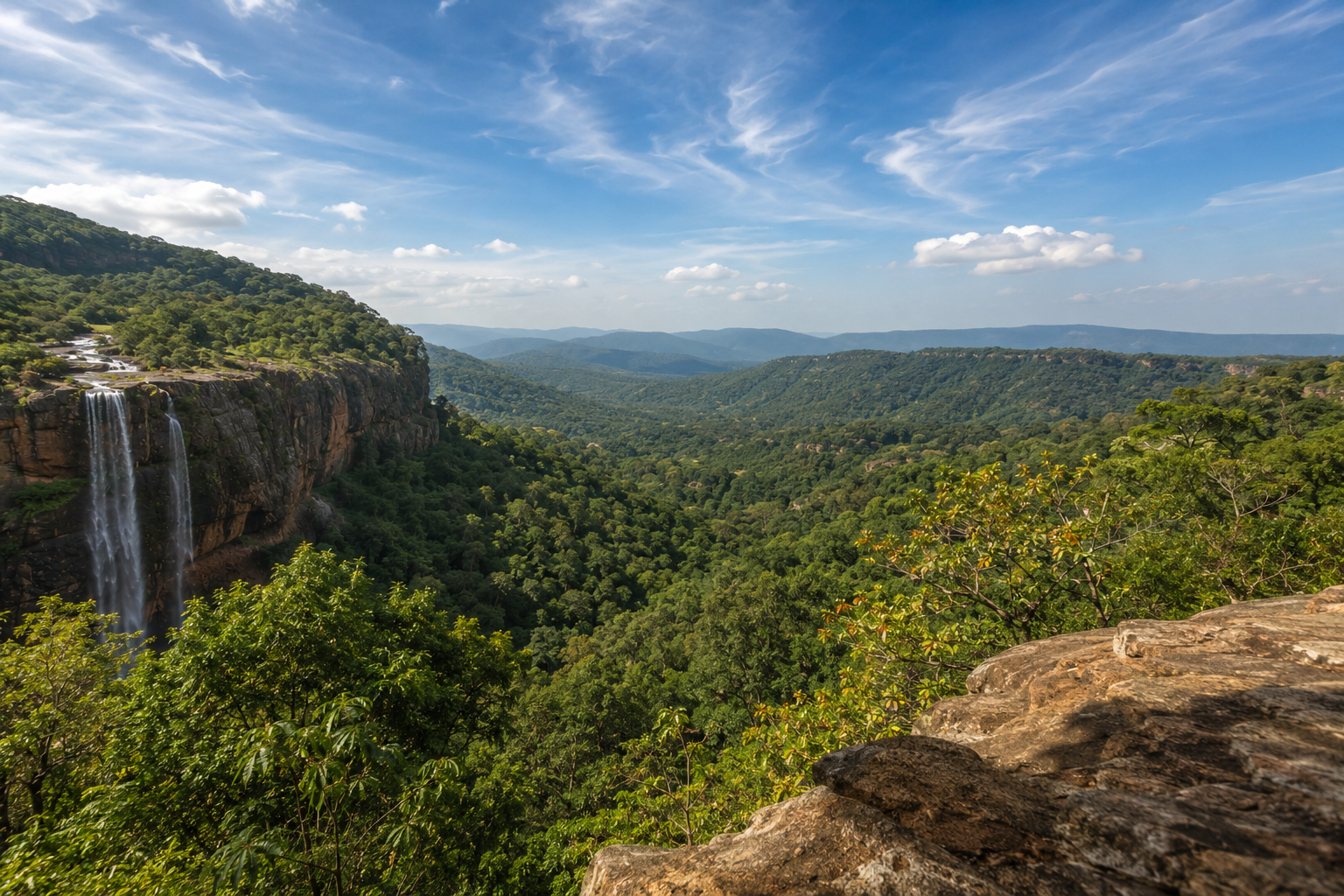
Most travellers in central India pass over Pachmarhi twice — once on the way to Khajuraho, once on the way back from Kanha or Bandhavgarh — without realising they are flying past the only hill station in the country’s vast central belt. It sits on a sandstone plateau in the Satpura range, 1,100 metres up, surrounded on every side by the kind of dense teak-and-sal forest that gives the Satpura Tiger Reserve its name. The British called it the Queen of the Satpuras. Locals call it Satpura ki Rani. Most Indians, if pressed, would struggle to point to it on a map.
Pachmarhi is a small hill station in the Satpura range of Madhya Pradesh — the only one in central India. Best visited October to March, with monsoon (July–September) a wilder, quieter second option. Two to three days is right. Reach by road from Bhopal (180 km) or Nagpur (265 km), with Pipariya as the nearest railhead. Expect waterfalls, colonial-era churches, sandstone caves, Dhupgarh sunset point, and access to Satpura Tiger Reserve safaris.
In this guide
Why Pachmarhi
Pachmarhi was “discovered” by the British in 1857, when Captain James Forsyth of the Bengal Lancers stumbled onto the plateau while chasing the trail of an obscure tribal rebellion. He came back the next year with surveyors. By 1862 the colonial cantonment was established as a summer retreat for the army stationed in the malarial plains of the Central Provinces. The Christ Church, built in 1875, still stands at the top of the town — its stained-glass windows shipped in from Belgium, its bells from England, both somehow surviving 150 monsoons in the middle of an Indian forest.
But Pachmarhi is much older than the British. The five sandstone caves (pach marhi literally means “five dwellings”) that give the town its name are attributed in local legend to the Pandavas, the five exiled brothers of the Mahabharata, who are said to have sheltered here. Whatever you make of the legend, the caves themselves are at least two thousand years old. Some carry Buddhist inscriptions. The forests around them have rock paintings going back 10,000 years.
The only hill station in central India
1,100 m above the surrounding plains. Summer cool, winter cold, and a microclimate quite different from the rest of Madhya Pradesh.
Inside a tiger reserve
Pachmarhi sits within the Pachmarhi Wildlife Sanctuary, which is part of the Satpura Tiger Reserve — declared MP’s first biosphere reserve in 1999.
Slow, by Indian standards
No malls, no major chain hotels, no traffic. Even at peak season the town feels mostly empty. Most travel is on foot or in shared jeeps.
When to go
Pachmarhi has three distinct seasons, and unusually for India, all three are worth a visit. The choice depends on what kind of trip you want.
October to March is the easiest window and the most popular. Days are mild (20–26°C), evenings cool, and the plateau air is dry and clear. Winter mornings can drop to 4–5°C in December and January — cold by central-India standards. This is when the Satpura Tiger Reserve core zones are open for safari (they reopen on the 15th of October each year), making it the best window if wildlife is on your list.
April to June is summer. The plains around Pachmarhi can hit 45°C, but up on the plateau the air is meaningfully cooler — usually 28–32°C in the day, sometimes touching the high 30s. This is when Pachmarhi historically existed: a British summer station, a refuge from the heat below. May and June can still be uncomfortable for outdoor walking but pleasant compared to Bhopal or Nagpur in the same months.
July to September brings the monsoon, and this is when Pachmarhi becomes genuinely spectacular. Rainfall here is roughly 1,700 mm a year — far higher than the rest of the surrounding district. The Bee Falls roar, lesser-known waterfalls appear out of dry ravines, the entire plateau turns a luminous green, and the tourist numbers thin out to almost nothing. The trade-off: Satpura Tiger Reserve core zones close from 1 July to 30 September, some trails get slippery, and a few roads can be cut off for hours after heavy rain. Buffer zones stay open and are at their most beautiful.
The Pachmarhi Monsoon Marathon and the Tour de Satpura cycling event run during the rains and shoulder seasons respectively — both bring some atmosphere to a town that normally feels half-asleep. Worth checking MP Tourism’s calendar if your dates are flexible.
Getting there
Pachmarhi is a road trip, not a flight. There is no airport on the plateau, no direct train, and the last 50 kilometres up from the plains are a slow climb through forest road that, on monsoon afternoons, can feel like driving inside a cloud. The nearest railhead is Pipariya, about 50 km away, which is well-connected to Mumbai, Delhi, Bhopal, and Jabalpur on the central trunk lines. From Pipariya, shared taxis and private cabs take you up to Pachmarhi in roughly 90 minutes.
If you are coming from Nagpur, the road takes you up via Chhindwara and Pench — a worthwhile route in itself, with the option to stop overnight at Pench Tiger Reserve. From Bhopal, the road runs east through Hoshangabad (now Narmadapuram) and crosses the Narmada at one of its widest bends before climbing into the Satpura. Both approaches are best done in daylight; the forest stretches close to the road and animal crossings are common at night.
Top things to do in Pachmarhi
The sights in Pachmarhi are not arranged for efficient ticking-off. Most are 15 to 40 minutes apart by jeep, scattered across the plateau and dropping into the valleys around it. You will need either a shared 4×4 (the official gypsies, organised by the Forest Department, cover most points) or a private car with a local driver who knows the gates. These are the places worth your time.
Dhupgarh at sunset
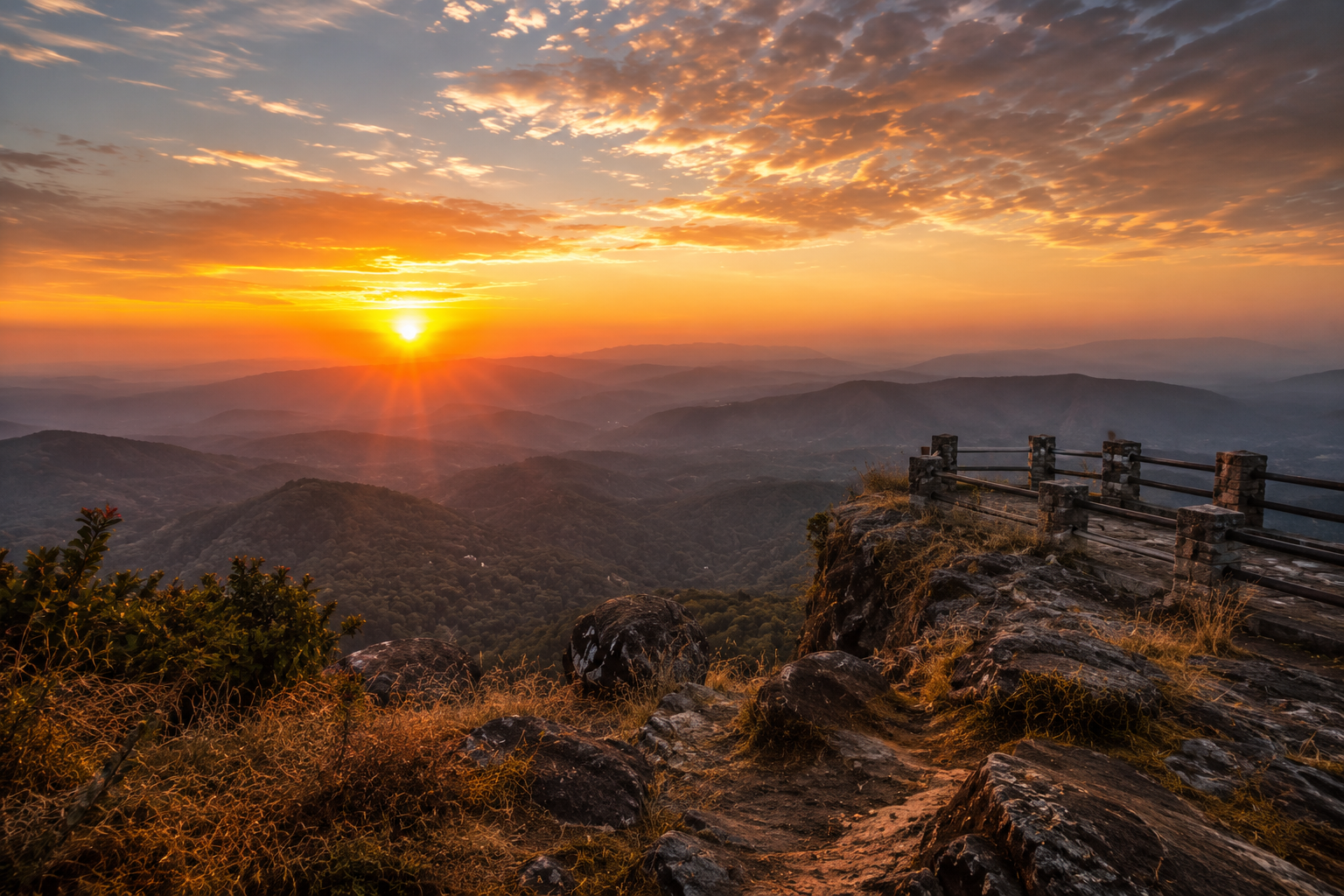
The highest point in Madhya Pradesh at 1,352 m, and Pachmarhi’s single most consistent attraction. The road climbs through forest until it ends at a wide flat outcrop facing west. Time your visit for an hour before sunset, walk to the edge, and watch the Satpura range fold itself into purple silhouettes as the sun drops behind the next ridge. Crowded in winter weekends, quiet on weekday evenings.
Bee Falls (Jamuna Prapat)
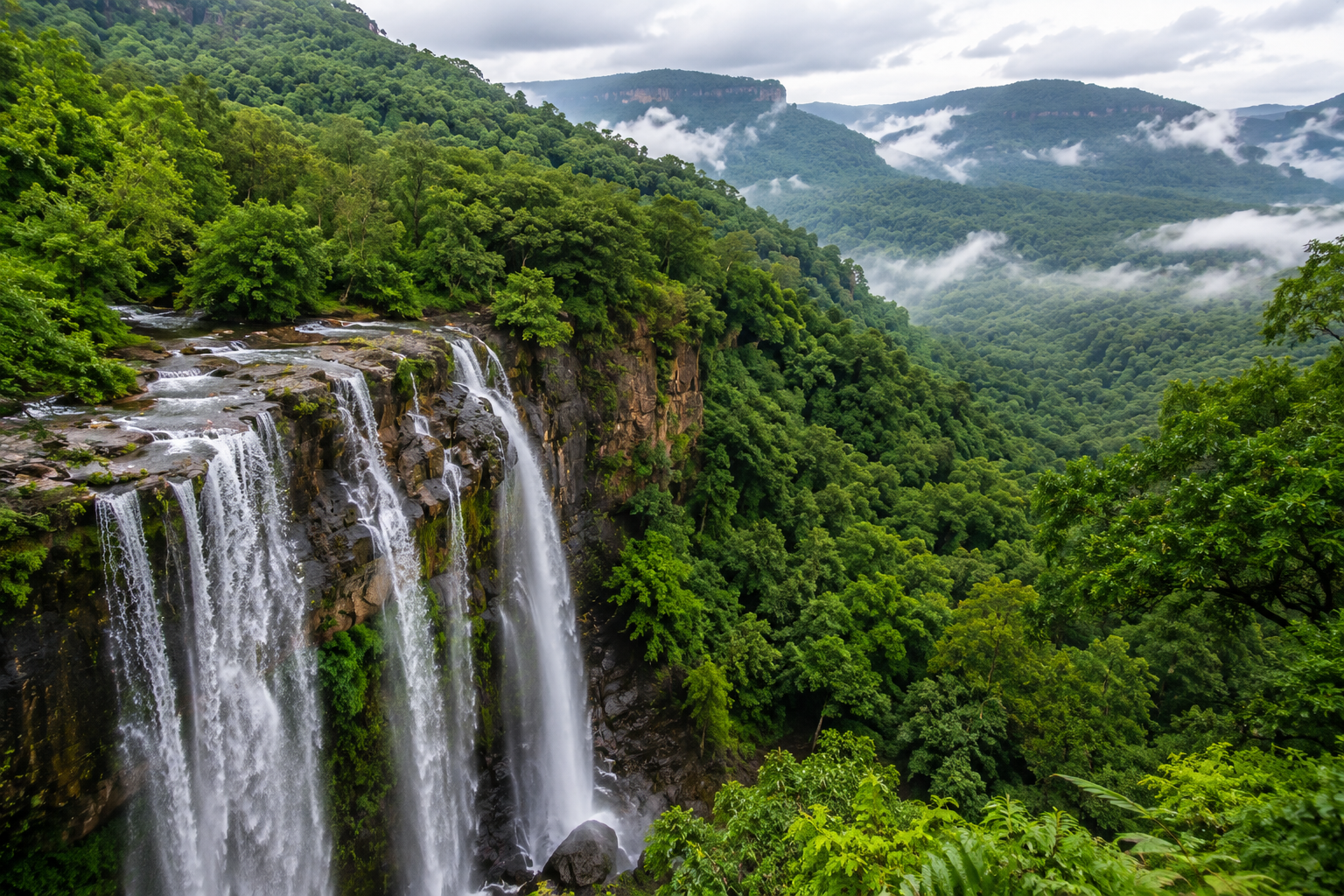
The most famous waterfall in Pachmarhi, with a steep stepped path of about 300 steps down to a clear pool at the bottom. In monsoon and immediately after, the volume is enormous; by April it dwindles to a trickle. The climb back up is the workout of the trip. Carry water and walking shoes — the sandstone steps are slippery when wet.
Pandav Caves
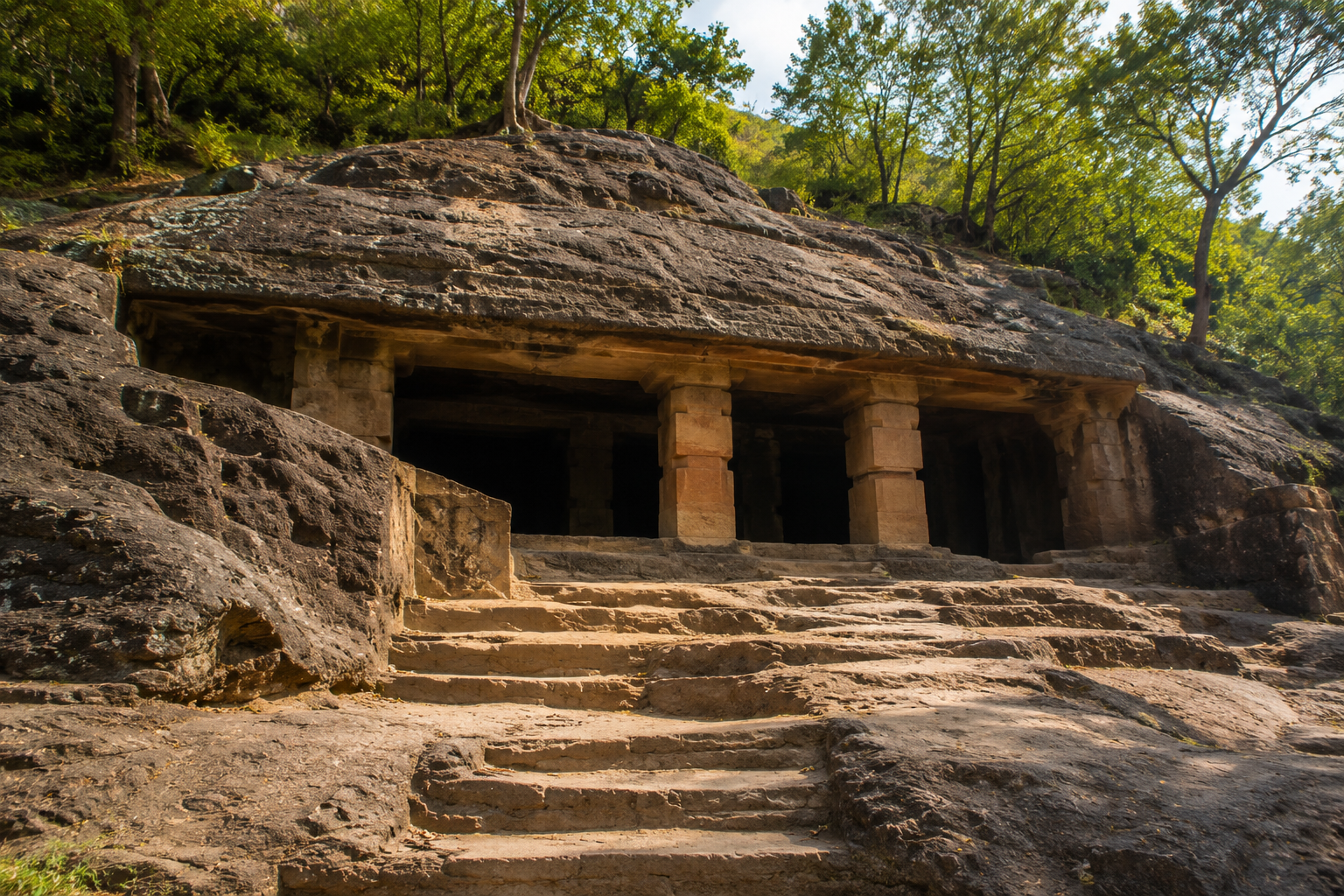
Five sandstone caves cut into a low hill at the edge of town. Local legend ties them to the Pandavas of the Mahabharata; archaeologists date the work to early Buddhist monks who used the caves as monastic cells, probably between the 1st and 5th centuries CE. The caves themselves are simple — what makes the spot interesting is the setting: open lawn, old trees, and a quiet that the rest of Pachmarhi rarely manages.
Jata Shankar Caves
A natural cavern formation hidden in a narrow ravine, with a small Shiva shrine inside and a stream that emerges from the rock. The walk in is the point: down a stepped path between high cliffs draped in vines, with light filtering in from above. It can feel theatrical on a quiet weekday morning. Avoid major festival days when the queues get long.
Christ Church and the cantonment walks
The 1875 stone church at the top of Pachmarhi is small, well-kept, and worth a quiet visit for the Belgian stained glass and the cool, unexpected hush. From the church, you can do a slow walk through the old British cantonment area — tin-roofed bungalows, parade grounds, and stone milestones — that still functions, in part, as an army station. Quiet, atmospheric, and unlike anywhere else in central India.
Apsara Vihar & Rajat Prapat
A short walk from the Pandav Caves leads to Apsara Vihar — a small natural pool fed by a gentle waterfall, shallow enough to wade in. Carry on for ten more minutes and the path opens onto Rajat Prapat, the “silver fall”, dropping over a high cliff into the gorge below. Best in monsoon and the weeks immediately after. The walk itself, through low forest, is half the pleasure.
Pachmarhi is the rare hill station that does not pretend to be anywhere else. There are no Tibetan-themed cafes, no fake Swiss chalets, no rooftops with views of nothing. It is, simply, a small town inside a very large forest.
— Travel India
The Satpura Tiger Reserve question
One of the first things people ask about Pachmarhi is whether you can do a tiger safari from there. The answer is: yes, but with caveats.
Pachmarhi sits inside the Pachmarhi Wildlife Sanctuary, which forms one of the buffer areas of the larger Satpura Tiger Reserve. The reserve itself is enormous — over 2,200 square kilometres including the core Satpura National Park, the Bori Wildlife Sanctuary, and Pachmarhi’s own sanctuary. There are five tourist gates spread around it. The gate nearest Pachmarhi is the Panaarpani Gate, about 18 km outside town, which leads into a newer safari zone.
From Panaarpani, only seven jeeps are allowed in for the morning round and seven for the evening round, with safaris closed on Wednesday afternoons. This is one of India’s lower-traffic tiger reserves and the wildlife sightings reflect that — less guaranteed than Bandhavgarh or Kanha, but the experience itself is far quieter. Most visitors who specifically want tigers stay on the western side of the reserve, near the Madhai Gate, where the famous Denwa river backwater resorts cluster. Madhai is reachable from Pachmarhi but is a long day’s drive — better stayed at as a separate stop.
Satpura Tiger Reserve core zones close annually from 1 July to 30 September for monsoon, then again briefly through wildlife management cycles. Buffer zones stay open through the year. Always check the current MP Forest Department status before booking safari dates.
Where to stay
Pachmarhi’s hotel scene is small, slightly dated, and concentrated near the town centre. There is no real luxury market — the closest thing to high-end stays are MPT’s heritage cottages and a handful of private resorts on the Denwa periphery 60–90 minutes away. For a first visit, three broad options:
MPT cottages & lodges
Madhya Pradesh Tourism runs several properties in town — Champak Bungalow, Rock End Manor, and the Hotel Glen View. Government-run, character-heavy, often the best location. Book ahead in peak season.
Private mid-range hotels
Several family-run hotels around the main market — clean, basic, no surprises. Best for shorter stays or off-season trips when prices halve. ₹2,000 to ₹5,000 a night typically.
Forest rest houses
Three forest rest houses inside the Satpura Tiger Reserve at Pachmarhi, two at Churna, one at Madhai. Basic, atmospheric, bookable through the Satpura Tiger Reserve office. Closest you can get to sleeping in the forest itself.
A solid 3-day itinerary
Two and a half to three days is the right length for a first visit. Anything longer starts to feel slow unless you are doing serious wildlife work; anything shorter and you will spend half your time on the roads up and down. Here is a route that works for most travellers.
Arrive, settle, and walk the town
Drive in from Bhopal, Nagpur, or Pipariya. Most travellers arrive by mid-afternoon. Settle in, then walk the town centre — Christ Church, the old cantonment, the small market — before light drops. Pandav Caves works as a soft introduction in the late afternoon. Dinner at the hotel, early night; the plateau air encourages it.
Waterfalls, caves, and Dhupgarh sunset
Hire a gypsy for the day. Morning: Jata Shankar, then Bee Falls (allow two hours for the steps). Lunch back in town. Afternoon: Apsara Vihar and Rajat Prapat — the gentler of the day’s walks. Late afternoon, head out to Dhupgarh for sunset. Leave at least 90 minutes before sunset; the climb is slow and the parking fills up. Dinner late, slowly.
Safari morning, slow drive out
Pre-dawn departure for a Panaarpani Gate safari (or, if you are a serious wildlife traveller, an overnight at Madhai the previous evening). Back to town by mid-morning for a late breakfast. Pack up, drive down through the forest to the plains. If you are heading to Bhopal, the Narmada crossing at Hoshangabad is worth a small detour for lunch by the river.
Practical tips that actually help
- Carry cash. ATMs in Pachmarhi exist but are unreliable. Many gypsy operators, smaller shops, and forest gate fees still want cash. Bring at least ₹5,000 in small denominations.
- Mobile signal is patchy. Jio and Airtel work in the town and at most major sights, but go dead inside the forest. Download offline maps before you arrive.
- Don’t self-drive to Dhupgarh. The last 4 km is restricted to Forest Department gypsies. Park at the gate, take the official 4×4.
- Layer up in winter. December and January mornings can hit 4–5°C. Most hotels do not have heating. A warm jacket, hat, and one thin thermal layer is enough.
- Slippers won’t cut it. Most of the waterfalls and caves involve stepped descents, wet rocks, or muddy paths. Closed walking shoes with grip make every day better.
- Plan around Wednesdays. Some safari gates and a few sights are closed on Wednesday afternoons. Check ahead if your dates are tight.
Pachmarhi FAQs
How many days do I need in Pachmarhi?
Two and a half to three days is right for a first visit. That covers the main sights, one sunset at Dhupgarh, and one safari morning if you choose to do it. Stretching to four days only really makes sense if you are combining with a serious Satpura Tiger Reserve stay at Madhai.
Is Pachmarhi safe for solo travellers, including women?
Yes, broadly. Pachmarhi is a small army cantonment town with very low crime and a quiet, slightly conservative pace. Solo women travellers report it as one of the more comfortable destinations in central India. Standard common sense applies — arrange transport in advance for early-morning safaris and late-evening Dhupgarh runs.
Can I do a tiger safari from Pachmarhi?
Yes, from the Panaarpani Gate (about 18 km from town), which enters the newest zone of the Satpura Tiger Reserve. Only seven jeeps per safari round, closed Wednesday afternoons, and core zones closed July through mid-October. For higher sighting rates, the Madhai Gate on the reserve’s western edge is more famous but is a separate trip from Pachmarhi.
Is Pachmarhi worth visiting in monsoon?
Yes, with caveats. Monsoon is when Pachmarhi is at its most beautiful — waterfalls at full volume, the plateau a deep green, far fewer tourists. The trade-offs: core safari zones are closed, some trails are slippery, and a few roads can be cut off briefly after heavy rain. If you are flexible and don’t mind getting wet, late August and September are arguably the best time of year.
How does Pachmarhi compare to other Indian hill stations?
It is quieter, smaller, and far less developed than the Himalayan hill stations (Manali, Shimla, Mussoorie) or the southern ones (Munnar, Ooty). There is no nightlife, no major mall culture, and the focus is squarely on the natural setting rather than the town itself. If you want a slow, mostly outdoor trip with very few crowds, Pachmarhi delivers. If you want cafe culture and a long main-street walk, it is not the right pick.
Can I combine Pachmarhi with a wider Madhya Pradesh trip?
Yes — it pairs well with Bhopal (the lakes and Sanchi stupa) on one side, and with Kanha or Pench tiger reserves on the other. A common longer loop is Bhopal — Sanchi — Pachmarhi — Pench (or Kanha) — out from Nagpur or Jabalpur. Allow 8 to 10 days for a comfortable version.
Planning a Madhya Pradesh trip?
I help travellers plan slow, well-paced India trips that get the seasons, distances, and logistics right — including offbeat picks like Pachmarhi. Free 48-hour reply.
Plan my India trip →
Ashvinee Nagle
I’m a travel writer based in Nagpur. Through Travel India, I share honest, on-the-ground guides shaped by years of travelling across India.
Written by Ashvinee Nagle
I travel India slowly and write it down honestly - practical guides and real itineraries from someone who lives here.
About Ashvinee →Plan your India trip with us
Get one short, honest India travel guide a week — plus a free 7-day Rajasthan itinerary to start.
Free. Unsubscribe any time.