
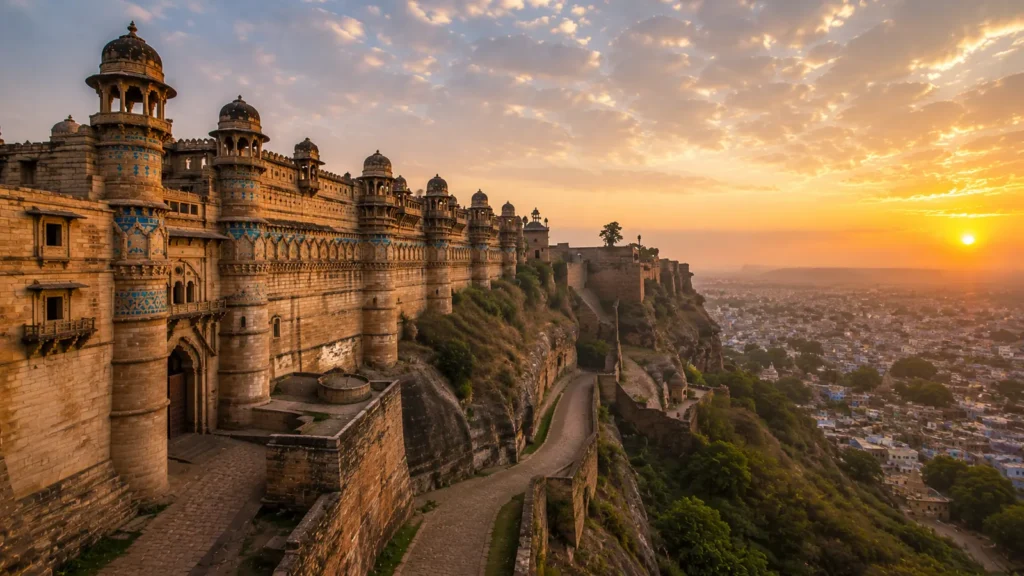
Travel to Gwalior: A First-Timer’s Guide to a Great Hill Fort City
A practical, no-fluff guide to Gwalior for first-time visitors — the mighty hilltop fort, the palaces and rock-cut temples, the opulent Jai Vilas, where music history lives, when to go, and an easy 2-day plan.
Gwalior wears its history on a hill. Rising sheer above the city on a long sandstone plateau, its great fort has been called the pearl among Indian fortresses — and everything below it, from the flamboyant Jai Vilas Palace to the tomb where the legendary musician Tansen is remembered, tells the story of the Scindias, the Tomars and centuries of North Indian power. It is a rewarding, underrated first stop on a Madhya Pradesh trip, and an easy add-on from Agra.
Gwalior is a historic city in northern Madhya Pradesh crowned by one of India’s most spectacular hill forts. The must-sees are the Gwalior Fort with the Man Singh Palace, the Sas-Bahu and Teli ka Mandir temples, the opulent Jai Vilas Palace and Scindia Museum, and the tombs of Tansen and Mohammad Ghaus. One busy day covers the highlights; a second adds the museums and the fort’s evening light show. Go October to March, and pair it with Orchha and Khajuraho on the same Madhya Pradesh trip.
Why visit Gwalior
Three reasons this fort city deserves more than the quick stop most people give it.
One of India’s great forts
Gwalior Fort sprawls across a huge sandstone hill, its walls, palaces and rock-cut sculptures visible for miles. Few forts match it for drama, and fewer still see so few foreign visitors.
Royal opulence
The Scindia family’s Jai Vilas Palace is jaw-dropping — giant chandeliers, a durbar hall dripping in gold, and a solid-silver toy train that once served after-dinner drinks around the table.
The home of a musical legend
Gwalior is bound up with Indian classical music — the tomb of Tansen, the great court musician, still draws pilgrims and hosts a famous annual music festival in his honour.
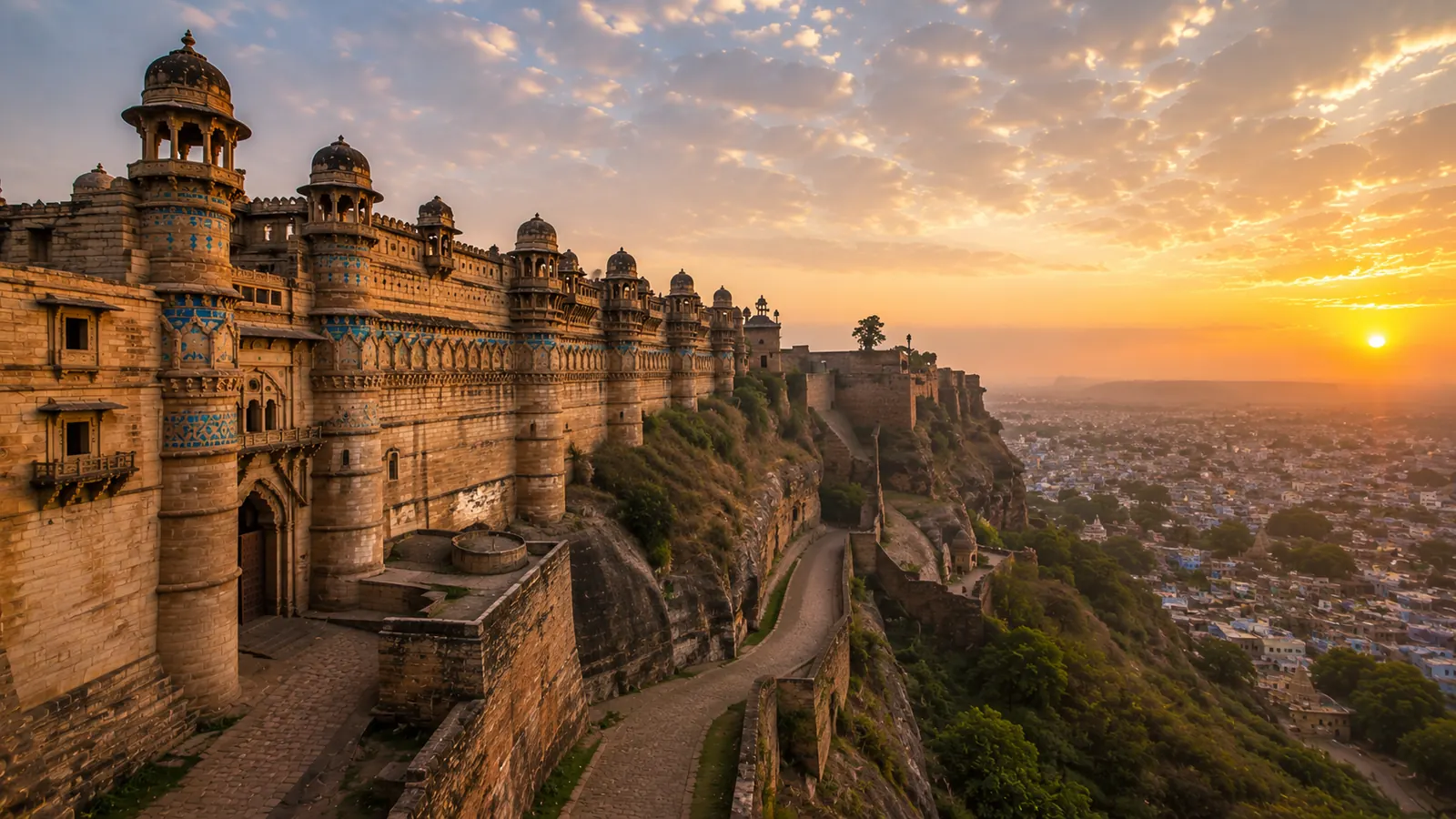
Gwalior Fort on its sandstone plateau — the ‘pearl among fortresses’ and the city’s crown.
When to go
October to March (the sweet spot): cool, clear days ideal for climbing the fort and exploring the palaces. This is comfortably the best time to visit, and the season of the Tansen music festival.
December (the Tansen Samaroh): the celebrated classical music festival fills the city each winter — magical if you love Indian music, though rooms book up, so plan ahead.
April to June (hot): northern Madhya Pradesh gets very hot, and the exposed fort is punishing at midday — go early and rest in the afternoon if you must visit then.
July to September (monsoon): cooler and greener, with occasional heavy rain. The fort and views can be lovely between showers, with far fewer crowds.
The fort is large and much of it is open and unshaded, with a stiff climb or drive to the top. Wear good shoes, carry water, and start early in the day — and save the palace interiors for the hotter hours.
Top things to do in Gwalior
From the great fort to a silver train, here is what fills a day or two in Gwalior.
Gwalior Fort & Man Singh Palace
The centerpiece of any visit — a vast hilltop fort whose star is the Man Singh Palace (Man Mandir), famous for its turquoise-tiled facade and atmospheric underground chambers. Give it a good half-day.
Sas-Bahu & Teli ka Mandir
Within the fort, the intricately carved Sas-Bahu temples and the towering Teli ka Mandir are masterpieces of early temple architecture — and superb spots for views over the city below.
Jai Vilas Palace & Scindia Museum
The still-royal Scindia residence, part museum, dazzles with its European-style durbar hall, colossal chandeliers and the famous solid-silver miniature train. Unmissable and unlike anything else in town.
Tomb of Tansen & Mohammad Ghaus
A serene Mughal-style garden holds the tombs of the musician Tansen and the saint Mohammad Ghaus, with beautiful stone latticework. The heart of Gwalior’s deep musical heritage.
The Gopachal Jain sculptures
Carved into the fort’s rock face are dozens of monumental Jain figures, some enormous, cut straight from the cliff — a striking, often-missed sight on the way up or down the hill.
The fort sound-and-light show
In the evening, a narrated light show brings the fort’s long history to life against the floodlit walls — an atmospheric way to end a day of sightseeing.
What to eat in Gwalior
Gwalior is a proper North Indian city, so the food is rich and varied — hearty local sweets, street chaat, old-city kebabs and comfortable modern restaurants.
Bahi (morena gajak)
The Gwalior-Morena belt is famous for gajak — crisp sesame-and-jaggery brittle, best in winter. Pick some up from an old sweet shop to snack on and take home.
Chaat & kachori
The old-city lanes do brisk North Indian street food — poha-jalebi for breakfast, and evening chaat, kachori and samosas. Cheap, tasty and very local.
North Indian thalis & curries
Sit-down restaurants across the city serve generous vegetarian thalis and rich Mughlai-style curries — the reliable choice for a proper meal after a day at the fort.
Modern cafes & bakeries
For a change of pace, Gwalior’s newer cafes and bakeries do coffee, snacks and Continental bites — handy if you want something lighter or familiar.
Winter is gajak season — the local sesame brittle is at its freshest and best from around November to February, and makes an easy, tasty souvenir to carry onward.
Where to stay
Gwalior is a spread-out city, so it’s worth choosing where you stay around what you want to see and how you’re travelling.
Heritage & upscale hotels
Gwalior has some characterful heritage and upscale hotels, a few in grand old properties, offering the most comfortable and atmospheric base for exploring.
Mid-range city hotels
Plenty of solid mid-range hotels sit close to the fort and main sights, with easy access to restaurants and transport — the practical all-rounder.
Near the station
Budget hotels cluster near the railway station — handy for arrivals and departures and for keeping costs down, if a little less scenic.
How to get to Gwalior & around
Gwalior is one of the easiest cities to reach in the region, sitting right on the main Delhi–Agra–central India rail and road corridor.
Gwalior opens the classic Gwalior–Orchha–Khajuraho heritage circuit and pairs neatly with Agra just to the north. Arriving by train from Delhi or Agra is quick, comfortable and the way most people come.
A simple 2-day plan
One day for the fort and the palace, a second for temples, tombs and the light show.
The fort & the palace
Spend the morning at Gwalior Fort and the Man Singh Palace, with the Sas-Bahu and Teli ka Mandir temples. In the afternoon, tour the dazzling Jai Vilas Palace and Scindia Museum.
Practical tips that actually help
Start early at the fort
Beat the heat and the crowds — the fort is big and largely unshaded, so mornings are far more pleasant.
Don’t skip Jai Vilas
The palace and its silver train are a Gwalior highlight — leave enough time for the museum, it’s bigger than it looks.
Wear proper shoes
There’s a fair bit of climbing and uneven stone at the fort — comfortable shoes make all the difference.
Hire a car for the day
The sights are spread across the city; a car or a full-day auto saves time and hassle between them.
Time the light show
Check the evening schedule and language in advance, and arrive a little early for a good seat.
Carry water
The open fort gets hot and dusty — bring water and sun cover, especially in the warmer months.
Mistakes first-time visitors make
- Treating Gwalior as a quick stop. The fort alone deserves half a day — give the city a full day or two.
- Skipping Jai Vilas Palace. It’s one of the most memorable sights in town; don’t rush past it.
- Climbing the fort at midday. The exposed hill is brutal in the heat — go early or late.
- Missing the rock-cut sculptures. The Gopachal Jain figures on the fort slopes are easy to overlook but remarkable.
Planning Madhya Pradesh beyond Gwalior?
Gwalior is the gateway to the heritage heart of Madhya Pradesh — Orchha’s riverside forts, the temples of Khajuraho, and the tigers further south. Tell me your dates and pace, and I’ll map a route that ties it all together.
Plan my Madhya Pradesh trip →Gwalior FAQs
How many days do you need in Gwalior?
One full day covers the fort, the Man Singh Palace and the Jai Vilas Palace. A second day lets you add the temples, the Tomb of Tansen, the rock-cut Jain sculptures and the evening light show without rushing.
What is the best time to visit Gwalior?
October to March, when the weather is cool and clear and ideal for the exposed fort. December brings the famous Tansen music festival. April to June is very hot, and the monsoon is greener but can be rainy.
What is Gwalior famous for?
Gwalior is famous for its magnificent hilltop fort and Man Singh Palace, the opulent Jai Vilas Palace of the Scindia family, and its deep connection to Indian classical music through the musician Tansen.
How do you reach Gwalior?
Gwalior Junction is a major railway stop on the Delhi–Agra–Bhopal line, making the train the easiest option. The city also has a small airport, and it’s an easy road trip from Agra or Orchha, each about 120 km away.
Is Gwalior worth visiting?
Yes. Its fort is one of the finest in India, the Jai Vilas Palace is unforgettable, and it sees far fewer foreign visitors than comparable sites — a rewarding and easy stop between Agra and the rest of Madhya Pradesh.
Related guides
Keep planning your Madhya Pradesh trip with these:
Madhya Pradesh Travel Guide
Tigers, temples, forts and marble gorges — how to string a Madhya Pradesh trip together.
Travel to Orchha
Riverside Bundela palaces and temples — the natural next stop south of Gwalior.

Ashvinee Nagle
I’m Ashvinee — I help first-time travellers plan India trips that actually work. I’ve spent years exploring the country’s regions, from Rajasthan’s forts to Kerala’s backwaters, and I write the guides I wish I’d had on my own first trips.

Written by Ashvinee Nagle
I travel India slowly and write it down honestly - practical guides and real itineraries from someone who lives here.
About Ashvinee →Plan your India trip with us
Get one short, honest India travel guide a week — plus a free 7-day Rajasthan itinerary to start.
Free. Unsubscribe any time.