
Travel to Orchha: A First-Timer’s Guide to the Bundela City on the Betwa
An honest, no-fluff guide to Orchha for first-time visitors — the fort palaces of Jehangir Mahal and Raja Mahal, the Ram Raja Temple where Rama is worshipped as a living king, sunset at the riverside chhatris, when to go, how it slots onto the Jhansi–Khajuraho circuit, and a relaxed 2-day plan.
Some towns announce themselves; Orchha just waits for you to notice. Barely 16 km from the railway junction at Jhansi — and, oddly, a whole state away, since Jhansi sits in Uttar Pradesh and Orchha in Madhya Pradesh — this small town on the Betwa river was once the capital of the Bundela kings. Its name means “hidden,” and in a way it has stayed that way: a cluster of soaring palaces, a living temple where Rama is worshipped as a reigning king, and a row of golden cenotaphs along the water that frame one of central India’s most quietly perfect sunsets. Most people pass through on the way to Khajuraho. The ones who stay a night always wish they’d given it two.
Orchha is a small, walkable heritage town on the Betwa in northern Madhya Pradesh, about 16 km from Jhansi. The Orchha Fort complex — Jehangir Mahal and the mural-filled Raja Mahal — is the headline, but the town’s soul is the Ram Raja Temple, the only place in India where Rama is worshipped as a reigning king. Add the rooftop views from Chaturbhuj Temple, the frescoes of Laxminarayan Temple, and sunset at the riverside chhatris, and one full day covers it comfortably — two lets you slow right down. Come October to March, and pair it with Khajuraho and the rest of Madhya Pradesh.
Why visit Orchha
Three reasons Orchha earns a night on a Madhya Pradesh trip — and wins over almost everyone who lingers.
Palaces frozen in time
The Orchha Fort complex packs Jehangir Mahal’s Mughal domes and lattice-work and the Raja Mahal’s painted halls onto one river island — grand medieval architecture with a fraction of the crowds of India’s bigger forts.
A temple like nowhere else
At the Ram Raja Temple, Rama is worshipped not in the abstract but as the ruling king of Orchha — complete with an armed guard and royal ritual. It began life as a palace, and there is nothing quite like it anywhere in India.
Riverside calm
After the intensity of most Indian sights, Orchha is a long exhale — a town you can walk end to end, ending each day with the Betwa turning gold behind the cenotaphs.
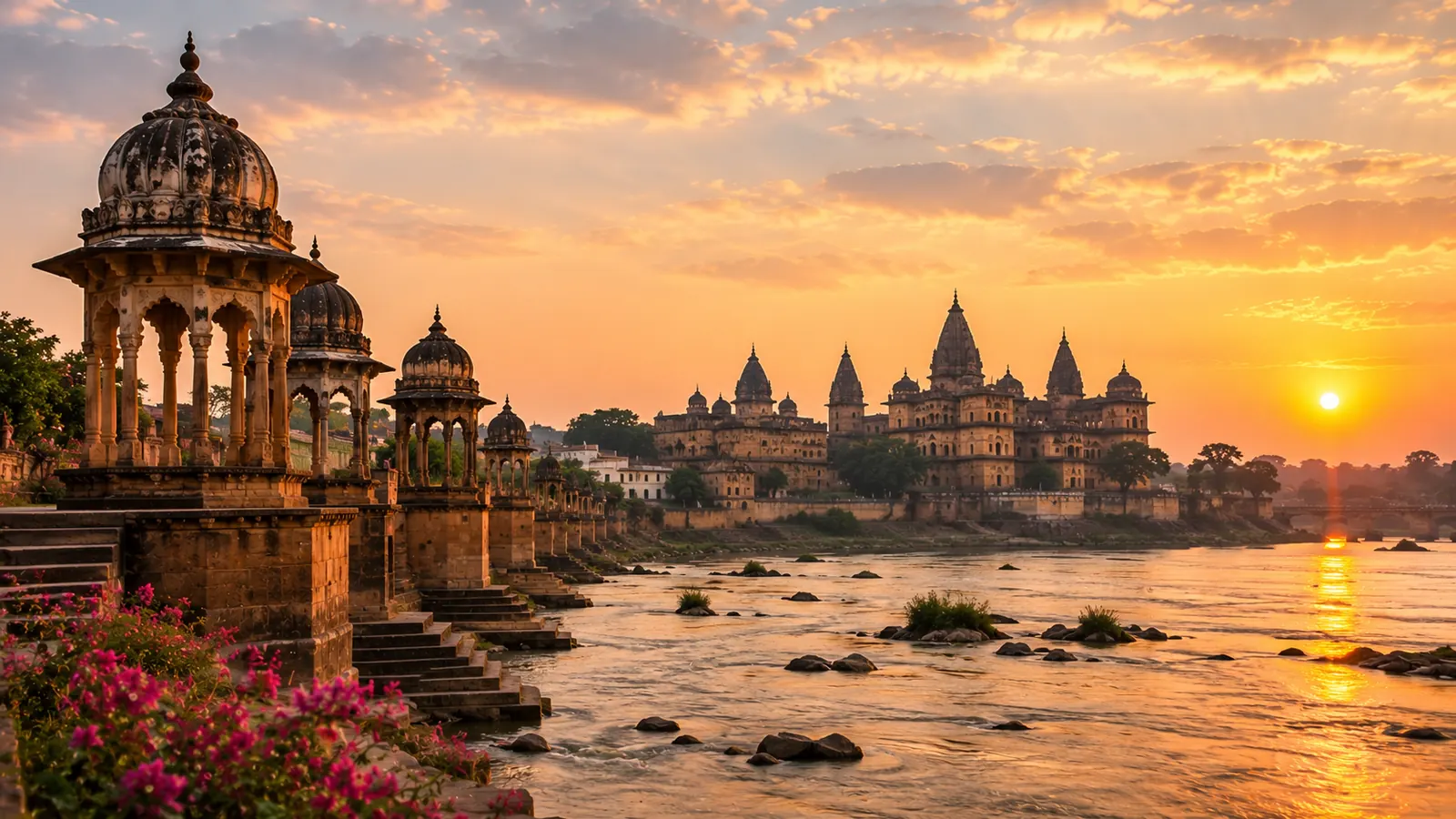
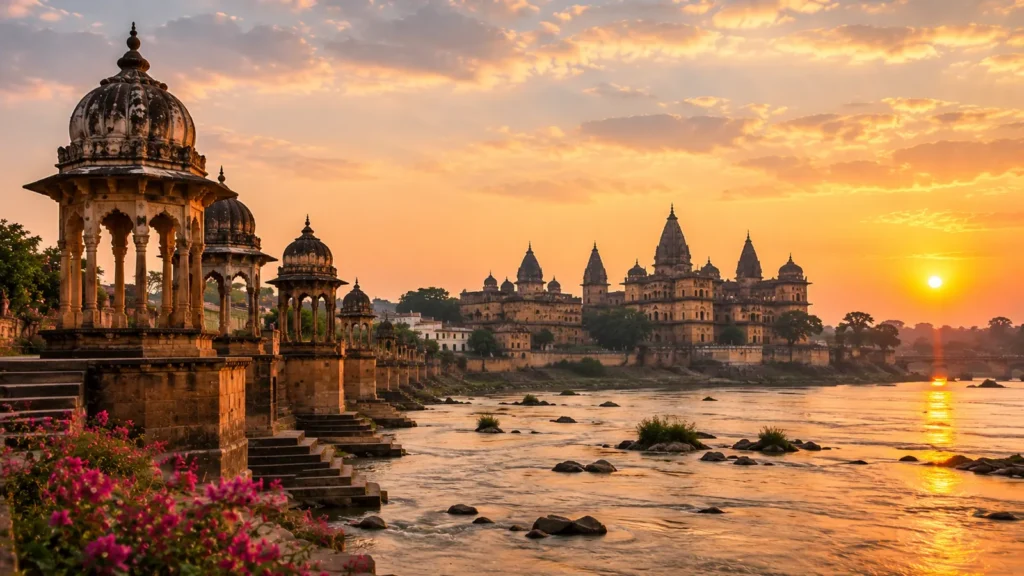
The Bundela chhatris on the Betwa at sunset — Orchha’s signature view, and the reason to stay the night.
When to go
October to March (the sweet spot): cool, clear days made for wandering the fort and long, soft evenings at the chhatris. This is peak season for good reason — and the most comfortable time by far.
Winter festivals: the Ram Raja Temple is a working shrine, and festivals such as Ram Navami and Vivah Panchami fill the town square with joyful crowds. Wonderful atmosphere, but book beds ahead.
April to June (hot): central India bakes, and midday at the exposed fort and riverbank is punishing. If you must come, do the sights at dawn and hide from the afternoon.
July to September (monsoon): fewer visitors and a lush green setting, with the Betwa running full behind the cenotaphs. Expect humidity and the odd downpour.
Orchha is all about the light. The fort, the temples and especially the chhatris come alive at sunrise and sunset, when low sun turns the sandstone gold and the river mirrors the spires. A flat midday visit shows you the same monuments at a fraction of their beauty.
Top things to do in Orchha
From palace courtyards to a boat on the Betwa, here is what fills a day or two.
The Orchha Fort complex
Built from the 16th century by the Bundela kings, the fort island holds Jehangir Mahal — domes, arches and trellised balconies — and the Raja Mahal, whose plain outside gives way to walls covered in bold religious murals. Give it a couple of unhurried hours.
Ram Raja Temple
The only temple in India where Rama is worshipped as a reigning king — a former palace where the deity, by legend, refused to be moved. Priests keep royal ritual and an armed guard stands watch. The square outside is the buzzing centre of town life.
Chaturbhuj Temple rooftop
Rising on a tall stone platform beside Ram Raja, Chaturbhuj was built to house the Rama idol that ended up staying in the palace instead. Climb its steep steps for the finest rooftop panorama in town — fort, temples and river in one frame.
The chhatris on the Betwa
A line of tall royal cenotaphs to the Bundela rulers stands along the Kanchan Ghat at the south of town. At sunset they glow and reflect in the river — the picture everyone takes home. Walk down early and simply sit for a while.
Laxminarayan Temple frescoes
A short ride west, this temple-fort hybrid on a low hill hides some of Bundelkhand’s finest wall paintings — battles, myths and royal processions in vivid colour. Far quieter than the town-centre sights, and worth the detour.
A Betwa boat ride
MP Tourism runs gentle boat rides and river safaris from the Kanchan Ghat, with the chhatris rising behind you and the small Orchha wildlife sanctuary along the far bank. A calm, different angle on the town — best in the soft light of morning.
What to eat in Orchha
This is a small town, so the food is simple — rooftop cafes near the temples, a few honest local kitchens, and the snack stalls around the Ram Raja square. Come for the monuments, but a few things are worth seeking out.
Bundelkhandi thali
Ask for a regional Bundelkhandi thali — wheat rotis, local dals and seasonal vegetables — for an earthy, home-style meal that beats the tourist menus.
Rooftop cafes
A cluster of rooftop cafes look out at the palaces and temple spires — the spot for a slow breakfast or a cold drink after the morning walk, with a mix of Indian and traveller-friendly dishes.
Poha, jalebi & kachori
Do as central India does and graze the stalls around the temple — poha and jalebi at dawn, kachori and hot chai through the day. Cheap, quick and full of local colour.
Local mithai
Pick up regional sweets from the market shops near the temple — an easy, tasty souvenir of a Bundelkhand stop and a good pick-me-up between sights.
Orchha is small and winds down early — most people eat near the Ram Raja square and turn in for an early start. Don’t expect nightlife beyond the evening light-and-sound show at the fort; expect quiet.
Where to stay
Everything clusters within a short walk or ride of the fort and the Ram Raja square, so wherever you stay you’re close to the sights. It’s really a choice of budget and whether you want a river view.
Palace-style stays
MP Tourism’s Sheesh Mahal, set inside the fort itself, and a handful of heritage hotels put you right in the middle of the history, with courtyards and monument views.
Betwa resorts & lodges
Resorts and eco-lodges by the Betwa offer rooms and tented stays a short walk or ride from the chhatris — the calm, green option, lovely at sunrise.
Town guesthouses
Simple, friendly guesthouses in the lanes around the temple give you clean rooms and local know-how at a fraction of the price, walkable to everything.
How to get to Orchha & around
Orchha is easy to reach thanks to Jhansi, one of central India’s big rail junctions, just up the road — and it’s small enough to explore on foot once you arrive.
Orchha sits right on the Jhansi–Orchha–Khajuraho heritage circuit — take a fast train to Jhansi, base in Orchha for a night or two, then drive on to Khajuraho. It’s one of the easiest and most rewarding stretches in central India.
A simple 2-day plan
One day for the headline sights done well, a second to slow down by the river.
Fort, temples & the golden chhatris
Start at the Orchha Fort (Jehangir Mahal and Raja Mahal) before it heats up, then cross to the Ram Raja Temple and climb the Chaturbhuj rooftop. Rest through the midday heat, then walk down to the chhatris on the Betwa for sunset.
Frescoes, river & onward
Cycle out to the Laxminarayan Temple for the murals, then take a gentle boat ride on the Betwa. In the afternoon, linger over the town or drive on to Khajuraho and the rest of Madhya Pradesh.
Practical tips that actually help
Chase the light
See the fort and chhatris at sunrise or late afternoon — low sun turns the stone gold; midday flattens everything.
One ticket, many sites
A single fort-complex ticket usually covers the main palaces — buy it at the fort first before exploring.
Rent a cycle
The town is flat and tiny — a bicycle is the perfect way to reach Laxminarayan Temple and the chhatris at your own pace.
Give it a night
Day-trippers from Jhansi miss the best hour — stay over for the sunset at the chhatris and the evening light show.
Dress for the temple
Ram Raja is a busy working shrine — modest clothing and shoes you can slip off easily make the visit smoother.
Carry small cash
Handy for tickets, cycle and boat hire, temple-square snacks and small tips at the monuments.
Mistakes first-time visitors make
- Treating it as a 2-hour stop between trains. Orchha rewards a slow day and at least one sunset — ideally an overnight.
- Skipping the chhatris. The riverside cenotaphs at golden hour are the image you’ll take home; don’t leave before dusk.
- Missing Laxminarayan’s frescoes. They’re a short ride out and among the finest wall paintings in Bundelkhand.
- Coming in peak summer. April to June is brutally hot with little shade — aim for the October-to-March window.
Planning Madhya Pradesh around Orchha?
Orchha slots naturally between Jhansi’s railhead and Khajuraho’s temples, with Gwalior’s fort and Panna’s tigers within reach. Tell me your dates and pace, and I’ll map a Madhya Pradesh route that ties the palaces to the jungle.
Plan my Madhya Pradesh trip →Orchha FAQs
How many days do you need in Orchha?
One full day covers the fort, the Ram Raja and Chaturbhuj temples, and sunset at the chhatris. A second day lets you add the Laxminarayan frescoes, a Betwa boat ride and a slower pace, or combine Orchha with Khajuraho on the heritage circuit.
What is Orchha famous for?
Its Bundela-era fort palaces — Jehangir Mahal and Raja Mahal — the riverside chhatris on the Betwa, and above all the Ram Raja Temple, the only temple in India where Rama is worshipped as a reigning king.
How do you get to Orchha?
Jhansi, about 16 km away, is the nearest major railhead, roughly 30 to 40 minutes by road, and Orchha also has its own small station. The closest airports are Gwalior and Khajuraho, both with seasonal flights.
What is the best time to visit Orchha?
October to March, when days are cool and clear and the light on the monuments is at its best. Winter also brings lively temple festivals at Ram Raja. April to June is very hot, and the monsoon from July to September is green and quiet but humid.
Is Orchha worth visiting?
Yes. It packs palaces, a unique living temple and a beautiful riverside into one small, walkable town with a fraction of the crowds — and it pairs perfectly with Khajuraho, about two to three hours away on the heritage circuit.
Related guides
Keep planning your Madhya Pradesh trip with these:
Madhya Pradesh Travel Guide
Tigers, temples, forts and marble gorges — how to string a Madhya Pradesh trip together.
Travel to Khajuraho
The thousand-year-old temples and extraordinary carving of Khajuraho — the natural next stop from Orchha.
Ashvinee Nagle
I’m Ashvinee — I help first-time travellers plan India trips that actually work. I’ve spent years exploring the country’s regions, from Rajasthan’s forts to Kerala’s backwaters, and I write the guides I wish I’d had on my own first trips.
Written by Ashvinee Nagle
I travel India slowly and write it down honestly - practical guides and real itineraries from someone who lives here.
About Ashvinee →Plan your India trip with us
Get one short, honest India travel guide a week — plus a free 7-day Rajasthan itinerary to start.
Free. Unsubscribe any time.