
Travel to Jodhpur: The Ultimate First-Timer Guide to India’s Blue City
A practical, no-fluff guide to Jodhpur for first-time visitors — when to go, what to see, what to eat, where to stay, how to get around, and a 2–3 day itinerary built around the great fort and the blue old city.
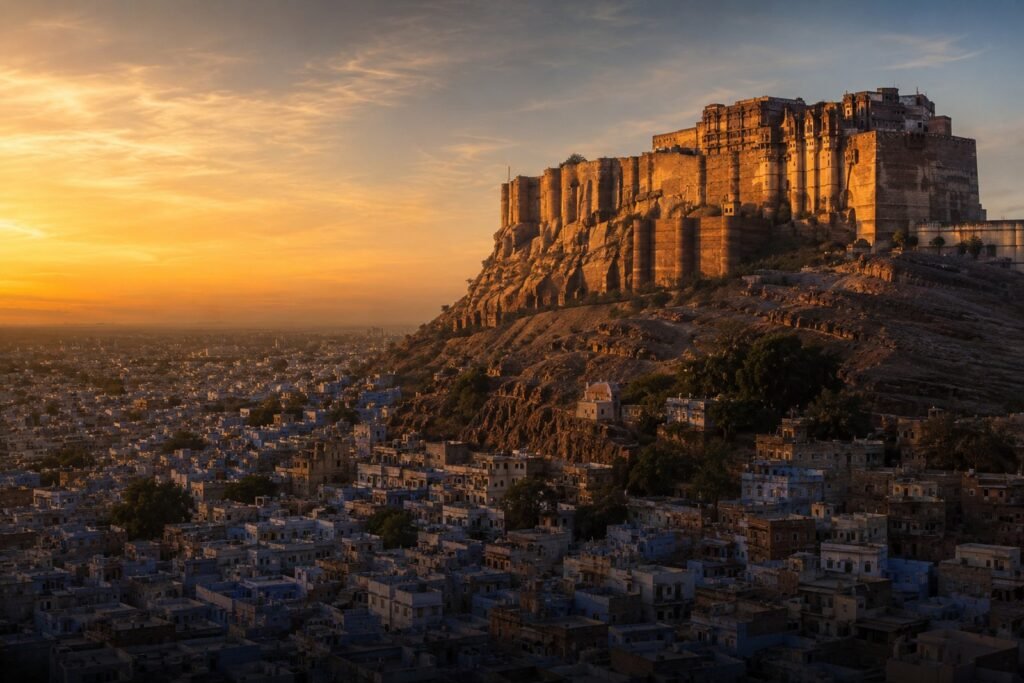
Jodhpur is Rajasthan at its most dramatic. The second-largest city in the state sits at the edge of the Thar Desert, and the entire old town huddles in the shadow of Mehrangarh — one of the largest and best-preserved forts in India, rising 120 metres of sheer rock straight out of the city. Look down from the ramparts and the reason for the nickname is obvious: a sea of indigo-washed houses spilling out below. Most first-timers pass through on the way to Jaisalmer and give it half a day. Two days is the right amount.
Two days suits a first Jodhpur trip. Mehrangarh Fort takes a full morning and is the best fort experience in Rajasthan; Jaswant Thada sits right beside it. Spend an afternoon getting lost in the blue lanes of the old city and the Toorji stepwell, and an evening at the Clock Tower and Sardar Market. Add a third day for a Bishnoi village safari or the desert temples at Osian. Stay near the Clock Tower for fort views. Best months are October to March. Budget ₹1,800–8,000 per day.
Why visit Jodhpur
Jodhpur was founded in 1459 by Rao Jodha as the capital of Marwar, the largest of Rajasthan’s princely states. The Rathore rulers built Mehrangarh on an isolated rock for defence, and the city grew up beneath it. Centuries later that relationship still defines Jodhpur — a working desert city of bazaars and Marwari traders, watched over by a fort so dominant it feels less like a monument than a permanent piece of the sky. The blue houses, the bold food, and the gateway position on the edge of the Thar give the city a character entirely its own.
The greatest fort
Mehrangarh is widely rated the finest fort in Rajasthan — intact, beautifully run, and rising in a single sheer cliff straight above the old city.
The blue city
The indigo-washed lanes of Brahmpuri and Navchokiya, tumbling down the hillside below the fort, are some of the most photogenic streets in India.
Gateway to the Thar
Jodhpur sits between Udaipur and Jaisalmer, and is the jumping-off point for Bishnoi villages, Osian’s desert temples, and the road into the dunes.
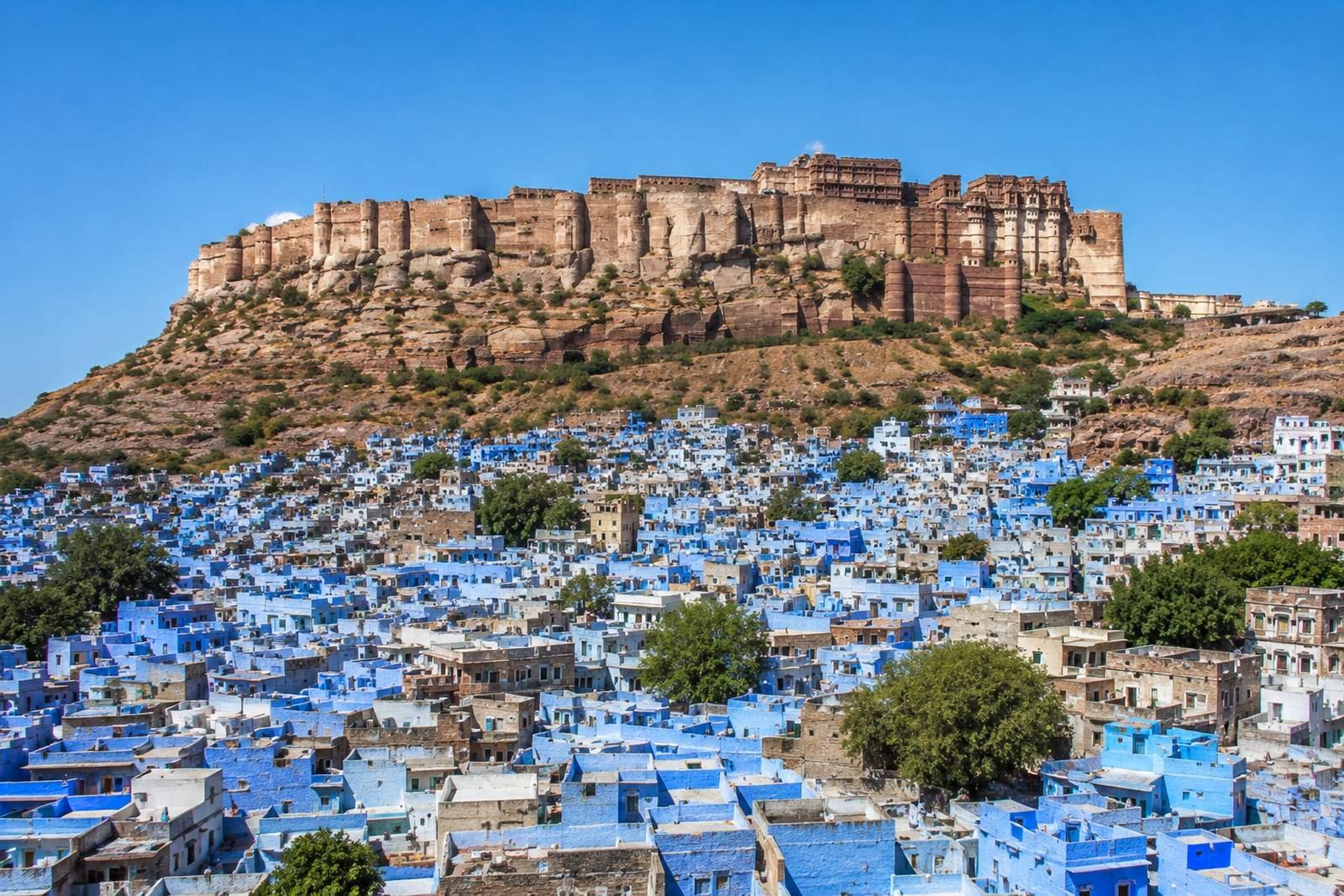
Mehrangarh rises in a single cliff straight above Jodhpur’s blue old town.
When to go
Jodhpur sits on the edge of the desert, so the season makes a bigger difference here than in the lake cities. Time it right and it is glorious; time it wrong and the heat is punishing.
October to March is the right window. Days are warm but comfortable (18–28°C), nights are cool, and the desert light makes the fort and the blue houses photograph beautifully. December and January are coolest and busiest — carry a jacket for the evenings and book hotels ahead.
April to June is harsh. Temperatures regularly cross 42–45°C and the stone of the fort radiates heat. If you must come then, start at opening, retreat indoors at midday, and book a room with a pool.
July to September brings a light monsoon. Jodhpur gets less rain than eastern Rajasthan, the heat eases, and the surrounding scrub turns briefly green. Rates drop and crowds thin, with only occasional short showers to plan around.
The famous Marwar Festival (also called the Jodhpur Festival) falls around Sharad Purnima in October, with folk music and dance performances staged against Mehrangarh and Mandore. The Rajasthan International Folk Festival (RIFF) runs at the fort around the same full moon. If folk music appeals, timing a trip around either is worth it — but book early.
Top things to do in Jodhpur
Jodhpur’s sights cluster tightly around the fort and the old city, which makes two days surprisingly full. These are the experiences to build them around.
Mehrangarh Fort
The reason to come. Allow a full morning for the palaces, the museum, the courtyards, and the ramparts with their cannon and their staggering views over the blue city. The included audio guide is one of the best in India — do not skip it. Go at opening to beat the heat and the tour groups.
Jaswant Thada
A serene white-marble cenotaph built in 1899 for Maharaja Jaswant Singh II, a five-minute drive from the fort. The translucent marble glows in the sun, and the terraced gardens give a quieter, postcard view back to Mehrangarh. Pair it with the fort in one trip up the hill.
Clock Tower & Sardar Market
The beating heart of the old city. The Ghanta Ghar (Clock Tower) is ringed by Sardar Market, a dense maze of stalls selling spices, textiles, bandhani, silver, and sweets. Come in the late afternoon and evening when it is liveliest, and climb a rooftop cafe for the fort lit up at night.
The blue lanes of Brahmpuri
The indigo houses are concentrated in the old Brahmin quarters of Brahmpuri and Navchokiya, on the slopes just below the fort. Wander slowly in the morning light, accept a chai from a doorway, and let yourself get lost — the tangle of blue alleys is the real Jodhpur experience, not a single viewpoint.
Toorji ka Jhalra
A beautifully restored 18th-century stepwell of carved sandstone, descending in sharp geometric steps near the Clock Tower. Once choked with debris, it is now the centre of a small revived quarter of cafes and boutique stays — a good spot to pause with a coffee between bazaar and fort.
Bishnoi village safari
A half-day jeep safari into the Bishnoi villages on the desert edge — a community famous for protecting wildlife and trees for five centuries. You will likely see blackbuck and chinkara, visit a potter and a weaver or dhurrie-maker, and share an opium-tea ceremony. Arrange through your hotel with a reputable operator.
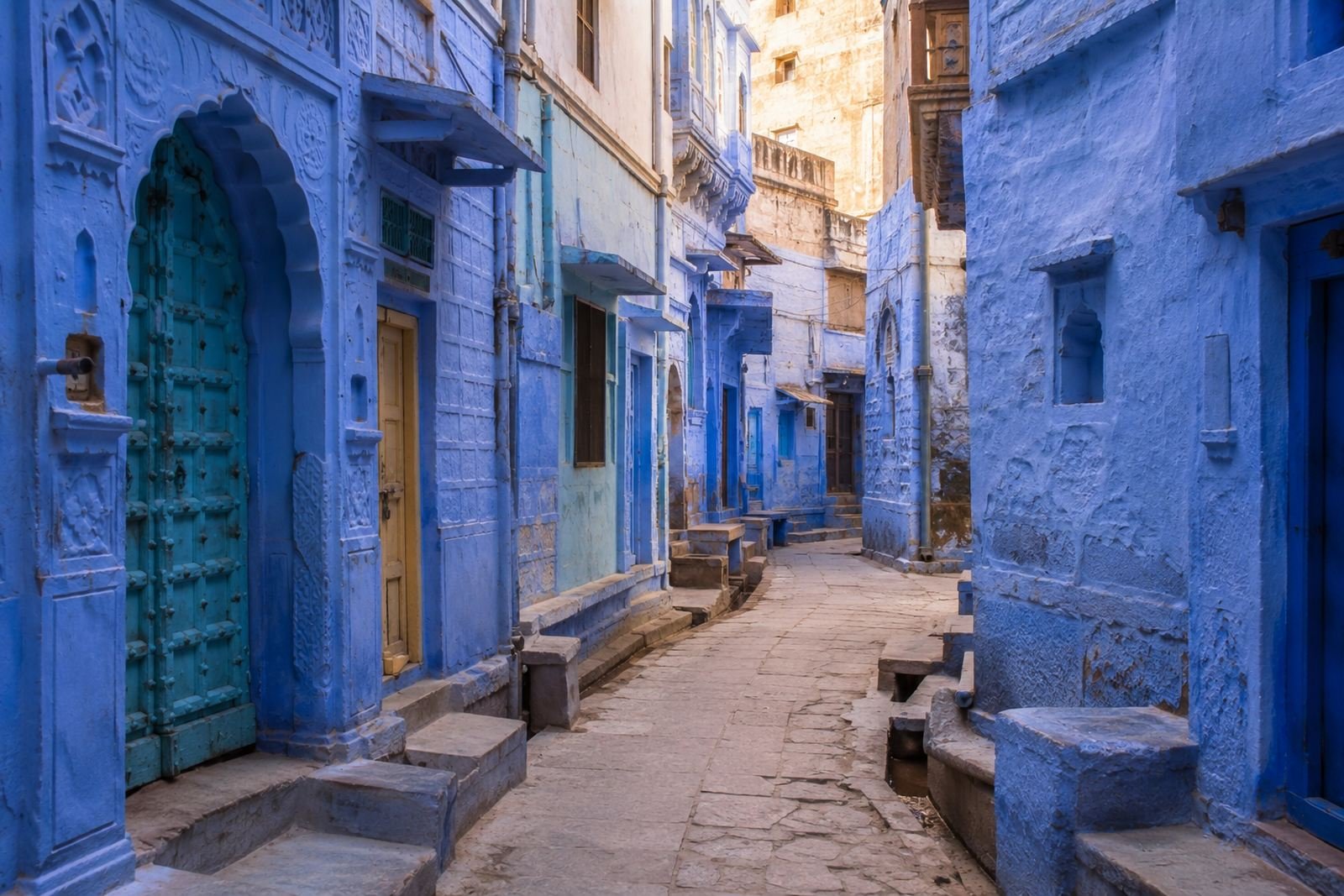
Getting lost in the blue lanes below the fort is the real Jodhpur experience.
What to eat in Jodhpur
Marwari food is bold, spicy, and unapologetically rich — desert cooking built on ghee, gram flour, and dried ingredients. Jodhpur is also the home of two legendary sweets-and-snacks institutions. These four cover the range from a ₹50 lassi to a fort-view splurge.
Shri Mishrilal Hotel
Famous across India for its makhaniya lassi — a thick, saffron-and-cardamom lassi topped with a slab of malai, almost a dessert in a glass. A Jodhpur rite of passage, served at the corner of Sardar Market since 1927. One glass is a meal.
Janta Sweet Home
The place for mawa kachori (a sweet, syrup-soaked stuffed kachori unique to Jodhpur) and the savoury pyaaz and mirchi versions. Also good for a quick Rajasthani snack-lunch. Busy, cheap, deeply local — the Jodhpur sweet shop everyone names first.
Gypsy Dining Hall
The go-to for an unlimited Rajasthani-Gujarati thali — dal baati churma, gatte, ker sangri, and a dozen refilled bowls. Spotless, family-friendly, and away from the tourist core. Come hungry and let the servers keep going until you stop them.
On the Rocks / RAAS rooftop
For a special evening, dine with the floodlit fort overhead — the garden restaurant On the Rocks (by Ajit Bhawan) for Rajasthani and tandoori, or the rooftop at RAAS for refined Marwari plates and the best fort view in the city. Book ahead in season.
Marwari food runs hot and heavy — mirchi bada and laal maas are seriously spicy, and the sweets are very rich. Pace yourself, especially on day one, and treat the makhaniya lassi as a meal rather than a drink. Lassi and chaas (buttermilk), not water, are the local antidote to the chilli.
Where to stay
Where you sleep in Jodhpur is mostly about how close to the fort and old city you want to be. Three areas cover almost everyone.
Old City / Clock Tower
Blue-house guesthouses and havelis with rooftop fort views, many for ₹1,200–5,000. Walking distance to Sardar Market, the stepwell, and the blue lanes. Atmospheric and central — the right base for a first visit, if a little noisy.
Toorji / stepwell quarter
The streets around Toorji ka Jhalra have become Jodhpur’s boutique pocket — design-led small hotels and cafes, still walkable to the fort but calmer than the market core. From ₹4,000–8,000. Good for comfort with character.
Heritage palaces
RAAS Jodhpur (fort views, in the old city), Ajit Bhawan (the original heritage hotel), and the grand Umaid Bhawan Palace — still partly the royal residence and one of the world’s great hotels. From ₹10,000 to the stratosphere.
How to get around
Jodhpur’s old city is compact and walkable, but the lanes are tight and steep, and the fort sits on a hill above it. You will mix walking with autos and the odd cab.
If you have a third day, a Bishnoi village safari in the morning pairs well with the temples and dunes around Osian (about 1.5 hours north) in the afternoon. Hire a car with driver for the full day, leave early, and you will see a side of the desert most fort-hopping visitors miss entirely.
A solid 2-day itinerary
Two days cover Jodhpur’s essentials comfortably. Add a third for the desert villages if you have it; trim to a long single day only if you are truly rushed between Udaipur and Jaisalmer.
Fort & old city
Open Mehrangarh Fort at 9am with the audio guide, then walk or drive down to Jaswant Thada. Lunch near the Clock Tower. Afternoon at the Toorji ka Jhalra stepwell and a slow wander through Sardar Market. Sunset and dinner at a rooftop with the fort lit up overhead.
Blue lanes & Mandore
Morning getting lost in the blue lanes of Brahmpuri and Navchokiya in the soft light. Mid-morning, drive 8km north to the Mandore Gardens — the cenotaphs of the old Marwar capital. Afternoon for shopping in the bazaar or a makhaniya lassi run, then a relaxed final evening.
Optional: desert day
If you have a third day, take a morning Bishnoi village safari for wildlife and crafts, and continue to the desert temples and dunes around Osian in the afternoon. A full day with a car and driver, and a memorable contrast to the city.
Practical tips that actually help
Use the fort audio guide
Mehrangarh’s audio guide is included with the ticket and genuinely excellent — well-narrated and paced. Collect it at the entrance and do not rush; it turns the fort from pretty to fascinating.
Shoot the blue lanes early
The best light on the blue houses is mid-morning, before the heat and crowds. Navchokiya, west of the fort, has the densest concentration and some of the best rooftop viewpoints back to Mehrangarh.
Bargain in Sardar Market
Spices, bandhani, and textiles are good buys, but opening prices are high. Counter low and walk if needed. Be wary of guides steering you only to commission shops near the Clock Tower.
Dress for the heat & sun
Even in winter the midday desert sun is strong. Carry water, a hat, and sunscreen for the exposed fort ramparts, and cover shoulders and knees if entering temples.
SIM & UPI
Get a Jio or Airtel SIM on arrival. UPI (Google Pay, PhonePe) is accepted almost everywhere, including market stalls and autos — far easier than carrying change.
Try the zip-line
The Flying Fox zip-line circuit runs over the lakes and walls around Mehrangarh — a genuinely fun, well-run way to see the fort from the air if you have the time and the nerve.
Mistakes first-time visitors make
- Giving Jodhpur only half a day en route to Jaisalmer. A rushed fort visit misses the whole point. Stay two nights so you get the blue lanes, the market, and a fort-view evening.
- Seeing the fort but skipping the blue lanes. Mehrangarh is the headline, but the indigo alleys below it are what make Jodhpur Jodhpur. Build in time to wander them slowly.
- Climbing the fort at midday in summer. The ramparts are exposed and the stone radiates heat. Go at opening or in the last couple of hours before closing.
- Underestimating the food. Marwari dishes and sweets are rich and spicy. Sample in small amounts rather than ordering a full thali plus mawa kachori plus makhaniya lassi in one sitting.
- Not pre-booking a special dinner or palace visit. The best rooftop tables and a meal or tour at Umaid Bhawan need booking ahead, especially in peak season.
Want help planning your India trip beyond Jodhpur?
I help travellers turn confusing wish lists into custom India itineraries that actually work — based on your season, pace, and travel style.
Plan my India trip →Jodhpur FAQs
How many days do I need in Jodhpur?
Two days is right for a first visit — a full morning at Mehrangarh and Jaswant Thada, an afternoon in the blue lanes and the stepwell, and an evening at the Clock Tower and a rooftop. Add a third day for a Bishnoi village safari or the desert temples at Osian. A single day only really covers the fort.
Is Jodhpur safe for solo travellers, including women?
Jodhpur is generally safe, including for solo women, with standard urban caution: stay in well-reviewed places, avoid empty lanes very late, and use app cabs or hotel transport at night. The old city and market are comfortable during the day and early evening.
Why are the houses painted blue?
Several reasons overlap. The blue was traditionally associated with the Brahmin quarters; the indigo and lime wash is also said to keep interiors cooler and to deter insects. Today many homes are painted blue partly to keep the famous look alive. It is a mix of old tradition and present-day pride rather than a single official rule.
How does Jodhpur compare to Jaipur, Udaipur, or Jaisalmer?
Jaipur is the biggest and busiest. Udaipur is the calm, romantic lake city. Jaisalmer is the golden desert fort town further west. Jodhpur is the dramatic one — a single colossal fort over a blue old city, with bold food and a desert edge. It pairs naturally between Udaipur and Jaisalmer on a Rajasthan loop.
How do I get to Jodhpur?
Jodhpur Airport has direct flights from Delhi, Mumbai, and other metros, about 5km from the centre. By road and rail it is roughly 5 hours from Udaipur, 5–6 hours from Jaisalmer, and 6 hours from Jaipur. Overnight and daytime trains connect it well across Rajasthan, making it an easy mid-point on a desert circuit.
Related guides
Pair Jodhpur with another of Rajasthan’s great first-timer cities — same honest, on-the-ground approach.
7-Day Rajasthan Itinerary
See where Jodhpur sits in a relaxed first week in Rajasthan — between Udaipur’s lakes and the Jaisalmer desert, with the full route and timings.
The Lake CityTravel to Udaipur
City Palace, sunset boat rides on Lake Pichola, and the Aravalli forts. The calm, romantic counterpoint to Jodhpur’s drama.
The Golden CityTravel to Jaisalmer
A living sandstone fort, carved havelis, and a night in the dunes under desert stars. The natural next stop west of Jodhpur.
Ashvinee Nagle
I’m a travel writer based in Nagpur. Through Travel India, I share honest, on-the-ground guides shaped by years of travelling across India.
Written by Ashvinee Nagle
I travel India slowly and write it down honestly - practical guides and real itineraries from someone who lives here.
About Ashvinee →Plan your India trip with us
Get one short, honest India travel guide a week — plus a free 7-day Rajasthan itinerary to start.
Free. Unsubscribe any time.