
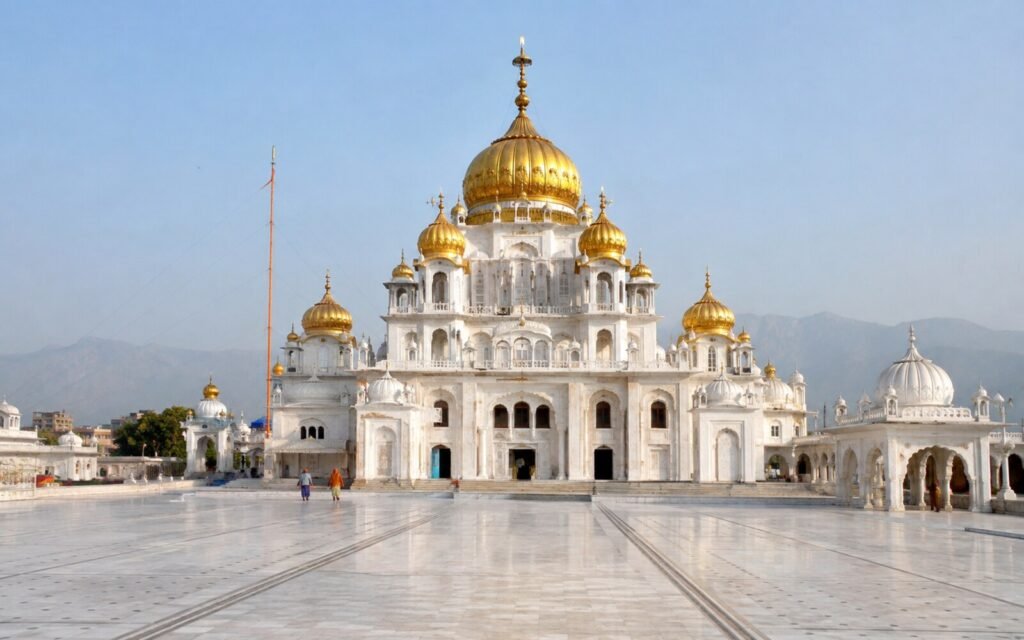
Travel to Anandpur Sahib: Where the Khalsa Was Born
A hill town of white domes and Shivalik ridges — the takht where Guru Gobind Singh founded the Khalsa in 1699, the extraordinary Virasat-e-Khalsa museum, and the thunder of Hola Mohalla every spring.
Anandpur Sahib is one of the most consequential small towns in India. Founded in 1665 by Guru Tegh Bahadur on land at the foot of the Shivaliks, it became the home of the last two Sikh Gurus for more than two decades — and on Baisakhi in 1699, Guru Gobind Singh gathered the community here, called for five volunteers, and created the Khalsa. Today the town is compact enough to walk in an afternoon, but it holds a takht, a ring of ruined forts, one of the best museums in the country, and every spring a festival that fills the fields with Nihang horsemen. Most people come as pilgrims. Everyone leaves having learned something.
Why visit Anandpur Sahib
The birthplace of the Khalsa
Takht Sri Keshgarh Sahib stands on the rise where the Khalsa was founded — one of five takhts, the seats of temporal authority in Sikhism. The weapons of Guru Gobind Singh are kept inside as relics and brought out for darshan. Whatever your faith, standing on that spot with the hills behind you is a genuinely stirring thing.
A museum worth the trip on its own
Virasat-e-Khalsa, designed by Moshe Safdie and opened in 2011, is not a dusty provincial collection. Sandstone-and-steel petals rise out of two ridges either side of a ravine, linked by a bridge, and inside, a sequence of galleries tells five hundred years of Sikh history through murals, models and sound. It regularly ranks among the most-visited museums in India, and entry is free.
Hola Mohalla
Guru Gobind Singh instituted Hola Mohalla in 1701 as a martial counterpoint to Holi — a day for the Khalsa to drill rather than throw colour. It survives as a multi-day fair each spring when Nihang jathas descend on the town for gatka, tent-pegging and bareback riding, and a procession winds between the gurdwaras. Lakhs of people attend. It is one of the great spectacles of northern India.
When to go to Anandpur Sahib
October to March is the comfortable season — cool, clear days, good light on the hills, and easy walking between the gurdwaras. Hola Mohalla, usually in March (it follows Holi, and the date moves with the lunar calendar), is the single most dramatic time to be here, but expect enormous crowds, closed roads and rooms booked out months ahead. Baisakhi in April is the other big date, marking the founding of the Khalsa itself. May and June are fiercely hot and the museum has been known to shorten its hours in heatwaves. The monsoon greens the Shivaliks beautifully but brings humidity and the odd washed-out afternoon.
Top things to do in Anandpur Sahib
Takht Sri Keshgarh SahibDo not miss
The heart of the town and of the Khalsa. The white gurdwara sits on the hill where Guru Gobind Singh administered amrit to the Panj Pyare in 1699; inside the inner domed chamber, a set of the Guru’s weapons is preserved and displayed. There are entrances from the main road near the bus stand and from the museum side. Go early or in the evening for the calmest darshan.
Virasat-e-KhalsaDo not miss
Moshe Safdie’s museum spreads across two complexes on either side of a ravine, joined by a bridge, on a site of over a hundred acres. The galleries move chronologically through Sikh history and philosophy with commissioned art and immersive sound. Allow two to three hours. Entry is free but ticketed, photography is restricted inside the galleries, and it is closed on Mondays — hours shift seasonally, so check before you set out.
Gurdwara Sis Ganj Sahib
The site where the severed head of Guru Tegh Bahadur, brought from Delhi after his execution in 1675, was cremated by his son. It is a short walk from the takht and one of the town’s most affecting stops — small, quiet, and heavy with the history that shaped everything that followed here.
Guru ke Mahal & Bhora Sahib
The residence of Guru Tegh Bahadur, later inherited by Guru Gobind Singh, where the Sahibzade were born. Beneath it is the bhora — a small underground chamber where the ninth Guru meditated, cut off from the noise of the town above. Ducking down into it is a quietly memorable few minutes.
The ring of forts — Anandgarh and beyond
Guru Gobind Singh fortified the town with a ring of forts — Anandgarh, Lohgarh, Holgarh, Fatehgarh and Taragarh — to defend it against the sieges of the 1700s. Gurdwaras now stand on several of the sites. Qila Anandgarh, with its stepped approach and views over the town, is the easiest to visit and the most rewarding.
Hola MohallaDo not miss
If you can time your trip for it, do. Nihang Singhs in blue and saffron gather in their thousands for displays of gatka, horsemanship and mock battles on the ground near Holgarh, across the Charan Ganga rivulet. The closing procession is led by the Panj Pyare from Takht Sri Keshgarh Sahib, past the main gurdwaras and back. Langars run around the clock. Book accommodation far in advance.
The langar and evening shastar darshan
As at every gurdwara, the community kitchen serves a free meal to anyone who sits down, and volunteering for seva — rolling rotis, washing steel thalis — is welcomed. In the evening at the takht, the Guru’s weapons are brought out for darshan; ask about the timing when you arrive, as it shifts with the season.
What to eat in Anandpur Sahib
Langar
The free community meal at the gurdwaras — dal, roti, a sabzi, kheer on good days — eaten seated in rows on the floor. Simple, endless and offered to everyone.
Kada prasad
Warm, ghee-heavy semolina halwa pressed into your cupped hands at the shrine. Accept it with both palms together; it is prasad, not a snack.
Sarson da saag & makki di roti
Winter Punjab on a plate — mustard greens slow-cooked to a thick green mash, cornmeal roti, and a coin of white butter melting into it. Best from October to February.
Chole bhature & chai
The dhabas and small cafes along the main road do reliable chole bhature, parathas and glasses of sweet milky tea. Anandpur Sahib is not a restaurant town — eat simply and well.
Where to stay in Anandpur Sahib
Gurdwara serais
The SGPC runs simple, very cheap rooms and dormitories for pilgrims near the takht. Basic but clean, and unbeatable for early-morning darshan.
Town guesthouses
A handful of small hotels and guesthouses sit along the main road and near the bus stand. Expect functional rooms rather than character — most visitors stay one night.
Ropar & Nangal
Both are within an hour and have more mid-range choice, which helps if you arrive during a festival and the town itself is full.
Chandigarh as a base
Around two hours away, with the full range of hotels. Many people visit Anandpur Sahib as a long day trip from Chandigarh rather than staying over.
How to get to Anandpur Sahib & around
By air: Chandigarh is the nearest airport, roughly 90–100 km away and about two hours by road. By train: Sri Anandpur Sahib has its own station on the Ropar–Nangal line, with connections via Chandigarh and Ambala. By road: the drive from Chandigarh takes about two hours; Amritsar is roughly four to five hours west, and Delhi around six. State buses run frequently from Chandigarh and Ropar. Getting around: the takht, Sis Ganj Sahib, Guru ke Mahal and Virasat-e-Khalsa are all within easy walking distance of each other in the town centre — take an auto or your own vehicle for the outlying forts and for day trips.
Best day trips from Anandpur Sahib
Kiratpur Sahib
An older Sikh settlement just south, associated with the sixth and seventh Gurus, and traditionally where ashes are immersed in the Sutlej.
Sri Naina Devi
A hilltop Shakti Peeth just over the Himachal border, reached by a winding road and a cable car, with long views back over the plains.
Bhakra Nangal Dam
One of the world’s highest gravity dams, holding back the Sutlej at Gobind Sagar. Access is restricted and usually needs prior permission — check well before you go.
Ropar & the Ropar Wetland
An Indus Valley archaeological site and a Ramsar-listed wetland on the Sutlej, good for winter birdlife and a quiet half day.
A simple 2-day Anandpur Sahib plan
The takht & the town
Morning darshan at Takht Sri Keshgarh Sahib, then walk to Gurdwara Sis Ganj Sahib and Guru ke Mahal with its underground bhora. Eat in the langar. Spend the afternoon at Virasat-e-Khalsa, and return to the takht in the evening for shastar darshan.
Full day · mostly on foot
Forts & hills
Climb to Qila Anandgarh early for the views, then loop the outlying fort gurdwaras including Holgarh across the Charan Ganga. In the afternoon, drive out to Naina Devi for the cable car and the ridge-top views, or south to Kiratpur Sahib.
Full day · vehicle needed
Practical tips that actually help
Cover your head and remove your shoes at every gurdwara — scarves are available at the entrances if you arrive without one. Tobacco and alcohol are not permitted anywhere in the sacred precincts, and Anandpur Sahib takes this seriously. Virasat-e-Khalsa is closed on Mondays and its timings move with the season, so build the rest of your day around it rather than assuming it will be open. The walk between the main sights is short but exposed, so carry water and a hat outside winter. Photography is restricted inside the museum galleries and inside the takht’s inner chamber. Carry cash — card acceptance is patchy. And if you come for Hola Mohalla, book months ahead and expect to walk the last stretch into town.
Mistakes first-time visitors make
Turning up on a Monday and finding the museum shut — it is half the reason to come. Treating Anandpur Sahib as a two-hour stop on the way to somewhere else, when the town rewards an unhurried day. Arriving during Hola Mohalla without a booking and discovering every room for forty kilometres is taken. Skipping the langar out of uncertainty about the etiquette, when it is open to everyone. Underestimating the summer heat on the walk up to Anandgarh. And driving out to Bhakra Dam assuming you can simply turn up, without checking the current access rules.
Anandpur Sahib FAQs
How many days do you need in Anandpur Sahib?
One full day covers the takht, the main gurdwaras and Virasat-e-Khalsa comfortably. A second day lets you add the fort sites and a trip out to Naina Devi or Kiratpur Sahib. Many people visit as a long day trip from Chandigarh.
Why is Anandpur Sahib important to Sikhs?
It is where Guru Gobind Singh founded the Khalsa on Baisakhi in 1699, initiating the Panj Pyare at the site of Takht Sri Keshgarh Sahib — one of the five takhts of Sikhism. The town was also home to the ninth and tenth Gurus for over two decades.
Is Virasat-e-Khalsa free, and when is it open?
Entry is free, though you collect a ticket. The museum is closed on Mondays and generally opens from mid-morning to late afternoon, but timings change seasonally and it also shuts on some national holidays and maintenance periods — worth confirming before you travel.
When is Hola Mohalla held?
It falls in spring, on the day after Holi, so the date moves each year with the lunar calendar — usually in March. The celebrations run for several days at Anandpur Sahib and draw lakhs of visitors, so book accommodation well in advance.
How do I reach Anandpur Sahib?
Chandigarh is the nearest airport, about 90–100 km and two hours by road. Sri Anandpur Sahib has its own railway station on the Ropar–Nangal line, and state buses run regularly from Chandigarh and Ropar.
What should I wear in Anandpur Sahib?
Dress modestly and cover your head at all gurdwaras — scarves are provided at the entrances. Shoes come off before you enter, and you wash your feet at the threshold. Tobacco and alcohol are prohibited in the sacred precincts.
Related guides
Punjab Travel Guide
The Golden Temple, Wagah, royal cities and the best food in India.
Amritsar Travel Guide
The Golden Temple by day and night, Jallianwala Bagh and the Wagah border.
Written by Ashvinee Nagle
I travel India slowly and write it down honestly - practical guides and real itineraries from someone who lives here.
About Ashvinee →Plan your India trip with us
Get one short, honest India travel guide a week — plus a free 7-day Rajasthan itinerary to start.
Free. Unsubscribe any time.