
Travel to Bishnupur: A First-Timer’s Guide to the Terracotta Temple Town
A town of extraordinary 17th-century terracotta temples, a living tradition of Baluchari silk weaving, and its own classical music gharana — one of Bengal’s great under-visited stops.
Bishnupur, in the Bankura district of western Bengal, was for centuries the capital of the Malla kings — and their devotion left behind one of India’s most remarkable clusters of temples. Built of the only material to hand, burnt clay, these 17th- and 18th-century shrines are covered in astonishingly detailed terracotta panels depicting scenes from the epics and everyday life. Beyond the temples, Bishnupur is famous for its Baluchari silk saris and its own classical music gharana, making it a rare town where architecture, craft and music all trace back to the same royal golden age. It stays refreshingly off the mainstream trail.
Why visit Bishnupur
The terracotta temples
Bishnupur’s temples are unlike anything else in India — curved Bengal-hut roofs and walls sheathed in intricate carved clay panels. The craftsmanship, and the sheer number of them, make it an essential stop for anyone who loves heritage.
Baluchari silk
The town is the home of Baluchari saris, whose pallus are woven with entire mythological scenes in silk. Watching weavers at work — and buying direct — is a highlight.
A royal cultural legacy
As the Malla capital, Bishnupur also gave rise to the Bishnupur gharana of classical music and to distinctive crafts like Dokra metalwork and terracotta horses — a whole culture born of one dynasty’s patronage.
When to go to Bishnupur
October to March is by far the best time, with cool, comfortable weather for walking between the temples. This season also includes the Bishnupur Mela (usually late December), a festival of music, crafts and culture that’s a wonderful time to visit. April to June is hot, and the monsoon is humid, though the surrounding countryside turns green. Aim to explore the open-air temple sites in the cooler mornings.
Top things to do in Bishnupur
RasmanchaDo not miss
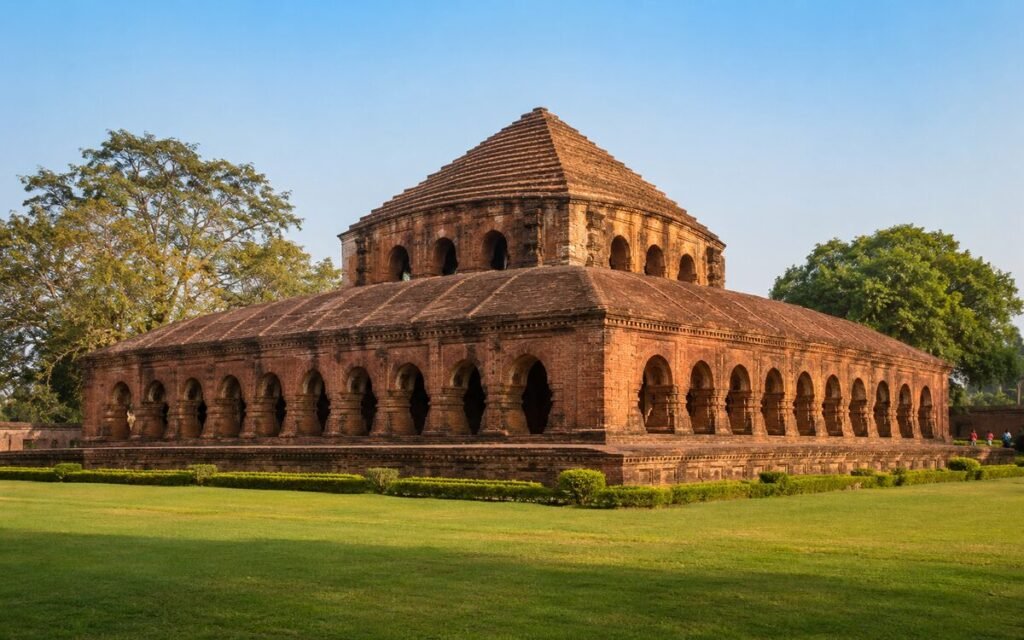
Bishnupur’s most iconic monument — a unique pyramidal brick structure built in the 16th century to display the town’s deities during the Ras festival. Its elegant arched galleries are unlike any other temple in India.
Jorbangla & Shyamrai templesDo not miss
Two of the finest terracotta temples, their walls covered in exquisitely detailed panels of gods, battles and daily life. The Jorbangla’s twin-hut roof and the Shyamrai’s five towers are masterpieces of the form.
Madan Mohan TempleDo not miss
A striking white ekaratna (single-tower) temple with beautifully carved terracotta panels, still an active place of worship and one of the town’s most photographed shrines.
Dalmadal Cannon & the fort remains
The great Dalmadal cannon, and the gateways and ramparts of the old Malla fort, recall Bishnupur’s days as a royal capital — a quick but atmospheric look at its martial past.
Watch Baluchari weaving
Visit weavers’ workshops to see Baluchari and Swarnachari silk saris being made on the loom, their borders and pallus telling whole stories in thread — and buy direct from the makers.
Dokra & terracotta crafts
Bishnupur and its surrounds are known for Dokra lost-wax metal figures and the famous Bankura terracotta horse. Craft shops and nearby villages are the place to find them.
What to eat in Bishnupur
Bengali thali
Simple, home-style Bengali meals — rice, dal, vegetables and fish curry — are the mainstay in the town’s modest eateries.
Bishnupur sweets
The town has its own sweet traditions alongside Bengal’s classics — worth sampling from a local shop.
Kachuri & street bites
Morning kachuri with aloo dum and other simple street snacks are a good, cheap way to eat between the temples.
Nolen gur (winter)
In winter, sweets made with date-palm jaggery are a regional treat across this part of Bengal.
Where to stay in Bishnupur
Town guesthouses
Simple, affordable guesthouses and lodges cluster near the temples and the bus/train links.
WBTDC tourist lodge
The state tourism lodge offers reliable, comfortable rooms and is a popular, convenient base.
Small hotels
A handful of mid-range hotels provide a bit more comfort within easy reach of the sights.
Local homestays
A few homestays give a more personal, home-cooked experience of the town.
How to get to Bishnupur & around
By train: Bishnupur is on the railway line and reachable directly from Kolkata (Howrah), taking roughly 3–4 hours depending on the service. By road: it’s about 140–150 km from Kolkata, around 4 hours by car. By air: Kolkata is the nearest airport, then train or road. Getting around: the temples are spread across town but close together; hire a toto (e-rickshaw), cycle-rickshaw or car for a half-day loop, or walk between the central clusters. A local guide adds a lot to understanding the terracotta panels.
Best trips around Bishnupur
Shantiniketan
Tagore’s town pairs naturally with Bishnupur for a western-Bengal culture-and-heritage loop.
Susunia Hill
A low hill popular for rock climbing, springs and views — a nature break from the temples.
Joyrambati & Kamarpukur
Villages linked to Ramakrishna and Sarada Devi, important pilgrimage stops in the region.
Mukutmanipur
A large reservoir ringed by hills and forest, a scenic spot for a relaxed day out.
A simple 1–2 day Bishnupur plan
The temple trail
Start early at Rasmancha, then work through the Jorbangla, Shyamrai and Madan Mohan temples and the fort remains, ideally with a guide. Break for a Bengali lunch, then more of the terracotta cluster in the afternoon.
Full day
Crafts & countryside
Visit Baluchari weavers and Dokra/terracotta craftspeople, shop direct from the makers, and add a short trip out to Susunia Hill or Mukutmanipur before you leave.
Full day
Practical tips that actually help
Hire a local guide for the temples — the terracotta panels come alive once someone explains the stories they tell. Explore the open-air sites in the cooler morning hours. Buy Baluchari silk and Dokra crafts direct from weavers and artisans for the best value and authenticity. The train from Kolkata is comfortable and scenic. Time your visit for the Bishnupur Mela in late December if you want music and crafts alongside the temples.
Mistakes first-time visitors make
Rushing all the temples in a couple of hours — the detail rewards a slower look. Skipping a guide and missing the meaning of the carvings. Visiting in peak summer heat, when walking between open-air sites is draining. Buying “Baluchari” from tourist shops rather than from weavers. And treating Bishnupur only as a day trip when an overnight lets you enjoy both temples and crafts properly.
Bishnupur FAQs
How many days do you need in Bishnupur?
One full day covers the main terracotta temples and the fort; a second day lets you add the Baluchari weavers, Dokra crafts and a nearby trip like Susunia Hill or Mukutmanipur at a relaxed pace.
What is Bishnupur famous for?
Its 17th- and 18th-century terracotta temples built by the Malla kings, its Baluchari silk saris woven with mythological scenes, and its own Bishnupur gharana of classical music — plus Dokra metal crafts and the Bankura terracotta horse.
What is the best time to visit Bishnupur?
October to March, for cool, comfortable weather to walk between the temples — and the Bishnupur Mela festival in late December. Summers are hot and the monsoon humid.
How do I reach Bishnupur?
By direct train from Kolkata (Howrah), roughly 3–4 hours, or by road (about 140–150 km, around 4 hours). The nearest airport is Kolkata, from where you continue by train or car.
Are the Bishnupur temples still active?
Some, like the Madan Mohan Temple, remain active places of worship, while others are protected heritage monuments. Dress and behave respectfully, especially at those still used for worship.
Can I buy Baluchari saris in Bishnupur?
Yes — Bishnupur is the home of Baluchari silk, and you can visit weavers’ workshops to watch the saris being made and buy directly, which is the best way to ensure authenticity.
Related guides
West Bengal Travel Guide
Darjeeling’s tea hills, the Sundarbans, Kolkata and Tagore’s countryside — the whole state, and how to plan it.
Shantiniketan Travel Guide
Tagore’s abode of peace — Visva-Bharati, Baul folk music and the Sonajhuri forest market.
Written by Ashvinee Nagle
I travel India slowly and write it down honestly - practical guides and real itineraries from someone who lives here.
About Ashvinee →Plan your India trip with us
Get one short, honest India travel guide a week — plus a free 7-day Rajasthan itinerary to start.
Free. Unsubscribe any time.