
The Wagah Border Ceremony: A Complete Visitor’s Guide
Every evening at the Attari–Wagah joint check post, Indian and Pakistani troops lower their flags in front of thousands of roaring spectators. Here is how to see it — when to arrive, what you can carry, and what to expect.
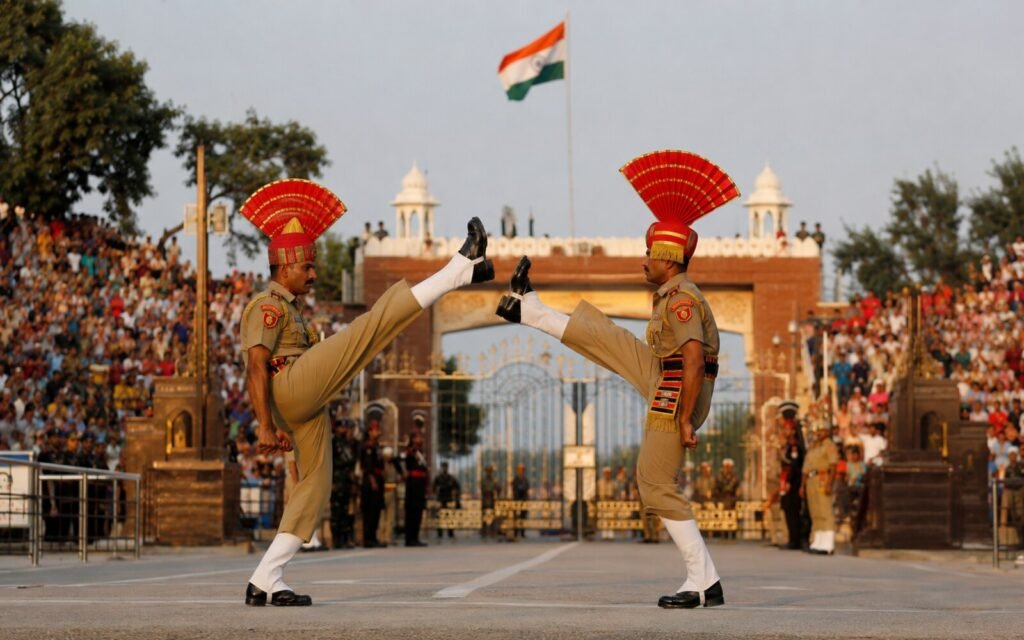
Every evening since 1959, just before sunset, the Border Security Force and the Pakistan Rangers have performed the same drill on either side of a painted line at the Attari–Wagah joint check post. Boots slam, legs kick above head height, moustaches bristle, and two flags come down in perfect synchrony while stadium-sized crowds on both sides shout themselves hoarse. It is part military ritual, part theatre, part sporting fixture — and it is one of the most extraordinary hours you can spend in India. Attari, on the Indian side, sits about 28 km west of Amritsar, which makes the ceremony the classic half-day trip out of the city.
Why go to the Wagah border ceremony
Nothing else quite like it
A daily, formalised performance of rivalry between two nuclear-armed neighbours, staged for cheering civilians who can see each other across the gates. The choreography is genuinely impressive — the high kicks, the stamping, the flourished salutes — and the atmosphere is somewhere between a parade ground and a cup final.
The crowd is half the show
Before the drill begins, the Indian stands turn into a party: patriotic songs over the loudspeakers, women and children dancing on the road, a runner carrying the tricolour the length of the approach. Watching the terraces fill and roar is as memorable as the ceremony itself.
It puts the region in context
If you have spent the day at Jallianwala Bagh and the Partition Museum in Amritsar, standing at the actual line drawn in 1947 lands differently. The border you have been reading about all day is right there, thirty metres away, with a crowd on the other side of it.
When to go
The ceremony runs daily, year round, timed to finish at sunset — so it starts earlier in winter and later in summer, and the exact slot is revised periodically. As of the most recent revision it runs in the 5.30pm to 6pm window, moved back from a 5pm start. Treat any published time as indicative and confirm on the day, either with your hotel or the BSF gate staff.
October to March is the pleasant season and also the busiest. Independence Day (15 August) and Republic Day bring vastly bigger crowds and an expanded programme with cultural performances, so go only if you want the spectacle at maximum scale and are prepared to queue for a long time. April to June means sitting in open concrete stands in serious heat — carry water and a hat.
The ceremony is subject to security conditions and has been curtailed or closed to the public at short notice in the past — most recently during the 2025 India–Pakistan tensions, when the drill was scaled back and public entry paused for around two weeks. It has since been running daily for spectators, but which elements are included can change. Confirm status locally on the day rather than relying on any guide, including this one.
What to expect, step by step
Getting through security
Gates open well before the ceremony and there are multiple checkpoints. Bags are heavily restricted — travel as light as you possibly can, ideally with nothing but a phone, a camera, water and your ID. Large bags, backpacks and outside food will not get through, and there is limited left-luggage provision. Vehicles park some distance out, so expect a walk of a kilometre or more to the stands.
Claiming a seatDo not miss
Seating is free, unreserved and first-come. On a normal evening, arriving around two hours before the start gives you a decent position; on weekends, holidays and through the peak season you want longer. There are separate enclosures, including a section for foreign passport holders and one for VIPs, which are usually less crowded — carry your passport if you want to use the foreigners’ gallery.
The build-up
For the hour before the drill, the road in front of the stands becomes a dance floor. Bollywood and patriotic tracks play, a compere works the crowd, children and women are invited out to dance, and volunteers run the length of the approach carrying an enormous tricolour. It is loud, joyful and completely unlike the formality that follows.
The Beating Retreat drillDo not miss
Then the tone flips. Bugles sound, and BSF troops in fan-crested turbans march out for a sequence of stamping, arm-swinging and astonishingly high kicks, mirrored move for move by the Pakistan Rangers a few metres away. The two national flags are lowered simultaneously and folded, and the whole thing is over in roughly half an hour.
The gates and the handshake
Historically the ceremony ended with the iron gates swinging open and the two guard commanders shaking hands. Following the 2025 tensions the BSF scaled this back — the gates stayed shut and the handshake was dropped. Whether those elements have been restored varies with the political weather, so go for the drill and treat anything more as a bonus.
Getting out again
Thousands of people leave at once down a single approach road, and the queue for vehicles is slow. Either accept a wait of 45 minutes or so, or slip out during the final few minutes of the drill if you would rather beat the crush. Have your driver’s number saved and agree a meeting point before you go in.
How to get to Wagah from Amritsar
Shared taxi or tempo
Shared vehicles leave the area around the Golden Temple and the bus stand each afternoon and fill up fast. The cheapest option by far, and sociable, but you travel on the group’s schedule both ways.
Private cab
A car hired for the afternoon with a wait-and-return arrangement is the least stressful choice, especially for the slow exit. Agree the price and the waiting time up front.
Hotel or agency tour
Most Amritsar hotels and agencies run an afternoon Wagah trip, often bundled with a stop or two on the way. Convenient, and they know what time to leave.
Bus to Attari
Local buses run along the Amritsar–Attari road, leaving a short auto or walk at the far end. Slowest option, and awkward for the return in the dark.
What to eat near the border
Highway dhabas
The Amritsar–Attari road is lined with dhabas doing parathas, dal, tandoori roti and endless chai. The obvious stop on the way out in the afternoon.
Stalls near the check post
Snacks, bottled water, tea and flags are sold outside the security perimeter. Buy water before you go through — you cannot bring much in and it is a long wait in the stands.
Dinner back in Amritsar
You will be back in the city by mid-evening, which is perfect timing for a late kulcha, an Amritsari fish fry or a thick lassi in the old city.
Langar at the Golden Temple
The temple kitchen serves through the night, so a late return is no obstacle to eating well — and the lit temple after dark is worth the detour anyway.
Where to stay
There is essentially nowhere to stay at the border itself, and no reason to try — Amritsar, 28 km east, is where everyone bases themselves. The old city near the Golden Temple puts you in walking distance of the main sights and the food, with everything from SGPC pilgrim lodging to restored havelis. Ranjit Avenue and the Mall are quieter and greener with comfortable mid-range hotels, and the international chains sit a short drive out. Any of them works for a Wagah afternoon; what matters is leaving early enough.
Combine it with
Pul Kanjari
A small heritage complex built by Maharaja Ranjit Singh close to the border, with a baoli, a temple and a mosque. Quiet, offbeat, and an easy stop on the way out.
The Golden Temple
Harmandir Sahib is at its most beautiful lit up after dark — exactly when you get back from the border. The natural end to the day.
Jallianwala Bagh & Partition Museum
Do these in the morning before heading out. Seeing the Partition story first gives the border a weight it otherwise lacks.
Tarn Taran Sahib
A revered gurdwara with one of the largest sarovars in Punjab, south of Amritsar — a calm morning counterweight to a loud evening.
A simple half-day Wagah plan
Head west
Leave Amritsar by early afternoon, allowing for traffic on the Attari road. Stop at a dhaba or at Pul Kanjari on the way. Aim to be through security and in the stands roughly two hours before the start — earlier at weekends and in peak season.
Leave ~2–3 pm
Ceremony & back
Enjoy the build-up, then the drill itself, which runs about half an hour. Expect a slow exit. Back in Amritsar by mid-evening — go straight to the Golden Temple to see it lit, then eat late in the old city.
Back by ~8–9 pm
Practical tips that actually help
Carry photo ID, and your passport if you are a foreign national — it gets you into the less crowded foreigners’ enclosure. Travel with almost nothing: bags are restricted at security and there is little storage. Buy water before the checkpoints. Wear something you do not mind sitting on concrete in, and bring a hat outside winter. Confirm the day’s timing locally, since it shifts with the season and has been revised more than once. If you are prone to crowd anxiety, be aware that this is a genuinely packed, very loud environment with a long walk at either end. And be respectful with your camera — photograph the ceremony and the crowd, not the security arrangements.
Mistakes first-time visitors make
Arriving forty minutes before the start and ending up standing at the back with a view of other people’s phones. Bringing a daypack and having to abandon it or trek back to the car. Assuming a published start time is current when the schedule has changed. Turning up on Independence Day without realising the crowds are several times normal. Not agreeing a meeting point with the driver, then hunting for a car among thousands in the dark. And treating it as a standalone trip rather than pairing it with Amritsar’s Partition sites, which is what makes the whole day cohere.
Wagah border FAQs
What time is the Wagah border ceremony?
It is timed to end at sunset, so it starts earlier in winter and later in summer, and the slot is revised periodically — most recently to a roughly 5.30pm to 6pm window. Always confirm the day’s timing locally rather than relying on a published figure.
Is the Wagah border ceremony free?
Yes. Entry and seating are free and unreserved, on a first-come basis. You only pay for transport from Amritsar. There are separate enclosures including one for foreign passport holders and one for VIPs.
How far is Wagah from Amritsar and how do I get there?
Attari, on the Indian side, is about 28 km west of Amritsar, roughly 45 minutes to an hour depending on traffic. Shared taxis and tempos leave the city each afternoon, and private cabs or hotel-arranged tours are the easiest option, especially for the slow return.
How early should I arrive?
Around two hours before the start on an ordinary evening, and longer at weekends, in peak season or on national holidays. Seating is unreserved, there are several security checks, and it is about a kilometre on foot from the parking area to the stands.
What can I carry to the ceremony?
As little as possible. Bags are heavily restricted at security and storage is limited, so bring only a phone, a camera, water and photo ID. Buy water before the checkpoints, since you will be waiting a while in the stands.
Is the ceremony still taking place?
It runs daily and has continued to draw large crowds, but it is subject to security conditions and has been curtailed or briefly closed to the public before — during the 2025 India–Pakistan tensions the drill was scaled back and public entry paused for about two weeks. Check the current position locally before you plan around it.
Related guides
Punjab Travel Guide
The Golden Temple, Wagah, royal cities and the best food in India.
Amritsar Travel Guide
The Golden Temple by day and night, Jallianwala Bagh and the Partition Museum.
Written by Ashvinee Nagle
I travel India slowly and write it down honestly - practical guides and real itineraries from someone who lives here.
About Ashvinee →Plan your India trip with us
Get one short, honest India travel guide a week — plus a free 7-day Rajasthan itinerary to start.
Free. Unsubscribe any time.