
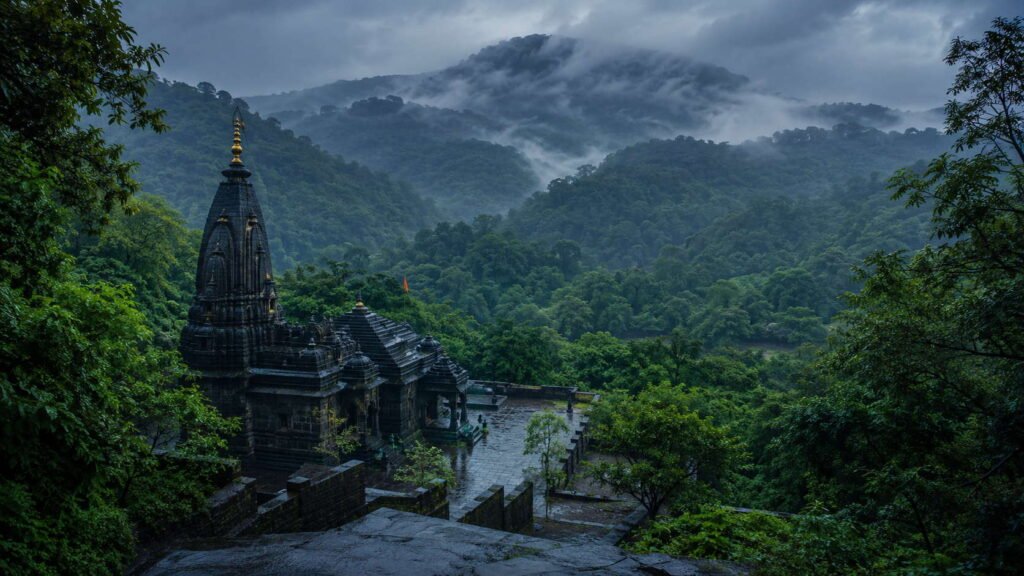
A slow weekend at Bhimashankar: a forest temple, a rare squirrel, and rain on the Ghats
One of the twelve Jyotirlingas, tucked inside a wildlife sanctuary — the rare Sahyadri weekend where a pilgrimage and a jungle walk are the same trip.
Most weekends in the Sahyadri ask you to choose. Temple towns or jungle trails, pilgrims or trekkers, the sacred or the wild. Bhimashankar quietly refuses the choice. Up here at around a thousand metres, an ancient Shiva temple — one of only twelve Jyotirlingas in all of India — sits right inside a wildlife sanctuary, so the same misty morning can hold a temple bell and the flash of a giant squirrel through the canopy. Come for the darshan, or come for the forest, or the trek, or the rain; Bhimashankar hands you all of it in one damp, green, unhurried weekend. It’s where a pilgrimage and a jungle walk turn out to be the same thing.
Bhimashankar is a temple-and-forest weekend in the Sahyadri, about 120 km from Pune and reachable from Mumbai (one road in runs via Malshej Ghat). At its heart is the sixth of the twelve Jyotirlingas, wrapped inside a wildlife sanctuary that protects the Shekru, the Indian giant squirrel and Maharashtra’s state animal. Best in the monsoon (June–September) for the green and the waterfalls, or October–February for the clearest wildlife spotting. Two days is right: temple and forest one day, a trek (Shidi or Ganesh Ghat) the next. Go slow, walk quietly, and let both sides of the place in.
Why Bhimashankar
Bhimashankar sits high in the Sahyadri in the Ambegaon and Khed talukas of Pune district, at roughly a thousand metres, on the ridge where the Bhima river begins. Its pull is really two pulls in one place. First, the temple: the Bhimashankar Jyotirlinga is one of the twelve most sacred Shiva shrines in India, drawing pilgrims from across the country — especially in the Hindu month of Shravan, when the crowds swell. Second, the forest: the whole area sits inside the Bhimashankar Wildlife Sanctuary, 131 square kilometres of dense Western Ghats jungle set aside in 1984 specifically to protect the Shekru, the Indian giant squirrel and Maharashtra’s state animal.
That overlap is what makes it special. Plenty of places have a famous temple; plenty have good jungle. Very few put a nationally important pilgrimage site in the middle of a biodiversity hotspot, so that the walk to the shrine doubles as a wildlife trail. In the monsoon the plateau turns a deep, dripping green, seasonal streams and waterfalls come alive, and the mist rolls through the forest canopy. It’s sacred and wild at once — and, for somewhere this significant, still surprisingly possible to enjoy slowly if you time it right.
A Jyotirlinga in the hills
One of only twelve Jyotirlingas in India, a genuinely major Shiva shrine — set not in a city but deep in a Sahyadri forest.
The Shekru’s forest
A wildlife sanctuary built to protect the Indian giant squirrel, Maharashtra’s state animal — plus hornbills, langurs and more.
Trails for every level
From a gentle forest walk to the river source, to the ladder-lined Shidi Ghat climb — a trek to match any pair of legs.
When to go
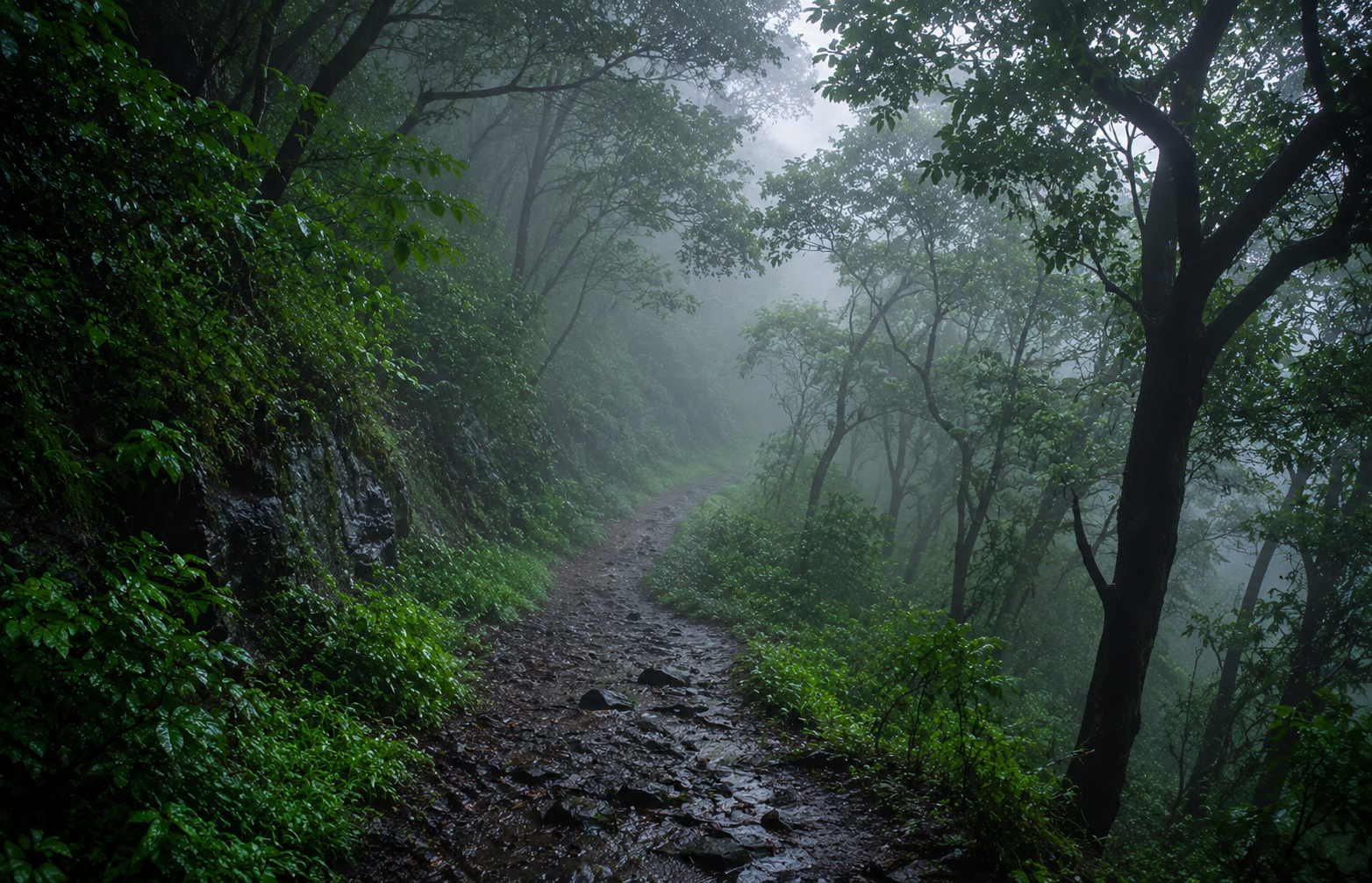
Bhimashankar has two good windows, and they suit different travellers. The monsoon (June–September) is when the place is at its most beautiful — the forest goes vivid green, the streams and waterfalls run full, and the mist turns the trek into something out of a dream. It’s the most popular season with trekkers and photographers, and the one this guide leans on. The catch: the ladders of the Shidi Ghat route can be slippery and are sometimes closed in heavy rain, and weekends around Shravan get very busy at the temple.
October to February is the other sweet spot, especially if wildlife is your reason to come — cooler, clearer, and the best window for spotting the Shekru and forest birds on early-morning walks. Peak summer is hot and the area faces real water scarcity, so it’s best skipped. If you want the drama, come in the rains; if you want the animals, come in winter.
This is a protected wildlife sanctuary and a working pilgrimage site, not a resort town. Services are thin, the last stretch of road has few good stops, and the temple keeps its own hours (with an afternoon break). Plan around darshan timings, carry cash, and don’t expect much once you’re up on the plateau — that quiet is the whole point.
The temple
The Bhimashankar temple is the reason the place is on the map for millions of people. It’s the sixth of the twelve Jyotirlingas — the most sacred class of Shiva shrines in India — and the building you see today, in the Nagara style with later additions, has stood on this spot for centuries. Legend ties it to Shiva’s battle with the demon Tripurasura, and the sweat of that struggle is said to have formed the Bhima river that rises here.
For all its fame, it’s a modest, atmospheric stone temple in a forest clearing rather than a grand complex, and that’s its charm. A few practical things make the visit far smoother: the temple opens very early (around 4:30 AM) and takes an afternoon break, roughly 1 to 4 PM, so the best darshan windows are early morning and again in the evening. On busy weekends and through Shravan, queues can run anywhere from ninety minutes to three hours, so arrive early. Photography is not allowed inside the sanctum.
For the calmest experience, aim for the 4:30–8:00 AM window — short queues, cool air, and the forest waking up around you. It also frees the rest of your day for the sanctuary and the walk to Gupt Bhimashankar.
The sanctuary & the Shekru
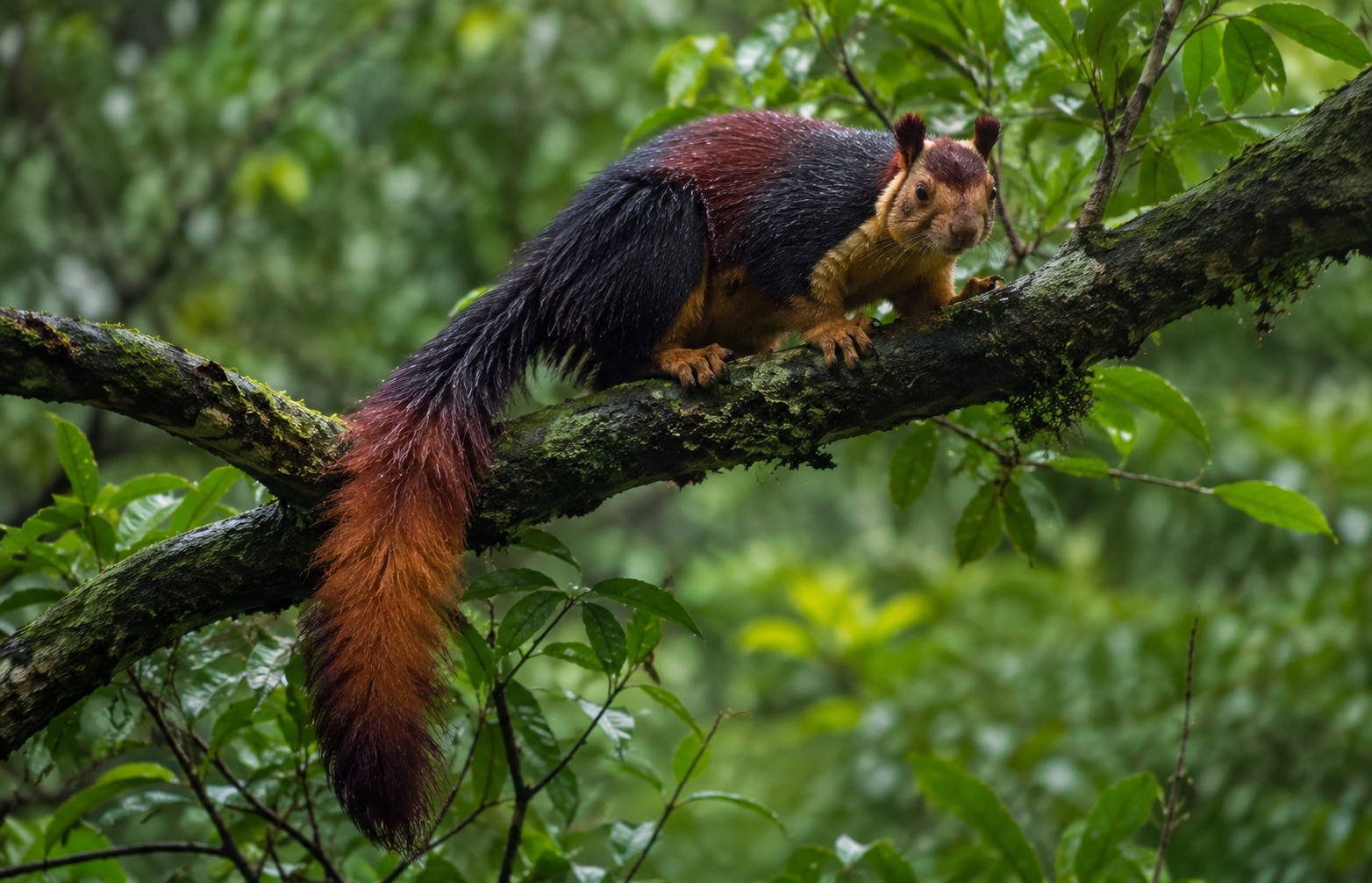
What sets Bhimashankar apart from every other Jyotirlinga is the forest it sits in. The Bhimashankar Wildlife Sanctuary covers about 131 square kilometres across the Pune, Raigad and Thane districts, and it was established in 1984 for one headline reason: to protect the Shekru, the Indian (or Malabar) giant squirrel, Maharashtra’s state animal. It’s a spectacular creature — far bigger than a common squirrel, with a long bushy tail, leaping through the high canopy — and this is one of the best places in the state to see one.
But the Shekru is just the headline. The sanctuary is a recognised Western Ghats biodiversity hotspot, sheltering leopard, gaur (Indian bison), barking deer, sambar and wild boar, along with a rich cast of birds — Malabar whistling thrush, Malabar pied hornbill, and more. There are no jeep safaris here; you explore on foot, on the trekking trails, which is exactly why quiet, patient walking is rewarded. Early morning on the forest trails is when the sanctuary comes alive.
This is protected habitat, not a zoo. Keep noise down, never feed or chase the wildlife, don’t litter, and stay on the marked trails — especially through the denser forest sections. Walk quietly and you’ll see far more; the Shekru in particular vanishes at the first loud sound.
Getting there
The honest geography: Bhimashankar is closest to Pune, and reachable but longer from Mumbai. Trekkers, though, usually come at it from a third direction — the base village of Khandas near Karjat, which is where the two famous trail routes start. Whichever way you come, top up fuel and cash in the last proper town, because the plateau has almost nothing.
~120–130 km · ~3 hours
The easiest drive, via Rajgurunagar (Rajguru Nagar), Manchar and Ghodegaon up to the temple. The standard approach for a road trip.
~215–250 km · 5–6 hours
Longer; one scenic option runs via Malshej Ghat. Best as a proper two-night trip rather than a dash up and back.
Khandas, near Karjat
Train to Karjat, then ~30 km by shared rickshaw or bus to Khandas — the base village for both the Shidi Ghat and Ganesh Ghat trails.
Karjat & Pune
Karjat is the trek railhead; Pune is the nearest big station and airport. State buses also run to the temple from Pune’s Shivajinagar.
State transport buses do reach the temple directly from Pune, which is handy for a pure darshan trip. But they won’t stop for waterfalls, viewpoints or the forest trails, so if you want to actually explore the sanctuary, a private or hired vehicle — or the trek from Khandas — is the way to do it.
The ghat roads up to the plateau are narrow, winding and often fog-bound in the monsoon, and the last stretch is poorly serviced. Drive slowly, keep fog lights on, don’t attempt it after dark if you can help it, and give yourself plenty of time on the final climb.
The best monsoon stops
Bhimashankar’s highlights cluster around the temple and the plateau, so once you’re up top you can see a lot on foot. Let the weather set the order, keep well back from fast water, and give the forest walks the unhurried time they deserve.
Bhimashankar TempleThe heart of it
The Jyotirlinga itself — an ancient, atmospheric stone Shiva temple in a forest clearing, and the reason most people make the journey. Go early to beat the queues, soak up the bells and the incense and the cool mountain air, then let the rest of the day open out into the forest around it.
Gupt BhimashankarThe river source
A short, lovely forest walk (about a kilometre) from the main temple leads to Gupt Bhimashankar — a Shivling set in the middle of a stream beneath a rock overhang, marking the hidden source of the Bhima river. Green, quiet and atmospheric, it’s the perfect gentle introduction to the sanctuary’s forest.
Nagphani (Cobra Hood)The big view
The highest point in the Bhimashankar area, named for its serpent-hood shape, reached by a walk up past the Hanuman temple. On a clear day the views over the ranges and down toward the Konkan are enormous; in the monsoon you’re often walking straight into cloud, which is its own kind of magic. Watch your footing near the edges.
Ahupe Waterfall & Dimbhe backwatersNearby
A little further out, the hidden Ahupe area offers a green plateau, a lovely monsoon waterfall and views over the Dimbhe Dam backwaters — a quieter, less-visited corner for those with an extra half-day and their own transport. A good add-on if you want to escape the temple-day crowds entirely.
The two trek routes
For many people, the trek is Bhimashankar — the climb up through the sanctuary from the base village of Khandas is one of the most loved monsoon trails in the Sahyadri. There are two classic routes, and the smart move is to combine them: up one, down the other. Both start from Khandas (near Karjat) and merge near a Ganesh temple at the halfway point before the final stretch to the top.
Shidi Ghat (the ladder route)
The steeper, more adventurous trail — named for the iron shidi (ladders) bolted onto its rocky sections, with one properly technical patch near the top. It’s shorter (roughly 7.5–8 km) but demanding, and the ladders can be slippery or closed in heavy monsoon, so check conditions. The usual approach is to ascend via Shidi Ghat while you’re fresh.
Ganesh Ghat (the gradual route)
The longer but easier trail (around 10–13 km), a gradual climb that opens into grassy meadows before diving back into dense forest — named for a small Ganesh temple at the halfway mark. It’s the beginner-friendly choice and the classic way to descend, letting you enjoy both trails in one two-day trip without a brutal single-day double.
Do the trek over two days with an overnight at the top, go with a local guide in the monsoon, and start early. Check whether the Shidi Ghat ladders are open before you commit, carry water and a torch, and never attempt the technical sections alone in heavy rain. The forest is protected, so carry your litter out.
Where to eat
Bhimashankar eating is simple, cheap and mostly clustered around the temple — this is pilgrim-and-trekker food, not a restaurant scene, and that’s exactly right after a wet climb. Save any bigger meals for Pune at either end of the trip.
- The famous Bhimashankar pedha. The local sweet everyone talks about — soft, fresh milk pedha sold at the little shops near the temple. Buy some for the road; it’s a rite of passage.
- Hot vada pav & kanda bhaji. The unofficial fuel of a Sahyadri monsoon, fried fresh at the stalls around the temple and trailheads. Exactly what you want standing in the drizzle.
- Simple Maharashtrian thalis. Small eateries near the temple do honest pithla-bhakri, zunka and veg thalis — warm, filling and cheap.
- Chai, everywhere. Endless cutting chai at the stalls; the natural pause between darshan and the forest walk.
- MTDC & lodge meals. If you stay at the MTDC resort or a lodge, meals are usually available on site — the reliable option up on the quiet plateau.
Where to stay
Bhimashankar isn’t a hotel town, so set expectations for simple, functional stays rather than luxury. Your choice depends on whether you want to wake up on the plateau near the temple, rough it at the trek base, or trade atmosphere for comfort back toward the city.
MTDC & local lodges
The MTDC resort and a handful of basic lodges and temple guesthouses put you minutes from the shrine and the forest — ideal for an early darshan and a dawn walk. Book the MTDC well ahead, especially in season.
Khandas homestays
Simple village homestays at Khandas let you start the trek fresh at first light. Rustic and basic, but full of local warmth and home-cooked food — the trekker’s choice.
Pune side
For a proper room and more options, base in Pune (or a stop like Manchar) and day-trip up. Best if you want the temple and a taste of the forest without roughing it overnight.
Wherever you stay, book ahead for monsoon weekends and the Shravan month, confirm the access road holds up in heavy rain, and check on power and hot water — both can be intermittent up on the plateau.
A suggested slow itinerary
Two days is the natural shape — enough for the temple, the forest and a trek, without the exhausting single-day dash that most people make and regret. Here’s a relaxed version for a driving trip; trekkers can flip it to start from Khandas.
Drive up, settle in
Come up from Pune in the afternoon via Rajgurunagar and Ghodegaon, and settle into your plateau stay before dark. Eat something hot, buy some pedha, and turn in early — tomorrow starts before dawn.
Temple at dawn, forest by day
Early darshan at the temple while the queues are short and the forest is waking. After breakfast, walk to Gupt Bhimashankar and the river source, then take a slow, quiet forest trail — eyes up for the Shekru. Afternoon: Nagphani for the big view if the cloud lifts.
A trek or Ahupe, then home
Point the morning at a proper trail — descend via Ganesh Ghat if you’re doing the classic trek, or drive out to Ahupe waterfall and the Dimbhe backwaters for a quieter half-day. Grab a last chai and pedha, then start home by early afternoon to beat the traffic and the fog.
Practical tips that actually help
Time your darshan
The temple opens ~4:30 AM and breaks 1–4 PM. Go early morning for short queues — and to free the day for the forest.
Walk quietly for wildlife
Early mornings on the forest trails, minimal noise, no feeding or chasing. The Shekru bolts at the first loud sound.
Check the ladders
The Shidi Ghat ladders can be slippery or closed in heavy rain. Confirm they’re open, and take a guide on the trek in the monsoon.
Respect Shravan crowds
The Hindu month of Shravan brings huge pilgrim numbers. Come outside it for calm, or embrace the energy — but arrive very early.
Carry cash & go self-sufficient
Services and signal are thin on the plateau. Draw cash, download offline maps, and top up fuel before the final climb.
Pack for real rain
Full waterproofs, dry bags, and grippy closed shoes for slick forest and rock. Leave no litter — this is protected habitat.
Planning a Maharashtra monsoon trip?
I help travellers plan slow, well-paced India trips that get the seasons, distances and logistics right — including off-the-map Sahyadri escapes like Bhimashankar, Malshej and Bhandardara. Free 48-hour reply.
FAQs about Bhimashankar
Why is Bhimashankar famous?
For two things at once. It’s home to one of the twelve Jyotirlingas — the most sacred class of Shiva temples in India — and that temple sits inside the Bhimashankar Wildlife Sanctuary, created in 1984 to protect the Shekru, the Indian giant squirrel and Maharashtra’s state animal. Few places combine a major pilgrimage site with a biodiversity hotspot like this.
When is the best time to visit Bhimashankar?
June to September for the classic monsoon experience — lush green forest, full waterfalls and misty trails. October to February is best for wildlife spotting and clear weather, with easier trekking. Peak summer is hot and water-scarce, so it’s best avoided.
How do I get to Bhimashankar?
It’s about 120–130 km from Pune (roughly 3 hours by road via Rajgurunagar and Ghodegaon), and 215–250 km from Mumbai, with one scenic route via Malshej Ghat. Trekkers come from Khandas village near Karjat, the base for both trail routes. State buses run to the temple from Pune; a private vehicle is best for exploring.
What are the trek routes at Bhimashankar?
Two classic trails start from Khandas near Karjat. Shidi Ghat is the steeper, shorter ladder route (about 7.5–8 km) with a technical rocky patch; Ganesh Ghat is the longer, gentler route (around 10–13 km) through meadows and forest. Many trekkers ascend via Shidi Ghat and descend via Ganesh Ghat over two days.
Will I actually see the giant squirrel?
There’s a good chance if you walk the forest trails quietly, early in the morning — the Shekru is most active then and this is one of the best places in Maharashtra to see it. Sightings are never guaranteed with wild animals, but October–February and a patient, silent approach improve your odds a lot.
What are the temple timings?
The temple opens very early (around 4:30 AM) and takes an afternoon break, roughly 1 to 4 PM, before reopening into the evening. The calmest darshan is in the early-morning window; weekend and Shravan queues can run from ninety minutes to three hours. Photography is not allowed inside the sanctum.
More slow monsoon weekends
If this is your kind of Sahyadri weekend, these companion guides cover more of it at the same unhurried pace.
Written by Ashvinee Nagle
I travel India slowly and write it down honestly - practical guides and real itineraries from someone who lives here.
About Ashvinee →Plan your India trip with us
Get one short, honest India travel guide a week — plus a free 7-day Rajasthan itinerary to start.
Free. Unsubscribe any time.