
Bhubaneswar: The Temple City, the Jain Caves, and Ashoka’s Battlefield
A practical guide to Bhubaneswar — the living Lingaraj and the jewel-box Mukteshwara, the rock-cut Udayagiri and Khandagiri caves, Ashoka’s edicts at Dhauli, and using the capital as the gateway to the whole Odisha coast.
Bhubaneswar is where the Kalinga style of temple architecture grew up, and it is still growing old gracefully in the lanes of the old town. Once said to hold hundreds of temples, the capital of Odisha keeps enough of them — from the small, perfectly carved Mukteshwara to the towering 11th-century Lingaraj — to make an afternoon of temple-hopping feel like walking through seven centuries of stonework. Add the rock-cut Jain caves of Udayagiri and Khandagiri, carved for monks more than two thousand years ago, and Dhauli, where Ashoka’s edicts mark the battlefield that turned a conqueror into a Buddhist, and the modern capital reveals itself as one of India’s great open-air history lessons.
Bhubaneswar is Odisha’s capital and its temple city — the 11th-century Lingaraj (Hindus only, with a viewing platform for others), the jewel-like Mukteshwara and Rajarani, the 2nd-century BCE Udayagiri and Khandagiri Jain caves, and Ashoka’s rock edicts at Dhauli. One full day covers the highlights, two if you go slowly. October to February is the season. It is the gateway to the coast and one point of the golden triangle with Puri and Konark on a wider Odisha trip.
Why visit Bhubaneswar
Three reasons the capital earns a day or two — and one note on the entry rule.
Seven centuries of temples
Nowhere shows the evolution of the Kalinga temple like Bhubaneswar. You can stand in front of a small 10th-century shrine and a soaring 11th-century tower within the same hour, and watch the style grow more ambitious in stone.
Jain caves older than most countries
The Udayagiri and Khandagiri caves were cut for Jain monks in the 2nd century BCE, under King Kharavela, whose Hathigumpha inscription is one of the most important early records in India. They are carved, climbable, and almost casually ancient.
Where Ashoka changed his mind
At Dhauli, on the edge of the city, the Mauryan emperor Ashoka fought the Kalinga War around 261 BCE — and was so appalled by the bloodshed that he turned to Buddhism. His edicts are carved into the rock there, beneath a white peace pagoda built in the 1970s.
When to go
Bhubaneswar is an inland city with a hot coastal climate, so the season is about comfort rather than access. The temples and caves are open year-round.
October to February (the season): cool, dry and comfortable for temple sightseeing and the open climb around the caves. December and January are the pick, and the city’s Ekamra and Kalinga cultural festivals fall in the cooler months.
March to May (hot): temperatures and humidity climb steeply; start early and keep the middle of the day for indoor museums. The June–September monsoon greens the city and the caves but brings heavy, humid spells.
Festival note: Shivaratri fills the Lingaraj temple; the Ashokashtami chariot festival (usually March–April) is Bhubaneswar’s own smaller Rath Yatra. Both are worth seeing if the timing lands, and busy if it does.
Things to do in Bhubaneswar
The temples cluster in the old town around the Bindusagar tank; the caves and Dhauli are short drives out. A car for the day joins them up easily.
Lingaraj Temple
The 11th-century Lingaraj, dedicated to Harihara (Shiva-Vishnu), is the largest and most important temple in the city, its 55-metre tower rising over the old town. It admits Hindus only; others get a clear view from the raised platform just outside the north wall, originally built for a visiting viceroy.
Mukteshwara Temple
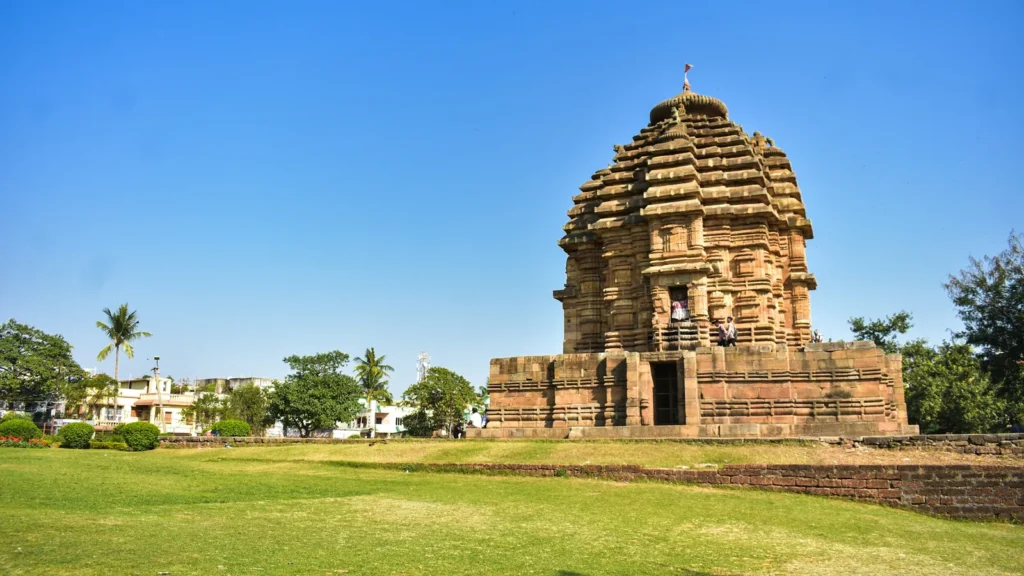
Small, early and exquisitely carved, the 10th-century Mukteshwara is often called the gem of Kalinga architecture — its free-standing arched torana gateway is the image everyone photographs. Open to all, and the single most rewarding temple to look at closely.
Rajarani & Brahmeswara
The Rajarani, built of a warm red-and-yellow sandstone (the local rajarani stone that gives it its name), is carved with sculpted couples and guardian figures and is often called the love temple. The nearby Brahmeswara adds another finely worked 11th-century shrine. Both open to all.
Udayagiri & Khandagiri caves
Two facing hills honeycombed with rock-cut cells for Jain monks — Udayagiri (Sunrise Hill) has eighteen caves including the double-storeyed Rani Gumpha and the Hathigumpha with Kharavela’s great inscription; Khandagiri has fifteen and a hilltop temple. A climbable, shaded couple of hours.
Dhauli and Ashoka’s edicts
On a low hill by the Daya river, Ashoka’s rock edicts record his remorse after the Kalinga War, and a white peace pagoda built by Japanese and Indian Buddhists in the 1970s crowns the site. Quiet, green and unexpectedly moving.
State Museum & Odisha Crafts
The Odisha State Museum holds sculpture, palm-leaf manuscripts and coins that put the temples in context, and the state handloom and crafts emporiums are the reliable place to buy ikat, silver filigree and pattachitra without the hard sell.
What to eat
The capital eats well — proper Odia thalis, temple-town sweets, and the street food of a growing city.
Odia thali
Dalma, santula, machha besara and a sweet to finish, served on a steel plate or a leaf. Ask for the Odia thali rather than the north-Indian one; a few dedicated Odia kitchens do it beautifully.
Chhena poda & rasagola
Odisha’s signature “burnt cheese” cake and the soft rasagola (the Pahala rasgulla belt is just up the road) are everywhere. Buy chhena poda fresh and slightly warm.
Dahibara-aludum & gupchup
The great Bhubaneswar breakfast-and-snack: soft lentil dumplings in yoghurt with a spiced potato curry, and gupchup (the local pani puri) in the evenings. Cheap and everywhere.
Hotel restaurants
The mid-range and business hotels do reliable multi-cuisine menus and a good Odia thali on request — the easy option after a long day of temples.
Where to stay
Bhubaneswar has the best-value hotel range on the Odisha coast and is a comfortable base for the whole golden triangle. Where you stay is mostly about convenience.
Janpath / Saheed Nagar
The widest choice — business hotels, comfortable mid-range options and budget rooms, handy for the museums, restaurants and the airport. The practical base for most visitors.
Airport & ring road
Convenient for a late arrival or early departure and for driving out to Puri and Konark without crossing the city. A little removed from the old town.
Getting there and around
By air: Biju Patnaik International Airport (BBI) is in the city, with direct flights from Delhi, Kolkata, Mumbai, Bengaluru, Hyderabad, Chennai and more, plus a few international routes. It is the main gateway for the whole Odisha coast.
By train: Bhubaneswar is a major junction on the East Coast line, with fast trains from Kolkata (around seven hours), Visakhapatnam, Chennai and beyond, and frequent local services to Puri and Cuttack.
Getting around: the temples cluster in the walkable old town; the caves and Dhauli are short drives. Autos and app cabs cover the city, but for a day that strings the temples, caves and Dhauli together — or for the run out to Konark and Puri — hire a car and driver.
Bhubaneswar, Puri and Konark form Odisha’s golden triangle within about 65 km. Base here or in Puri, and you can see all three plus the Chilika lagoon in four or five unhurried days.
A simple 1-day plan
One well-organised day covers the highlights; add a second to slow down or shop.
Temples, caves and Ashoka
Start early in the old town with Lingaraj (from the platform), Mukteshwara, Rajarani and Brahmeswara around the Bindusagar tank. Mid-morning, climb the Udayagiri and Khandagiri caves before the heat. After lunch, Dhauli for the edicts and the peace pagoda, then the State Museum or the crafts emporium to finish.
Practical tips that actually help
Lingaraj is Hindus-only
Use the viewing platform outside the north wall for the tower view. Don’t pay anyone promising to get non-Hindus inside — it isn’t possible.
Do the caves before midday
The Udayagiri and Khandagiri climb is open and warm; morning light and cooler air make it far more pleasant, and the Rani Gumpha carvings read better.
Photograph the Mukteshwara torana
The free-standing arched gateway is the finest single piece of carving in the city and is easy to walk past. Give it time.
Buy crafts at the emporiums
Silver filigree, ikat and pattachitra are cheaper and hassle-free at the state handloom and crafts emporiums than from touts around the temples.
Base here for the triangle
Bhubaneswar’s hotels are the best value on the coast. Use it as a hub for Konark, Puri and the Chilika lagoon rather than moving hotels every night.
Mind the festival crowds
Shivaratri at Lingaraj and the Ashokashtami chariot festival fill the old town. Wonderful to witness, harder for quiet sightseeing.
Mistakes first-time visitors make
- Treating it only as an airport stop. Bhubaneswar is a full day of genuine sights, not just the gateway. Give it at least a day before rushing to Puri.
- Expecting to enter Lingaraj. It admits Hindus only. Plan for the platform view so it isn’t a surprise on the day.
- Rushing the temples. The old-town shrines reward slow looking. Three seen properly beat ten glanced at from the car.
- Skipping Dhauli. The Ashokan edicts and peace pagoda are a short drive and one of the most resonant sights in the state. Don’t cut them for time.
Planning Bhubaneswar and the Odisha triangle?
Bhubaneswar is the easy hub — the question is how to string the temples, Konark, Puri and Chilika into the days you have. Tell me your dates and I’ll map the route.
Bhubaneswar FAQs
What is Bhubaneswar famous for?
Bhubaneswar is the temple city of Odisha, famous for its cluster of Kalinga-style temples including the 11th-century Lingaraj and the jewel-like Mukteshwara, the 2nd-century BCE Udayagiri and Khandagiri Jain caves, and Dhauli, where Emperor Ashoka’s rock edicts mark the site of the Kalinga War.
How many days do you need in Bhubaneswar?
One well-planned day covers the main temples, the Udayagiri and Khandagiri caves and Dhauli. A second day lets you slow down, add the State Museum and craft shopping, or use the city as a base for day trips to Konark and Puri.
Can non-Hindus enter the Lingaraj Temple?
No. Like the Jagannath Temple in Puri, the Lingaraj admits Hindus only. There is a raised viewing platform just outside the north wall — originally built for a visiting viceroy — from which non-Hindus can see the complex and its great tower.
How far is Bhubaneswar from Puri and Konark?
Puri is about 60 km (1.5 hours) and Konark about 65 km. Together with Bhubaneswar they form Odisha’s golden triangle, easily covered from a single base over a few days.
What is the best time to visit Bhubaneswar?
October to February, when the weather is cool and dry for temple sightseeing and the open climb around the caves. March to May is hot and humid, and the monsoon runs roughly June to September.
How do you reach Bhubaneswar?
Bhubaneswar has Biju Patnaik International Airport (BBI) with flights from most Indian metros, and it is a major railway junction on the East Coast line with fast trains from Kolkata, Visakhapatnam and Chennai.
Related guides
Keep planning your Odisha trip with these:
Odisha Travel Guide
The temple triangle, the Chilika lagoon and the wild coast — how to put an Odisha trip together.
Konark
The 13th-century Sun Temple built as a stone chariot — the classic day trip that completes the golden triangle.
Written by Ashvinee Nagle
I travel India slowly and write it down honestly - practical guides and real itineraries from someone who lives here.
About Ashvinee →Plan your India trip with us
Get one short, honest India travel guide a week — plus a free 7-day Rajasthan itinerary to start.
Free. Unsubscribe any time.