
Sultanpur National Park: Birdwatching on Delhi’s Doorstep
A practical guide to Sultanpur National Park — the wetland Ramsar site near Gurugram, its winter migratory birds, the walking trail and watchtowers, the best season and timing, and how to visit one of the finest birding spots near Delhi.
Sultanpur National Park is proof that you don’t have to go far from the capital to find serious birdlife. A compact wetland just beyond Gurugram, and a Ramsar-listed site of international importance, it fills each winter with migratory birds from across Asia and Europe, alongside a rich resident cast of herons, storks, kingfishers and egrets. A flat walking trail rings the main lake, with watchtowers and hides, and a good morning here — binoculars in hand, flocks wheeling over the water — is one of the easiest nature escapes from Delhi.
Sultanpur National Park, about 15 km from Gurugram and 50 km from Delhi, is a compact wetland and Ramsar site that’s one of the best birdwatching spots near the capital. Hundreds of resident and migratory species gather here, with the migratory season running roughly November to March. A flat loop trail with watchtowers rings the lake; a half-day (ideally at dawn) does it. Carry binoculars, go early, and combine it with a Haryana trip or a Delhi day out.
Why visit Sultanpur
Three reasons Sultanpur is the best easy birding trip from Delhi.
A Ramsar wetland near the capital
Sultanpur is a wetland of international importance (a Ramsar site) barely an hour from central Delhi — a genuine birding destination without a long journey.
Winter migratory spectacle
From November to March the lake fills with migratory ducks, waders and other visitors from across Asia and Europe, joining the resident storks, herons and kingfishers for the park’s richest months.
Easy, flat and compact
A level loop trail with watchtowers and hides rings the main jheel, so it’s an easy, accessible half-day — ideal for a dawn walk, families and first-time birders alike.
When to go
Sultanpur is entirely a winter destination — the season makes or breaks the visit.
November to March (the season): the migratory birds are in, the weather is cool, and the park is at its richest. This is the time to come.
Early mornings: whatever the month, dawn is by far the best time — birds are most active and the light is best. The park opens early for this reason.
April to September (off-season): the migratory birds have left and the heat is fierce; parts of the park can be closed in peak summer. Resident birds remain, but it’s a far quieter experience.
Things to do at Sultanpur
The trail, towers and interpretation centre are the whole experience — it’s about the birds.
The lake loop trail
A flat, well-made path rings the main jheel, passing reed beds, open water and grassland. Walking it slowly at dawn, stopping to scan, is the heart of a Sultanpur visit.
Watchtowers & hides
Several watchtowers and hides around the lake give raised, unobtrusive views over the water — the best spots to settle and watch flocks feed and fly.
Migratory & resident birds
In winter, migratory ducks, waders and visitors from across Asia join resident painted storks, herons, egrets, cormorants and the park’s kingfishers — hundreds of species in all.
Interpretation centre
The park’s interpretation/education centre helps you identify species and understand the wetland — a useful first stop, especially for newer birders.
Farrukhnagar & the Aravallis
The old town of Farrukhnagar (with its Sheesh Mahal and stepwell) is close by, and the wider Gurugram Aravalli belt offers more green escapes to combine with a Sultanpur morning.
What to eat
There’s little inside the park — eat in Gurugram, or carry a flask and snacks.
Gurugram dining
Gurugram, about 15 km away, has the full range of cafes and restaurants for a meal before or after your birding morning.
Tourism complex
The Haryana Tourism complex near the entrance (the Rosy Pelican) offers basic food and a place to pause — handy, but limited.
Flask & snacks
Bring water, a flask of tea/coffee and snacks for the trail — there’s little inside once you start walking, and early mornings are cold in winter.
No feeding/disturbing
Keep quiet, don’t feed or disturb the birds, and stick to the trail — this is a protected wetland.
Where to stay
Sultanpur is a half-day trip; stay in Gurugram or Delhi rather than at the park.
Gurugram
Gurugram has the full range of business and upscale hotels, 15 km away — the obvious base for an early start to the park.
Haryana Tourism (Rosy Pelican)
The Haryana Tourism property at the entrance offers simple rooms right by the park for the keenest early birders.
Getting there and around
From Gurugram/Delhi: Sultanpur is about 15 km from Gurugram and roughly 50 km from central Delhi, on the Gurgaon–Farrukhnagar road — an easy drive or cab ride.
By rail/metro: reach Gurugram by train or the Delhi Metro (Yellow/Rapid Metro), then take a cab for the last stretch to the park, which has no direct public transport.
Getting around: the park is explored entirely on foot along the loop trail; no vehicles go inside. A cab to and from the gate is the simplest plan.
Sultanpur is an easy half-day from Delhi or Gurugram and slots neatly into a wider Haryana trip alongside Surajkund and the city sights on the NCR edge.
A half-day plan
A dawn start and a few hours on the trail is all it takes — ideally in winter.
A birding morning
Arrive at opening time, walk the loop trail slowly with binoculars, settling at the watchtowers over the jheel, and visit the interpretation centre. Finish with a late breakfast in Gurugram.
Practical tips that actually help
Go at opening
Dawn is the best time by far — birds are most active and the light is beautiful. Arrive when the gate opens.
Bring binoculars
A pair of binoculars (and a long lens if you shoot) transforms the visit. The park is about patient watching, not quick sightseeing.
Come in winter
November to March is the migratory season and the only time Sultanpur is at its best. Summer is hot and the migrants are gone.
Allow for walking
The whole experience is on foot along the loop trail. Wear comfortable shoes and give yourself a couple of unhurried hours.
Check the weekly closure
Like many parks, Sultanpur has a weekly closed day (commonly a Monday or Tuesday) and set timings — check before you go.
Dress for the cold dawn
Winter mornings here are genuinely chilly. Layer up for the first hour, then shed as the sun warms the wetland.
Mistakes first-time visitors make
- Visiting in summer. The migratory birds leave and the heat is fierce — the park is a shadow of its winter self. Come November–March.
- Going mid-afternoon. Birds are quiet in the midday heat. Dawn is when the park comes alive — plan an early start.
- Forgetting binoculars. Sultanpur is about watching birds, often at a distance. Without binoculars you’ll miss most of it.
- Not checking timings. There’s a weekly closed day and set hours. Turning up blind can mean a locked gate.
Planning Sultanpur into a Haryana trip?
Sultanpur is an easy birding morning from Delhi or Gurugram. Tell me your dates and I’ll fit it into your Haryana or NCR plans.
Sultanpur FAQs
What is Sultanpur National Park famous for?
Sultanpur, near Gurugram in Haryana, is famous as one of the best birdwatching spots near Delhi — a compact wetland and Ramsar site that fills each winter with migratory birds, alongside resident storks, herons, egrets and kingfishers.
What is the best time to visit Sultanpur?
November to March, when migratory birds are present and the weather is cool. Early morning, at opening time, is best in any month. The April–September off-season is hot and the migrants have left.
How do you reach Sultanpur National Park?
It’s about 15 km from Gurugram and 50 km from central Delhi, on the Gurgaon–Farrukhnagar road. Reach Gurugram by train, cab or the Delhi Metro and take a cab for the last stretch; there’s no direct public transport to the gate.
How much time do you need at Sultanpur?
A half day — ideally a few hours from opening time — covers the loop trail, the watchtowers and the interpretation centre. Keen birders can easily spend a full morning.
Do you need binoculars at Sultanpur?
Strongly recommended. The park is all about watching birds, often across water or at a distance. Binoculars (and a telephoto lens for photographers) make a huge difference.
Is Sultanpur good for families and beginners?
Yes — it’s compact, flat and easy to walk, with watchtowers and an interpretation centre, making it one of the most accessible introductions to birdwatching near Delhi.
Related guides
Keep planning your Haryana trip with these:
Haryana Travel Guide
Kurukshetra, Panipat, the Mughal gardens, the hills and the birding wetlands — how to put a Haryana trip together.
Surajkund
The historic reservoir and the great February crafts fair on Delhi’s southern edge — another easy NCR add.
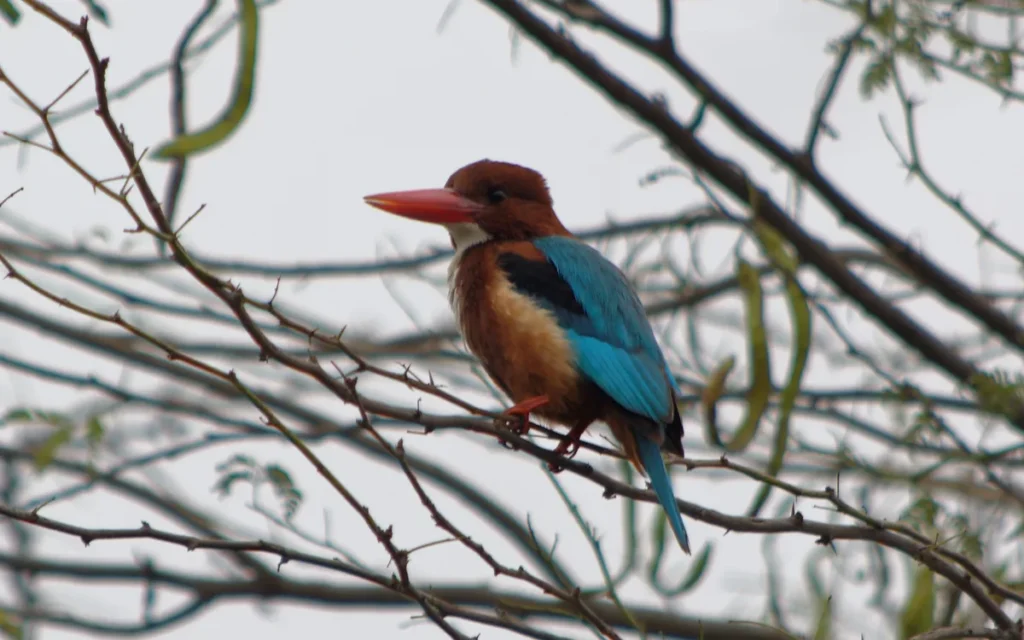
White-throated Kingfisher photo by Slyronit, CC BY-SA 4.0, via Wikimedia Commons; cropped and converted to WebP.

Written by Ashvinee Nagle
I travel India slowly and write it down honestly - practical guides and real itineraries from someone who lives here.
About Ashvinee →Plan your India trip with us
Get one short, honest India travel guide a week — plus a free 7-day Rajasthan itinerary to start.
Free. Unsubscribe any time.