
A slow monsoon weekend in Satara’s waterfall country
Thoseghar, Vajrai and the Chalkewadi windmills come alive for barely three months a year. This is how to do the Sahyadri’s loudest, greenest corner without rushing it.
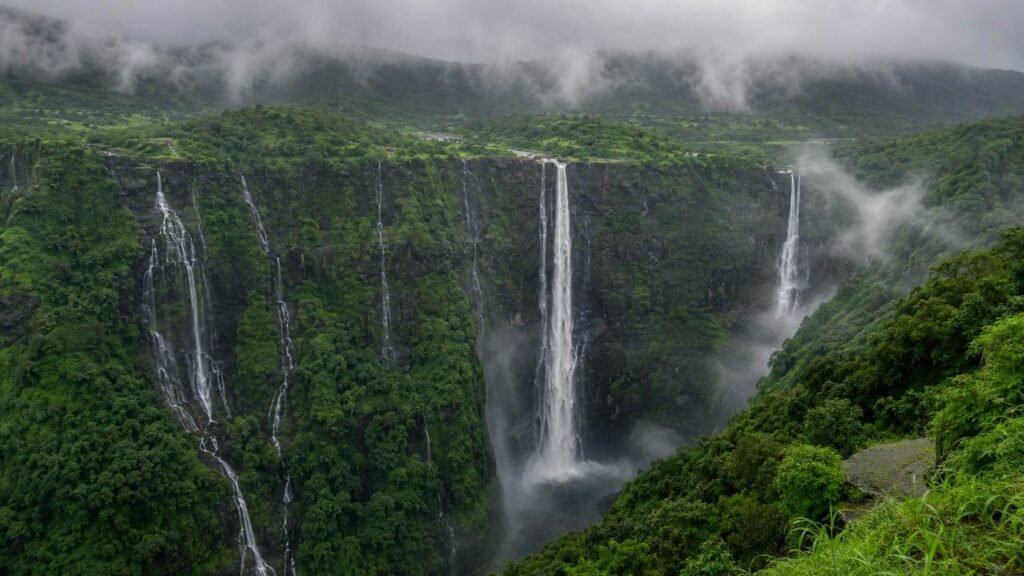
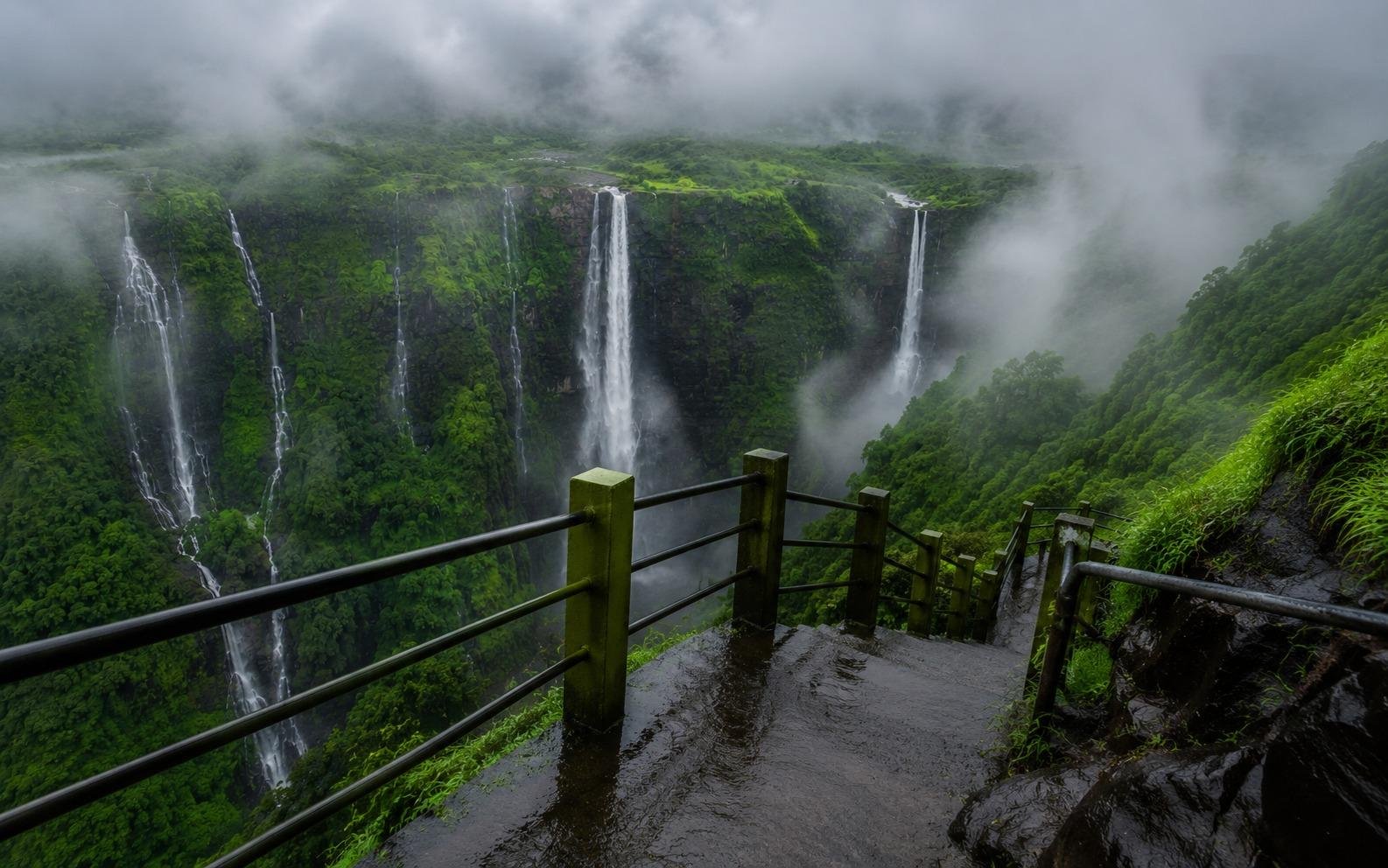
Thoseghar is a place that keeps a secret for nine months of the year. Turn up in December, as many first-timers do on their way to Mahabaleshwar, and you’ll find a tidy set of viewing platforms looking out over a quiet green gorge with a thin ribbon of water in it — pleasant, but you’ll wonder what the fuss is about. Come back in the middle of the monsoon and the same gorge is a wall of noise: half a dozen waterfalls at once, the tallest dropping some 200 metres, mist rolling up over the railings, and the whole Sahyadri escarpment running with water. This is a monsoon destination in the purest sense. The rain is not a thing to plan around here — it is the entire point.
Thoseghar Falls sits about 20 km from Satara, roughly 140 km from Pune and 260 km from Mumbai, and is worth the drive only in the monsoon — July to September, when the falls are in full roar. Base yourself in Satara, keep a private vehicle, and build a loose loop around Thoseghar, the Chalkewadi windmill plateau, Vajrai Falls and Sajjangad fort. Start early, respect the railings, and don’t try to swim. Two days is plenty; one long day is doable from Pune if you leave before dawn.
Why Thoseghar
Satara sits in a fold of the Western Ghats where the escarpment is especially steep and especially wet, and the result is one of the densest concentrations of good monsoon waterfalls anywhere in Maharashtra. Thoseghar is the headline act — a series of falls tumbling into a deep forested gorge, viewed from a set of well-built platforms and walkways that let families and older travellers get right up to the edge of the spectacle without any real trekking. A short distance away, Vajrai lays claim to being India’s tallest plunge waterfall, and the Chalkewadi plateau above turns into a surreal landscape of mist, wind turbines and standing water.
What makes the area special is that it rewards slowness in a way the marquee hill stations nearby do not. Mahabaleshwar and Panchgani, an hour or two away, get the crowds and the traffic. Satara’s waterfall country stays comparatively quiet, especially on weekday mornings, and it is small enough that you never spend the day driving. You can stand at Thoseghar for an hour watching the water, drive twenty minutes to a windmill plateau in the clouds, and still be back in Satara for a hot lunch. It is a compact, forgiving, deeply atmospheric monsoon weekend — if you go at the right time.
Waterfalls at full roar
A cluster of falls in one gorge, the tallest around 200 m, plus Vajrai’s three-tiered plunge nearby — all at their fiercest in July and August.
Built for viewing, not trekking
Thoseghar’s platforms and walkways mean the best views need no boots. It’s one of the more family-friendly waterfall spots in the Sahyadris.
Mist and windmills
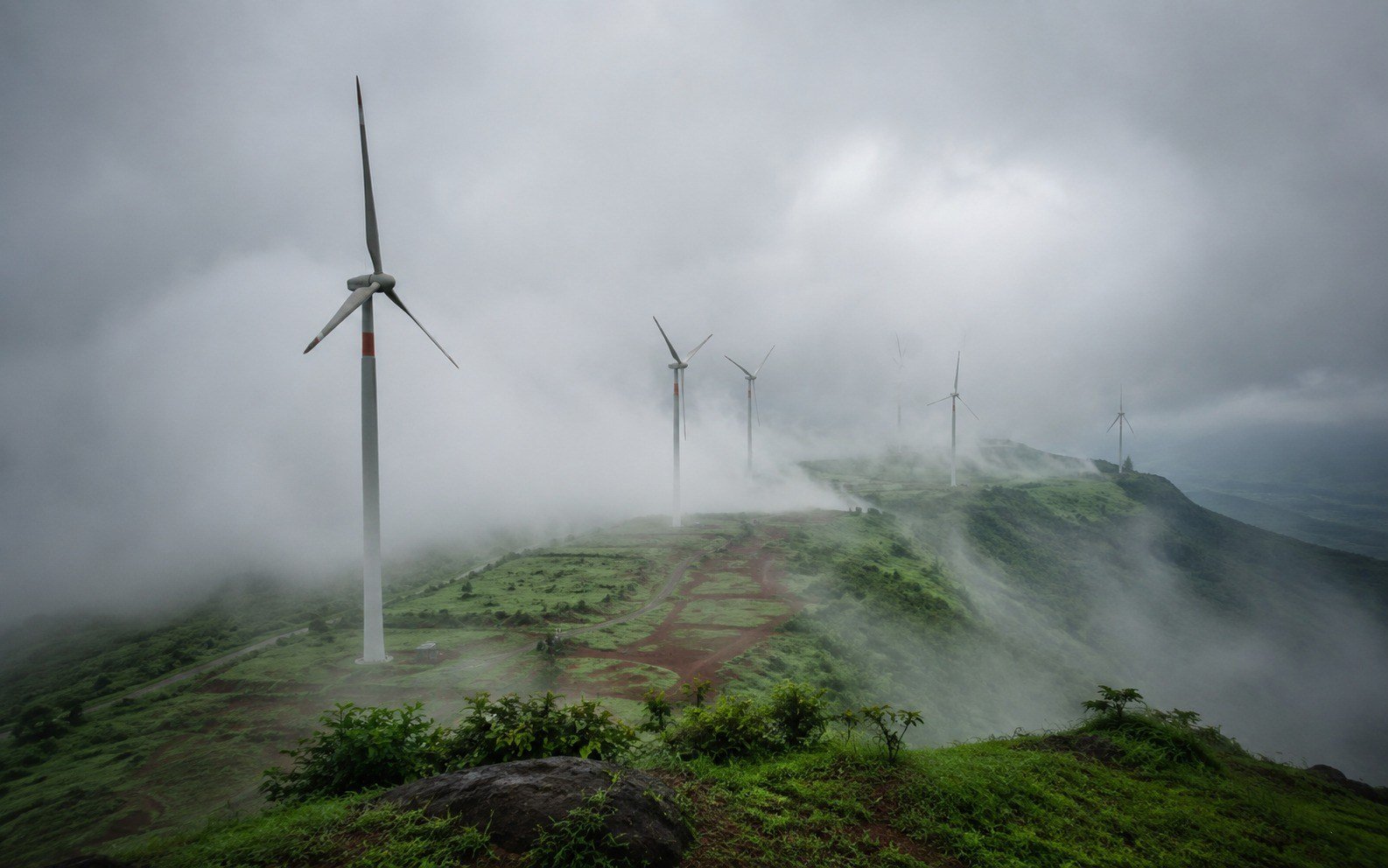
The Chalkewadi plateau above the falls is a low-cloud, turbine-studded landscape that feels otherworldly in heavy monsoon.
When to go
This is the rare guide where the timing advice is blunt: go in the monsoon or don’t bother. The falls at Thoseghar and the plateau at Chalkewadi are seasonal in the truest sense, and outside the rains there is little water to see. July through September is the window, with July and August the peak for sheer volume and drama. The hills are saturated green, the falls are thunderous, and the mist is near-constant.
Late September into October brings a different reward: as the heaviest rain eases, the nearby Kaas Plateau — Maharashtra’s UNESCO-listed “valley of flowers” — bursts into bloom for a four-to-six-week window. If flowers interest you more than full-volume falls, that’s a separate trip worth planning around (it needs advance online booking and has daily visitor caps). But for the waterfalls at their most powerful, aim squarely at July and August. Avoid the dry months entirely: from roughly November to May the falls thin to a trickle and the whole reason to come evaporates.
Peak monsoon means fierce flow and slick rock. Authorities keep the Thoseghar platforms railed and supervised for exactly this reason, and access can be restricted on the wildest-weather days. Check conditions before setting out if a big spell of rain is forecast, and never step past a barricade for a photo.
The drive up
Satara is the hub for all of this, sitting right on the Mumbai–Pune–Bengaluru highway, and everything worth seeing is within about 30 km of the city. From Pune it’s an easy highway run; from Mumbai it’s a longer haul that’s better split over two days.
~140 km · 2.5–3 hours
Straight down the highway to Satara, then ~20 km on smaller roads up to Thoseghar. The easiest approach by far.
~260 km · 5–6 hours
Via the expressway and highway to Satara. Long enough that an overnight makes far more sense than a day trip.
Rail & air
Satara has its own railway station (~26 km from the falls). Nearest airport is Pune International.
Private vehicle only
Chalkewadi and the falls aren’t served by state buses. You’ll want your own car or a hired one from Satara, and a full tank.
The road from Satara climbs through Parali toward the escarpment, getting narrower and greener as you go. The final stretch up onto the Chalkewadi plateau runs right along the cliff edge in places, with big drops and, in heavy monsoon, thick cloud. The tarmac is decent but the visibility is not, so this is a drive to take slowly.
The plateau roads are cliff-edge and often fogbound in peak monsoon. Fuel stations thin out badly once you leave Satara, so fill up in the city. Drive slowly, keep headlights on, don’t overtake on the narrow plateau stretches, and avoid being up there after dark.
The best monsoon stops
The beauty of the Satara cluster is how close together it all is. You can comfortably see the three big stops below in a single unhurried day, with time to just stand and watch the water. Here they are in the order that makes for the easiest loop.
Thoseghar FallsThe main event
The reason you came. A cluster of falls dropping into a deep gorge, seen from a network of platforms and walkways — a short, easy stroll of roughly a kilometre in total gets you the various viewpoints, including the gallery for the big fall (the Motha Dhabdhaba). There’s a small entry fee, usually cash only. Go early: by late morning on a weekend the platforms fill up and the peace goes with the crowd.
Chalkewadi windmill plateauOtherworldly
About 6 km on from Thoseghar, one of Asia’s largest wind farms sprawls across a high, open plateau. In clear weather it’s hundreds of turbines over rolling green hills; in heavy monsoon it’s a moody, cloud-wrapped landscape where the blades appear and vanish in the mist. On a good day you can see Thoseghar’s falls from points along the plateau. Access is private-vehicle only.
Vajrai FallsTake care
Near Bhambavli village, on the far side of the Kaas plateau, Vajrai is a three-tiered plunge often described as India’s tallest, and unlike Thoseghar it flows year-round (it’s the source of the Urmodi river). You can view it from a distance easily; the roughly 500 m trek to its base is genuinely risky in monsoon — slippery rock, deep pools, and leeches — and swimming is prohibited because of the deep water. Admire it, photograph it, but don’t get reckless at the base.
Lesser-known detours worth your time
If you have a full second day, or you simply want to slow the trip down further, two nearby stops round out the area without adding much driving.
Sajjangad Fort
Just a few kilometres from Thoseghar, this hilltop fort is the final resting place of the saint Samarth Ramdas and a working pilgrimage site, reached by a couple of hundred steps (or largely by vehicle). In the monsoon the fort floats in and out of cloud, and the views over the Urmodi valley and Sajjangad’s own reservoir are lovely. It’s a calm, contemplative counterpoint to the roar of the falls.
Kaas Plateau — for a return trip
Worth flagging even though it’s not a peak-monsoon stop. From roughly mid-September to mid-October the Kaas Plateau, ~25 km from Satara, blooms with hundreds of wildflower species — a UNESCO-listed spectacle. It has a strict system: online booking on the official site (kas.ind.in), a per-person entry fee, and a daily visitor cap split into time slots. If the flowers tempt you, plan it as its own autumn trip rather than squeezing it into a July waterfall weekend.
Where to eat: local and roadside food
Satara city has the sit-down options; up near the falls it’s simple roadside fare, and in the monsoon that’s exactly what you want. Come hungry for hot, fried, local things eaten in the drizzle.
- Kanda bhaji and hot chai. The universal Sahyadri monsoon ritual — crisp onion fritters and cutting chai from the stalls near the Thoseghar entrance and along the plateau roads.
- Zunka bhakri and pithla bhakri. Rustic Maharashtrian plates of spiced gram-flour with jowar or bajra flatbread — simple, warming village food, ideal after a cold wet morning at the falls.
- Vada pav and misal pav. Reliable fuel everywhere in and around Satara, and a proper Satara misal is worth seeking out in the city.
- Satara’s kandi pedha. The city is locally famous for this milk-based sweet — a good thing to carry home from a stop in town.
- Agri-tourism thalis. Several farm stays around Thoseghar and Chalkewadi serve unlimited home-style Maharashtrian thalis to day visitors — a fuller, sit-down option near the falls.
Where to stay for a peaceful weekend
Satara city is the practical base, with the widest range of hotels and the easiest logistics. For something closer to the falls and quieter, the agri-tourism farm stays up near Thoseghar and Chalkewadi are the slow-travel pick.
Satara city hotels
The most convenient choice — a solid range of mid-range hotels, easy food and fuel, and a short drive to every stop. Best if you want reliability over atmosphere.
Thoseghar / Chalkewadi agri-stays
Family-run farm stays near the falls with home-cooked thalis and quiet, misty nights. The pick for waking up close to the waterfalls and beating the crowds.
Panchgani / Mahabaleshwar
If you want to pair the falls with a hill-station stay, these are an hour-plus away — more polished, more crowded, and a longer daily drive to Thoseghar.
Wherever you stay, book ahead for monsoon weekends and confirm backup power — supply can be patchy on the plateau in heavy rain. If you choose a farm stay, check recent reviews and confirm they can cater meals on the days you’re visiting.
A suggested slow itinerary
Two days is the comfortable length from Pune or Mumbai; the waterfalls themselves are a single unhurried day, and the second day lets you slow down rather than rush. Here’s the loose shape.
Drive to Satara
From Pune, an easy evening run gets you into Satara in under three hours. From Mumbai, this is your main travel day. Check in, eat a proper Satara misal or a farm-stay thali, and turn in early — tomorrow starts before the crowds do.
Falls, plateau and fort
Leave at first light for Thoseghar — the platforms are near-empty and the morning mist is at its best. Mid-morning, drive up to the Chalkewadi windmills. Loop back for a long lunch, then take in Sajjangad fort or a distant look at Vajrai in the softer afternoon light. Keep it loose; this is a day for lingering, not ticking off.
One last look, then home
A slow morning — a second, quieter visit to Thoseghar if the falls stole your heart, or a relaxed breakfast before the drive. Pick up some Satara kandi pedha for the road, and aim to clear the ghats and be home before the Sunday-evening traffic builds.
Practical tips that actually help
Go on a weekday if you can
Thoseghar’s platforms get genuinely crowded on monsoon weekends. A weekday morning is a completely different, far quieter experience.
Raincoat, not umbrella
The wind on the plateau and at the falls makes umbrellas useless. A proper raincoat or poncho keeps you dry and your hands free.
Stay behind the railings
The flow is fierce and the rock is slick. The platforms exist so you don’t have to take risks — and swimming at Vajrai is prohibited for good reason.
Carry cash
The Thoseghar entry fee and roadside stalls are cash-first, and the network drops on the plateau. Keep small notes handy.
Fuel up in Satara
Petrol pumps thin out fast once you head for the falls. Fill the tank in the city before you climb.
Watch for leeches
If you trek toward Vajrai’s base, the wet forest has plenty of leeches. Closed shoes, socks, and a bit of salt or repellent help.
Planning a Maharashtra monsoon trip?
I help travellers plan slow, well-paced India trips that get the seasons, distances, and logistics right — including monsoon escapes like Thoseghar, Tamhini, Malshej and the Sahyadri forts. Free 48-hour reply.
Plan my India trip →FAQs about Thoseghar & Satara’s waterfalls
When is the best time to visit Thoseghar?
July to September, during the monsoon, is the only time really worth going. The falls are at full volume in July and August. Outside the rains — roughly November to May — they slow to a trickle and there’s little to see.
Can I do Thoseghar as a day trip from Pune?
Yes, at about 140 km each way it’s a doable long day if you leave before dawn and start at the falls early. But an overnight in Satara is far more relaxed and lets you catch the best early-morning mist. From Mumbai (~260 km), a day trip is too rushed — stay over.
Is there an entry fee at Thoseghar?
Yes, a small per-person entry fee is charged to maintain the platforms and walkways, and it’s usually cash only. It’s modest — carry small notes, as card and UPI aren’t reliable up there.
Is it safe? Can I swim at the waterfalls?
The Thoseghar viewing platforms are well built and supervised, and safe as long as you stay behind the railings. Swimming is not the point here — the flow is fierce, the rock is slippery, and at Vajrai swimming is outright prohibited because of deep pools. Don’t step past barricades for photos.
How does Thoseghar fit with the Kaas Plateau flowers?
They’re close (both near Satara) but peak at different times. Thoseghar is best in July–August for full-flow falls; the Kaas bloom runs roughly mid-September to mid-October and needs advance online booking with daily visitor limits. Treat the flowers as a separate autumn trip rather than combining them with peak-monsoon waterfalls.
Do I need my own vehicle?
Effectively yes. Satara is well connected by road and rail, but the falls, Chalkewadi and Vajrai aren’t served by regular state buses. A private or hired vehicle from Satara is by far the easiest way to link the stops.
More slow monsoon weekends
If Sahyadri monsoon country is your thing, these companion guides cover more of it at the same unhurried pace.
A slow weekend at Tamhini Ghat
The green Mulshi–Tamhini corridor within an hour of Pune — waterfalls, mist and lake country. Read the guide →
Maharashtra · MonsoonA slow weekend at Malshej Ghat
Flamingos, waterfalls and misty forts on the classic Kalyan–Ahmednagar ghat, done the slow way. Read the guide →

Written by Ashvinee Nagle
I travel India slowly and write it down honestly - practical guides and real itineraries from someone who lives here.
About Ashvinee →Plan your India trip with us
Get one short, honest India travel guide a week — plus a free 7-day Rajasthan itinerary to start.
Free. Unsubscribe any time.