
Travel to Spiti Valley: A First-Timer’s Guide to Himachal’s High Desert
A practical, no-fluff guide to Spiti for first-time visitors — when to go, which route to take, the great monasteries, the high villages, Chandratal, altitude and acclimatisation, where to stay and eat, and a realistic circuit plan.
Spiti is the Himalayas stripped to bare rock and big sky. A cold, high-altitude desert wedged between Kinnaur and Ladakh, it sits above 3,500 metres for most of its length — a moonscape of ochre cliffs and braided rivers, dotted with whitewashed monasteries a thousand years old and villages that count among the highest inhabited places on earth. It’s the most remote, most rewarding journey in Himachal, and unlike anywhere else in the state.
Spiti is a high-altitude cold desert in eastern Himachal, a world of ancient monasteries and tiny villages above 3,500 m. Give it six to eight days as a circuit — Key and Tabo monasteries, the high villages of Langza, Komic and Hikkim, and the lake at Chandratal — basing yourself in Kaza. It’s summer-only (June to September), and best reached gently via the Shimla–Kinnaur road. See how it fits the wider Himachal map.
Why visit Spiti Valley
Three reasons Spiti is worth the long, high journey — and why those who make it tend to call it their best trip in India.
A high-altitude moonscape
Spiti is cold desert at the scale of Ladakh but far less travelled — ochre and grey mountains, glacier-fed rivers and a thin, clear light. Driving through it feels like crossing onto another planet.
Thousand-year-old monasteries
Tabo, founded in 996 AD, holds murals often called the “Ajanta of the Himalayas”; Key clings to a crag above the river; Dhankar perches on a cliff edge. These are living centres of Tibetan Buddhism, not museums.
The highest villages on earth
Komic, Langza and Hikkim sit around 4,500 m, home to the world’s highest post office, fossil-strewn hillsides and some of the darkest, most star-filled night skies you’ll ever stand under.
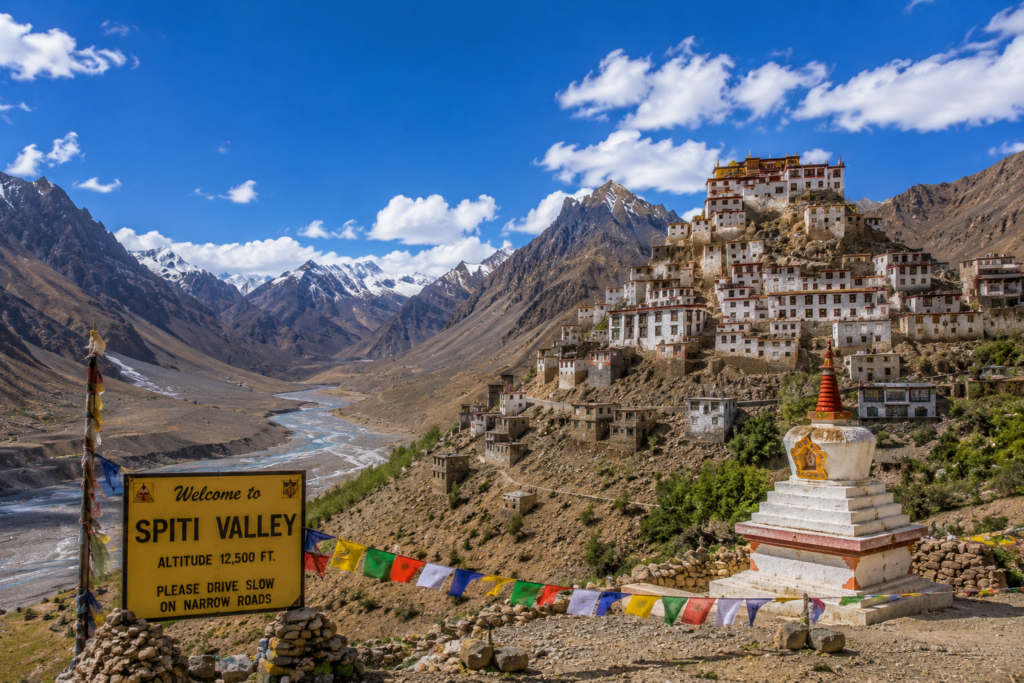
The cold desert of Spiti — ancient monasteries under an enormous sky.
When to go
June to September (the season): the only realistic window. The Manali–Kunzum road is open, days are mild, and the high villages and Chandratal are all reachable. July–August can bring landslides on the Kinnaur side, so build in buffer days.
May & October (shoulder): the Kinnaur route may be open while the Manali pass is still shut or already closing. Colder, quieter and riskier on timing — for flexible, experienced mountain travellers only.
October to May (winter): Spiti effectively closes. The Kunzum Pass is snowbound, only the long Kinnaur road reaches Kaza, and temperatures plunge far below freezing. Winter Spiti is a serious expedition, not a first trip.
Altitude is the real planning factor here. Acclimatise by gaining height slowly — sleep at Kalpa and Tabo before Kaza — and never rush from Manali straight to the high villages. Altitude sickness is common above 4,000 m; carry medication, hydrate, and descend if symptoms worsen.
Top things to do in Spiti Valley
The monasteries, villages and lakes that make up a Spiti circuit — spread over several days and a lot of altitude.
Key Monastery
Spiti’s most photographed sight — a white monastery stacked up a hillside above the river, home to monks for centuries. Visit at dawn for the morning prayers and the best light.
Tabo Monastery
Founded in 996 AD and famous for its 1,000-year-old murals and stucco, often called the “Ajanta of the Himalayas.” Stay overnight in Tabo to help acclimatise on the way up.
Langza, Komic & Hikkim
A cluster of villages around 4,500 m — the giant Buddha at Langza, the high monastery at Komic, and the world’s highest post office at Hikkim, where you can mail a postcard from the roof of the world.
Chandratal
A startling crescent of blue at 4,300 m near the Kunzum Pass, ringed by bare peaks. Camp nearby (seasonal) for the stars, but acclimatise first — it’s high and exposed.
Dhankar Monastery & lake
A monastery balanced dramatically on a spur above the Spiti–Pin confluence, with a short, steep hike up to a quiet high lake behind it. Spiti at its most cinematic.
Pin Valley & Kibber
Detour into the green Pin Valley National Park, or up to Kibber and the Chicham bridge — one of Asia’s highest — with a chance of spotting ibex or, in winter, the elusive snow leopard.
What to eat in Spiti Valley
Food in Spiti is simple, warming and tied to the land — Tibetan and Bhoti staples, barley and seabuckthorn, and whatever the homestay kitchen is cooking that night.
Thukpa & momos
The reliable mountain meal — hot noodle soup and steamed dumplings that taste twice as good in the cold, thin air.
Butter tea & tsampa
Salty butter tea and roasted-barley tsampa are the traditional fuel of the plateau — an acquired taste, but the real thing.
Seabuckthorn juice
Tart, vitamin-packed juice from the orange berries that grow wild along the rivers — Spiti’s signature drink, and good for the altitude.
Home-cooked dal & rice
Most village meals are simple dal, rice and vegetables shared with your host family — wholesome, communal and part of the experience.
Supplies are limited and trucked in over high passes, so menus are short and fresh produce is scarce. Eat what’s cooked locally, carry some snacks, and don’t expect variety beyond Kaza.
Where to stay
Kaza is the hub for hotels and supplies; the real magic is in the village homestays higher up, run through community networks.
Kaza guesthouses
Spiti’s main town, with the most rooms, cafes, fuel and a hospital — the practical base for day trips out to the monasteries and villages.
Village homestays
Simple, warm homestays — many run through community ecotourism networks — that put you in a real Spiti home at altitude. The most memorable nights.
Tabo monastery stay
Guesthouses and the monastery’s own rooms make Tabo a perfect lower-altitude overnight to acclimatise before pushing up to Kaza.
How to get to Spiti Valley & around
Spiti has no airport and no easy way in — it’s reached by two long mountain roads, ideally one in and the other out.
Go up via Shimla and Kinnaur and out via Manali if you can. The Kinnaur side gains altitude gradually, which dramatically lowers your risk of altitude sickness compared with charging straight up from Manali.
A realistic 6–8 day circuit
A realistic loop that acclimatises properly and still sees the best of the valley. Summer only.
Shimla to Kalpa
Drive up into Kinnaur via Narkanda and the Sutlej gorge to Kalpa (around 2,960 m), under the Kinnaur Kailash peaks. A scenic first day that starts the gentle climb.
Kalpa to Tabo
Continue through Reckong Peo and Nako to Tabo, visiting its 996 AD monastery and sleeping at a still-moderate altitude before going higher.
Tabo to Kaza
Stop at cliff-top Dhankar and the green Pin Valley en route to Kaza (3,800 m), Spiti’s hub and your base for the days ahead.
Key, Kibber & high villages
Day-trip from Kaza to Key Monastery, Kibber and the Chicham bridge, then up to Langza, Komic and Hikkim for the giant Buddha and the world’s highest post office.
Chandratal & out to Manali
Cross the Kunzum Pass to camp near Chandratal lake, then descend via the Atal Tunnel to Manali — closing the loop. Add a buffer day for weather or road delays.
Practical tips that actually help
Climb slowly
Gain altitude over several days and sleep low early on. Rushing up is the single biggest mistake here.
Plan for AMS
Carry altitude medication, hydrate hard, skip alcohol on arrival, and descend if symptoms get worse.
Carry plenty of cash
Kaza has the only reliable ATM, and it often runs dry. Bring enough cash for the whole circuit.
Fuel up at Kaza
Kaza has the only petrol pump for a vast area. Tank up fully before any side trips.
Expect no signal
Only BSNL and some Jio work, patchily. Tell people you’ll be offline and download maps in advance.
Pack for all seasons
Sunny afternoons, freezing nights and strong UV — layers, sunglasses and sunscreen are essential.
Mistakes first-time visitors make
- Attempting Spiti in winter as a first trip. Most of it is snowbound and only the long Kinnaur road stays open — leave winter Spiti to experienced expeditions.
- Driving Manali to Kaza in one shot. The altitude jump is brutal; acclimatise via Kinnaur or break the journey over two days.
- Giving it too few days. Distances are short on the map but slow on the ground — six to eight days is the honest minimum.
- Relying on cards and signal. Bring cash and tell people you’ll be off-grid; both ATMs and networks are unreliable.
Planning the Spiti circuit?
Spiti works best as a loop with Shimla, Kinnaur and Manali — timed for summer and paced for altitude. Tell me your dates and comfort level, and I’ll map a Spiti route that acclimatises you safely.
Plan my Himachal trip →Spiti Valley FAQs
When is the best time to visit Spiti Valley?
June to September is the main season, when both routes are usually open, the weather is mild and the high villages and Chandratal are reachable. May and October are riskier shoulder months, and from roughly November to April the valley is snowbound and reachable only via the long Kinnaur road.
Which route should I take into Spiti?
For a first trip, go up via Shimla and Kinnaur and come out via Manali. The Kinnaur side climbs gradually, which helps you acclimatise, while the Manali side over the Kunzum Pass is faster and steeper and only open in summer. Doing one route in and the other out also gives you more to see.
How do you avoid altitude sickness in Spiti?
Gain height slowly and sleep at lower stops like Kalpa and Tabo before reaching Kaza at 3,800 m. Drink plenty of water, avoid alcohol for the first days, carry altitude medication, and descend if symptoms worsen. Avoid driving straight up from Manali to the high villages in one day.
How many days do you need for Spiti?
Plan for six to eight days. Distances look short on a map but the roads are slow and you need time to acclimatise. That length lets you take the Kinnaur route up, base in Kaza for the monasteries and high villages, see Chandratal, and exit via Manali without rushing.
Do you need permits for Spiti Valley?
Indian travellers do not need a permit for the main Spiti circuit via Kinnaur or Manali. Foreign nationals should check current rules, as inner-line permits can apply on certain border stretches. Either way, carry ID, and confirm the latest requirements before you travel as they can change.
Related guides
Keep planning your Himachal trip with these:
Himachal Pradesh Travel Guide
Hill stations, Tibetan towns, Spiti and quiet valleys — how to string Himachal together.
Travel to Manali
The adventure-hub gateway where the Spiti circuit ends — snow, cafes and the Atal Tunnel.
Ashvinee Nagle
I’m Ashvinee — I help first-time travellers plan India trips that actually work. I’ve spent years exploring the country’s regions, from Rajasthan’s forts to the Himalayan valleys of Himachal, and I write the guides I wish I’d had on my own first trips.
Written by Ashvinee Nagle
I travel India slowly and write it down honestly - practical guides and real itineraries from someone who lives here.
About Ashvinee →Plan your India trip with us
Get one short, honest India travel guide a week — plus a free 7-day Rajasthan itinerary to start.
Free. Unsubscribe any time.