
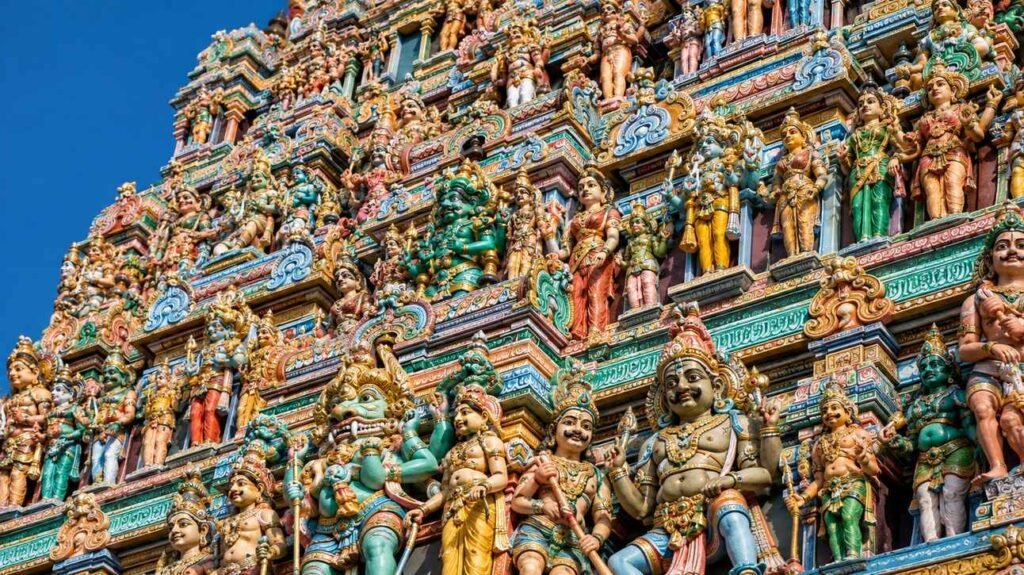
Madurai — The Temple City
One of the oldest continuously inhabited cities on earth, built in concentric rings around the Meenakshi Amman Temple and its fourteen soaring towers.
Why visit Madurai
A living temple, not a monument
Meenakshi Amman has run continuous daily worship for centuries, its fourteen gopurams covered in thousands of painted figures.
2,500 years old
One of the oldest continuously inhabited cities on the planet, and the ancient heart of Tamil culture and Sangam-era literature.
A street-food city
Kari dosa, bun parotta and the jigarthanda that was invented here — Madurai eats late and eats well.
When to go to Madurai
December to February is the comfortable window, with daytime temperatures around 20–30°C. Madurai sits on the hot southern plains, so from April to June it regularly tops 40°C — punishing for temple-hopping on foot.
The city gets the tail of Tamil Nadu’s northeast monsoon in October and November, though less fiercely than the coast. The one time worth planning around deliberately is the Chithirai festival in April: the twelve-day re-enactment of Meenakshi’s celestial wedding, with chariot processions through the streets and lakhs of pilgrims. Spectacular, but book months ahead and expect heat and crowds together.
Mobile phones and cameras are banned inside Meenakshi Amman Temple, following a Madras High Court order. There are lockers at the entrance, but it is simpler to leave them in your hotel or car. Security screening is strict.
Top things to do in Madurai
Meenakshi Amman Temple Do not miss
The reason Madurai exists. Fourteen gopurams, a thousand-pillared hall, the golden lotus tank, and the shrines of Meenakshi and Sundareswarar at its heart. Go at opening, around 5am, for the calm before the crowds. The temple closes midday and reopens at 4pm.
The 9pm night ceremony
Every evening the image of Sundareswarar (Shiva) is carried in a silver palanquin to Meenakshi’s bedchamber for the night, accompanied by drums, pipes and lamplight. The Palliyarai ceremony around 9pm is the most atmospheric thing in the city — and unlike the wedding, it happens every single night.
Thirumalai Nayakkar Mahal
A 17th-century palace of vast pillared courtyards in a hybrid Dravidian-Islamic style, of which only a quarter survives. The scale of the surviving Celestial Pavilion still stops people in their tracks. There is a sound-and-light show in the evenings.
Gandhi Memorial Museum
Housed in the old Tamukkam Palace, and the only Gandhi museum in South India. Its most affecting exhibit is the blood-stained dhoti Gandhi was wearing when he was assassinated in 1948 — and it was in Madurai that he first adopted the dhoti in 1921.
Puthu Mandapam bazaar
A 17th-century pillared hall right beside the temple’s east gate, now packed with tailors, silk and cotton sellers and souvenir stalls. The carved pillars overhead are as good as anything in the palace; the tailors will run up a shirt in hours.
Thiruparankundram
A rock-cut cave temple 8km from the city, one of the six sacred abodes of Lord Murugan, cut into a hillside. Quieter and older-feeling than the great temple, and an easy half-day out.
Vandiyur Mariamman Teppakulam
An enormous 17th-century temple tank with an island shrine at its centre, fed by underground channels from the Vaigai. It is best in January–February during the Float Festival, when illuminated deities are paraded across the water on rafts.
What to eat in Madurai
Madurai is the street-food capital of Tamil Nadu, shaped by the Saurashtrian silk-weavers who settled here and by a temple culture that keeps the messes open late. Eat where the queue is.
Kari dosa
A dosa layered with spiced minced mutton and egg — Madurai’s own. Simmakal Konar Mess is the name everyone cites.
Jigarthanda
Invented here: milk, almond gum, nannari (sarsaparilla) syrup and ice cream. The name means ‘cool heart’. Try it near the temple.
Bun parotta with mutton
Soft, fried bun-shaped parotta soaked in salna or mutton curry. The city’s classic midnight meal.
Idli and paruthi paal
Famously soft idlis at Murugan Idli Shop — the chain started in Madurai — and cottonseed milk, a local specialty.
Where to stay in Madurai
Around the temple
Dozens of clean pilgrim hotels within walking distance of the east gate — the sensible choice for early darshan and the night ceremony.
West Perumal Maistry Street
Mid-range hotels, several with rooftop restaurants that look straight onto the floodlit gopurams at night.
Outside the centre
A few restored bungalows and resort-style stays on the edges of the city, quieter but a drive from the temple.
Town Hall Road
Simple, cheap lodges close to the station and the bus stands, handy for onward travel.
How to get to Madurai & around
Best day trips from Madurai
Kodaikanal
The nearest hill station: cliff walks, a star-shaped lake and cool air. Needs a free e-pass for private vehicles.
Chettinad
Mansion villages around Karaikudi and the famous fiery Chettinad cuisine. Doable as a long day, better overnight.
Rameswaram
Island temple town and the new Pamban sea bridge. Better as an overnight than a day trip.
A simple 1-day Madurai plan
The great temple
Meenakshi Amman at opening, before the heat. Then the palace and the Gandhi Museum before the midday temple closure.
From 5am
Bazaar & night ceremony
Puthu Mandapam and the temple streets, kari dosa for dinner, then back to Meenakshi Amman for the 9pm palanquin ceremony.
From 5pm
Practical tips that actually help
No phones inside
Phones and cameras are banned in the temple. Lockers exist, but leaving them behind is simpler.
Dress modestly
Shoulders and knees covered; no shorts. Footwear comes off at the gate.
Come back at night
The temple is a different, quieter place after dark. The 9pm ceremony is the highlight.
Mind the midday closure
The temple shuts around 12:30pm and reopens at 4pm. Plan the museum and palace for that gap.
Mistakes first-time visitors make
- Turning up at 11am and finding the temple about to close for the afternoon.
- Carrying a phone to the gate and losing half an hour to the locker queue.
- Seeing the temple by day and skipping the far better night ceremony.
- Booking April for the Chithirai festival without booking a hotel months ahead.
- Rushing through in a morning. Madurai deserves a night as well as a day.
Planning Tamil Nadu beyond Madurai?
Madurai anchors the deep south and pairs naturally with Chettinad, Rameswaram and the hill station of Kodaikanal.
Madurai FAQs
What is Madurai famous for?
The Meenakshi Amman Temple above all — a vast, living Dravidian temple with fourteen painted gopurams — plus being one of the oldest continuously inhabited cities on earth, and its street food, including kari dosa and jigarthanda.
How many days do you need in Madurai?
One full day and a night covers the temple, the palace, the Gandhi Museum and the food. A second day lets you add Thiruparankundram or a trip out to Chettinad or Kodaikanal.
Can you take a phone into Meenakshi Amman Temple?
No. Mobile phones and cameras are banned inside, following a Madras High Court order. Lockers are available at the entrance, but it is easier to leave them at your hotel.
What is the dress code for Meenakshi Amman Temple?
Modest dress with shoulders and knees covered; no shorts for men. Footwear is removed at the gate. Traditional Indian attire is welcomed but not required.
What is the best time to visit Madurai?
December to February for the mildest weather. April to June is very hot; the northeast monsoon brings some rain in October and November. The Chithirai festival in April is spectacular but hot and extremely crowded.
How do I get from Chennai to Madurai?
By overnight train or a short domestic flight; the two are around 460km apart. Madurai Junction is well connected by rail, and the airport has regular flights from Chennai and Bengaluru.
Related guides
Tamil Nadu Travel Guide
Temples, hill stations, Chola bronze and the Coromandel coast.
Chennai Travel Guide
The gateway city: Mylapore, the Marina and the best breakfast in India.

Written by Ashvinee Nagle
I travel India slowly and write it down honestly - practical guides and real itineraries from someone who lives here.
About Ashvinee →Plan your India trip with us
Get one short, honest India travel guide a week — plus a free 7-day Rajasthan itinerary to start.
Free. Unsubscribe any time.