
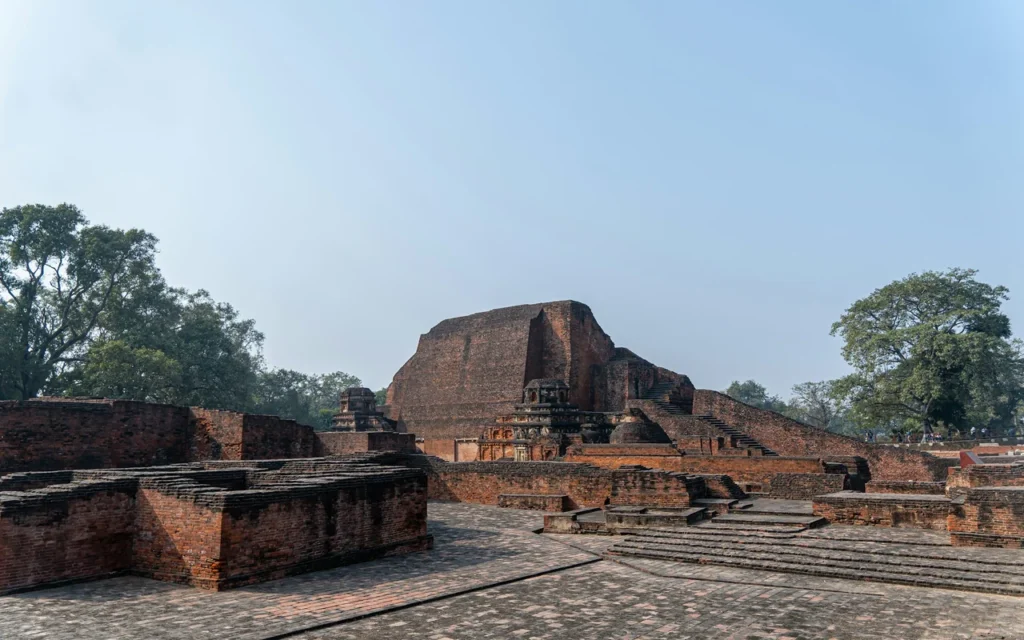
Nalanda: The Ruins of the Ancient University
A practical guide to Nalanda — the red-brick ruins of the Mahavihara that taught for seven centuries, the UNESCO World Heritage site, the archaeological museum and Xuanzang hall, and how to visit it from Rajgir or Patna in Bihar.
Nalanda was the greatest university of the ancient world — a vast residential Mahavihara in what is now central Bihar, where as many as ten thousand students from across Asia studied Buddhist philosophy, logic, grammar, medicine and astronomy for some seven centuries, long before Oxford or Bologna existed. Sacked in the late 12th century and lost for hundreds of years, it survives as a magnificent field of red-brick monasteries, lecture halls and stupas, a UNESCO World Heritage Site that you walk rather than simply look at. It is the intellectual heart of a Bihar trip.
Nalanda, in central Bihar near Rajgir, is the ruined Mahavihara — a residential Buddhist university that flourished from around the 5th to the 12th century. The red-brick ruins of monastic cells, lecture halls and stupas are a UNESCO World Heritage Site, best paired with the excellent Nalanda Archaeological Museum and the Xuanzang Memorial Hall nearby. A half-day covers it; combine it with Rajgir and Pawapuri on a Bihar trip.
Why visit Nalanda
Three reasons the ruins of Nalanda belong on every Bihar itinerary.
The world’s first great university
Nalanda taught for roughly 700 years and drew scholars from China, Korea, Tibet and across Asia. Standing among its ruins is standing in the place where much of classical Buddhist learning was shaped — history you can feel underfoot.
Ruins you walk through
Unlike a single monument, Nalanda is a sprawling excavated campus — rows of monastic cells, staircases, wells, lecture halls and votive stupas in warm red brick. The sheer scale only lands when you walk it.
Museum and memory
The Nalanda Archaeological Museum next door holds the bronzes, seals and sculptures recovered from the site, and the Xuanzang Memorial Hall honours the Chinese pilgrim-scholar who studied and wrote about Nalanda in the 7th century.
When to go
Nalanda is an open, largely shadeless archaeological site, so time your visit for comfort.
October to March (the season): cool and pleasant, ideal for walking the ruins. The best window, and it lines up with the wider Bihar circuit season.
April to June (hot): very hot and exposed across the open brick field. If you come then, go early and carry water and sun cover.
July to September (monsoon): the surrounding country greens up and the brick glows after rain, but paths can be wet and humid.
Things to do at Nalanda
The excavated ruins are the main event; the museum and the nearby memorials complete a half-day.
The Nalanda ruins
The excavated Mahavihara — monasteries (viharas) of monastic cells around courtyards, the great Temple 3 stupa with its stucco Buddhas, lecture halls and wells. Give yourself a couple of hours to walk it; a guide brings the campus to life.
Nalanda Archaeological Museum
The ASI museum opposite the ruins displays the bronzes, stone sculptures, seals and everyday objects dug from the site — the finds that turn the bare brick into a living university.
Xuanzang Memorial Hall
A short distance away, this hall honours Xuanzang (Hiuen Tsang), the 7th-century Chinese monk whose account of his years at Nalanda helped archaeologists identify and understand the site.
Nalanda University & Silao
The revived Nalanda University has a modern campus near Rajgir, continuing the name. On the road, the town of Silao is famous across Bihar for khaja, a flaky layered sweet — a good edible souvenir.
What to eat
Food around Nalanda is simple and local — eat in Rajgir, or grab the famous Silao sweet on the way.
Veg thali
Simple North Indian vegetarian meals and tiffins at modest restaurants near the site and in nearby Rajgir are your main options; there’s little at the ruins themselves.
Silao khaja
The town of Silao, between Nalanda and Rajgir, is famous for khaja — a crisp, flaky, multi-layered sweet soaked in syrup. Buy a box from a roadside shop; it’s the local speciality.
Water & snacks
The ruins are open and shadeless with few stalls. Carry water, a snack and sun cover, especially outside winter.
Dry state
Bihar is a dry state — alcohol is prohibited across it, so plan meals accordingly.
Where to stay
Most people visit Nalanda as a half-day trip and stay in Rajgir or Patna rather than at the ruins.
Rajgir
Rajgir, about 12 km away, has the handiest cluster of hotels — government (Tourism) properties, mid-range hotels and resorts — and lets you pair Nalanda with Rajgir’s own sights and Pawapuri.
Patna
Patna, about 90 km away, has the widest hotel range and the best transport links, and works as a base if you’re doing Nalanda and Rajgir as a long day out from the capital.
Getting there and around
From Patna: Nalanda is about 90 km south-east, roughly 2.5 hours by road — a comfortable day trip combined with Rajgir, or a stop en route between Patna and Bodh Gaya.
From Rajgir: only about 12 km away, so Nalanda and Rajgir are almost always visited together; there is also a Nalanda railway station on the Rajgir branch line.
Getting around: the ruins, museum and Xuanzang hall are close together and walkable once you arrive, but you’ll want a car with a driver or an auto to link them with Rajgir and Pawapuri.
Nalanda, Rajgir and Pawapuri form one tight cluster — most visitors do all three in a day or two from a base in Rajgir. Nalanda is best as a half-day within that.
A half-day plan
Half a day covers the ruins, the museum and the Xuanzang hall, leaving the rest of the day for Rajgir.
Ruins, museum and memorial
Arrive in the cool morning and spend a couple of hours walking the Nalanda ruins, ideally with a guide. Cross to the Archaeological Museum for the finds, then the Xuanzang Memorial Hall. Pick up Silao khaja on the road and continue to Rajgir for the afternoon.
Practical tips that actually help
Hire a guide
The ruins are vast and unlabelled in places. A good local guide turns the bare brick into a living university — well worth it for a couple of hours.
Go early
The site is open and shadeless. Morning light is best for photos and the coolest time to walk the campus.
Don’t skip the museum
The Archaeological Museum opposite holds the sculptures and bronzes that give the ruins meaning. It’s a short, rewarding visit.
Buy Silao khaja
On the Nalanda–Rajgir road, Silao is famous for its flaky khaja sweet. Grab a box — it’s the local speciality and travels well.
Check the closing day
Like many ASI sites and museums, parts can close on a weekly off-day. Check before planning a tight day trip around it.
Carry water & sun cover
There’s little shade or shopping at the site. Bring water, sun cover and a snack, especially outside the winter months.
Mistakes first-time visitors make
- Seeing the ruins without a guide. Much of Nalanda is unlabelled. Without context it’s just brick; with a guide it’s the greatest university of its age.
- Skipping the museum. The Archaeological Museum holds the finds that explain the site. It’s a short walk and makes the ruins make sense.
- Doing Nalanda alone. It’s 12 km from Rajgir and close to Pawapuri. Visiting one without the others wastes the trip out here — plan the cluster together.
- Coming in peak summer midday. The open brick field bakes. Walk it in the cool morning, in the October–March season.
Planning Nalanda into a Bihar trip?
Nalanda, Rajgir and Pawapuri make one perfect cluster. Tell me your dates and I’ll build it into a Bihar route with Bodh Gaya and Patna.
Nalanda FAQs
What was Nalanda famous for?
Nalanda was one of the world’s first great residential universities — a Buddhist Mahavihara in Bihar that taught philosophy, logic, medicine and more for roughly seven centuries, drawing thousands of students from across Asia until it was destroyed in the late 12th century.
Is Nalanda a UNESCO World Heritage Site?
Yes. The archaeological ruins of Nalanda Mahavihara were inscribed as a UNESCO World Heritage Site in 2016, recognising the excavated monasteries, temples and stupas of the ancient university.
How do you reach Nalanda?
Nalanda is about 90 km (2.5 hours) from Patna and only about 12 km from Rajgir, which is the most convenient base. There is a Nalanda railway station on the Rajgir branch line, and most visitors come by car or on a Rajgir–Nalanda–Pawapuri day trip.
How much time do you need at Nalanda?
About half a day covers the ruins, the Archaeological Museum and the Xuanzang Memorial Hall. Combine the rest of the day with Rajgir, 12 km away.
What is the best time to visit Nalanda?
October to March, when the weather is cool and comfortable for walking the open, shadeless ruins. Avoid the fierce April–June heat; the monsoon greens the surroundings but can be humid and wet.
Can you combine Nalanda with Rajgir and Pawapuri?
Yes — they form one tight cluster. Nalanda (ruins and museum), Rajgir (the ropeway, peace stupa and hot springs) and Pawapuri (the Jal Mandir) are easily done over a day or two from a base in Rajgir.
Related guides
Keep planning your Bihar trip with these:
Bihar Travel Guide
Bodh Gaya, Nalanda, Rajgir and Patna — how to put a Bihar Buddhist-circuit trip together.
Rajgir
The ropeway and peace stupa, hot springs and Ghora Katora lake — Nalanda’s natural pairing, just down the road.
Nalanda Mahavihara ruins photo via the Unsplash licence.

Written by Ashvinee Nagle
I travel India slowly and write it down honestly - practical guides and real itineraries from someone who lives here.
About Ashvinee →Plan your India trip with us
Get one short, honest India travel guide a week — plus a free 7-day Rajasthan itinerary to start.
Free. Unsubscribe any time.