
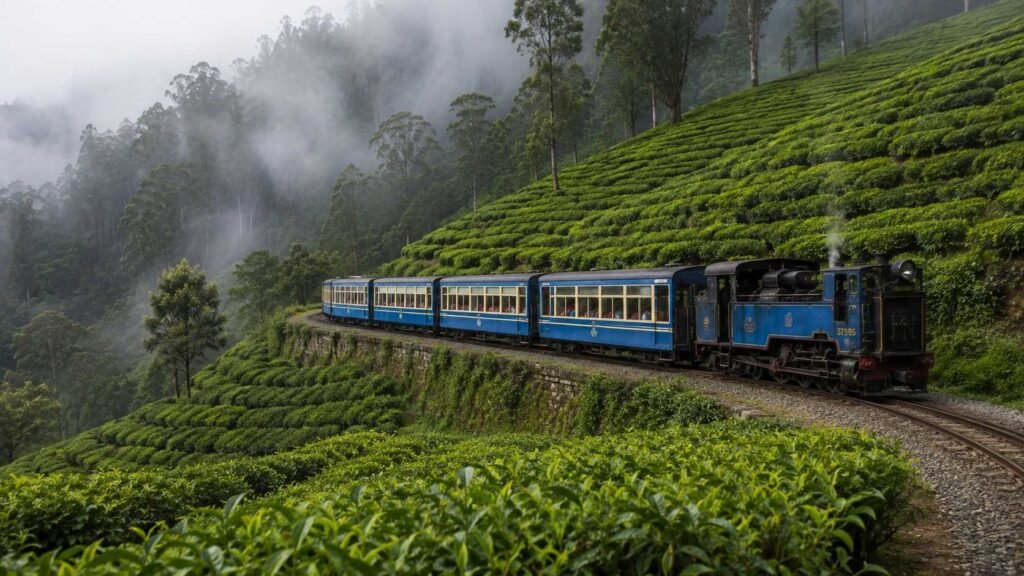
Ooty — The Blue Mountains
Tea slopes, eucalyptus air and a UNESCO-listed rack railway that grinds up from Mettupalayam. Quieter, greener Coonoor makes the better base — and Mudumalai’s elephants are an hour away.
Why visit Ooty & the Nilgiris
A UNESCO toy train
The Nilgiri Mountain Railway climbs from Mettupalayam through Coonoor on a rack-and-pinion track — a World Heritage Site and the best way up the hills.
Tea and cool air
Rolling tea estates, misty mornings and daytime temperatures in the teens — a genuine relief after a week in the hot southern plains.
Elephants an hour away
Mudumalai Tiger Reserve, on the Nilgiri elephant corridor, is one of the most reliable places in the south to see wild elephants.
When to go to Ooty
The Nilgiris are at their best from April to June, exactly when the plains are punishing — this is the classic hot-season escape, with clear skies and cool days around 15–25°C. It is also peak season, so expect crowds and higher room rates.
September to November is quieter and green after the rains, though mornings can be misty. The hills catch both the southwest monsoon (June–August) and the tail of the northeast monsoon, so pack a layer and a light waterproof whatever the month. Winter nights can drop close to freezing.
Private, non-local vehicles driving up into the Nilgiris need a free e-pass with a QR code, issued instantly at epass.tnega.org. Ooty and Kodaikanal require separate applications. Government buses and the mountain railway are exempt. Rules have changed more than once, so check before you set off.
Top things to do in the Nilgiris
Nilgiri Mountain Railway Do not miss
The blue toy train from Mettupalayam to Ooty, via Coonoor, on a steam-hauled rack section. Book the Mettupalayam–Coonoor leg and sit on the left going up for the best of the drops and tea slopes. It fills weeks ahead in season.
Coonoor & the tea estates
Greener and calmer than Ooty, with Sim’s Park, the viewpoints at Dolphin’s Nose and Lamb’s Rock, and estate walks where you can watch tea being picked and processed.
Doddabetta Peak
At 2,637m the highest point in the Nilgiris, with a viewing platform that looks out over the plains on a clear morning. Go early before the cloud rolls in.
Botanical Gardens & Ooty Lake
The colonial-era gardens and the boating lake are the busy heart of Ooty — touristy but pleasant, and the gardens’ old trees and glasshouse are worth an hour.
Mudumalai Tiger Reserve
An hour down the far side of the hills, on the Nilgiri elephant corridor. Morning and evening safaris are the best chance of wild elephants, gaur and deer; tigers are present but rarely seen.
Tea factory & museum
Working factories around Coonoor and Ooty show the full leaf-to-cup process and sell estate tea far better than the roadside stalls. A good rainy-afternoon stop.
Avalanche & the Upper Nilgiris
Beyond the towns, the shola forests and grasslands around Avalanche and Emerald are the quiet, wild Nilgiris — best reached by hired jeep, with permits arranged locally.
What to eat in the Nilgiris
Hill food here is simple and warming — fresh estate tea, Badaga home cooking, and the odd colonial leftover in the old bakeries.
Nilgiri tea
Bright, fragrant high-grown tea straight from the estate — buy it at a factory, not a souvenir stall, for the real thing.
Badaga cuisine
The home cooking of the Nilgiris’ indigenous Badaga community — millet, greens and mild hill curries, served in a few local eateries.
Ooty varkey & homemade chocolate
The flaky varkey biscuit and the town’s many homemade-chocolate shops are an Ooty tradition, however touristy.
Maggi & hot bajji at a viewpoint
The universal hill-station snack — a plate of onion bajji and a hot instant noodle at a misty lookout. Don’t overthink it.
Where to stay in the Nilgiris
Coonoor
Quieter, greener and lower than Ooty, with tea-estate bungalows and boutique stays — the pick for most travellers.
Estate bungalows
Restored colonial planters’ bungalows on working tea estates around Coonoor and Kotagiri — the atmospheric splurge.
Central Ooty
Handy for the lake, gardens and railway station, but busier and more built-up. Best if you’re short on time.
Kotagiri
The smallest and calmest of the three hill towns, with big views and few crowds — good for a slow few days.
How to get to Ooty & around
Best day trips from Ooty
Coonoor
Tea estates, viewpoints and Sim’s Park — or ride the toy train down and back for the best of the line.
Mudumalai
The Nilgiri elephant corridor, with morning and evening safaris. Better as an overnight if you can.
Avalanche
Shola forest, grasslands and a quiet lake in the Upper Nilgiris — permits arranged locally.
A simple 2-day Nilgiris plan
The toy train & Coonoor
Ride the Nilgiri Mountain Railway up through Coonoor, then the tea estates and viewpoints — Dolphin’s Nose and Sim’s Park — before settling into a bungalow.
Full day
Peaks & elephants
Doddabetta at dawn for the view, the Ooty gardens and lake, or drop down to Mudumalai for an evening safari on the elephant corridor.
Full day
Practical tips that actually help
Sort your e-pass first
If you’re driving up in a non-local vehicle, apply at epass.tnega.org before you set off — it’s free and instant.
Book the train early
The mountain railway sells out weeks ahead in season. The Mettupalayam–Coonoor leg is the scenic best.
Pack a warm layer
Even in summer, mornings and evenings are cold, and winter nights near freezing. A jacket earns its place.
Base in Coonoor
Quieter, greener and better value than Ooty, and still close to everything worth seeing.
Mistakes first-time visitors make
- Turning up to drive without the free Nilgiris e-pass and being turned back.
- Leaving the toy train to the last minute — it sells out weeks ahead in season.
- Basing in central Ooty for the crowds when Coonoor is quieter and greener.
- Underdressing for the cold mornings and near-freezing winter nights.
- Expecting guaranteed tigers at Mudumalai — elephants are far more likely.
Planning Tamil Nadu beyond the Nilgiris?
Ooty is the cool end of a temples-and-hills loop that starts on the coast and runs through the great temple cities.
Ooty & Nilgiris FAQs
What is Ooty famous for?
Its cool climate, tea estates and the UNESCO-listed Nilgiri Mountain Railway — the ‘toy train’ that climbs from Mettupalayam. It’s Tamil Nadu’s best-known hill station, with Mudumalai’s elephants an hour away.
Do I need an e-pass for Ooty?
If you’re driving up in a non-local vehicle, yes. It’s free, issued instantly with a QR code at epass.tnega.org, and Ooty and Kodaikanal need separate applications. Government buses and the mountain railway are exempt. Check current rules before you travel.
What is the best time to visit Ooty?
April to June is the classic season, when the plains are hot and the hills are cool and clear — but also the busiest. September to November is quieter and green after the rains. Winter nights can drop close to freezing.
Should I stay in Ooty or Coonoor?
Coonoor for most people — it’s quieter, greener, lower and better value, with tea-estate bungalows, and still close to the railway and viewpoints. Central Ooty is more convenient but busier and more built-up.
How do I book the Nilgiri Mountain Railway?
Through IRCTC, well in advance — it sells out weeks ahead in season. The Mettupalayam to Coonoor leg is the most scenic; sit on the left going up.
Can you see elephants near Ooty?
Yes, reliably, at Mudumalai Tiger Reserve about an hour down the ghat, which sits on the Nilgiri elephant corridor. Tigers are present but sightings are far less predictable.
Related guides
Tamil Nadu Travel Guide
Temples, hill stations, Chola bronze and the Coromandel coast.
Madurai Travel Guide
The temple city: Meenakshi Amman and the best street food in the south.

Written by Ashvinee Nagle
I travel India slowly and write it down honestly - practical guides and real itineraries from someone who lives here.
About Ashvinee →Plan your India trip with us
Get one short, honest India travel guide a week — plus a free 7-day Rajasthan itinerary to start.
Free. Unsubscribe any time.