
Travel to the Sundarbans: A First-Timer’s Guide to the Mangrove Tiger Land
The world’s largest mangrove forest — a UNESCO-listed maze of tidal creeks explored by boat, home to the elusive Royal Bengal tiger, crocodiles and countless birds.
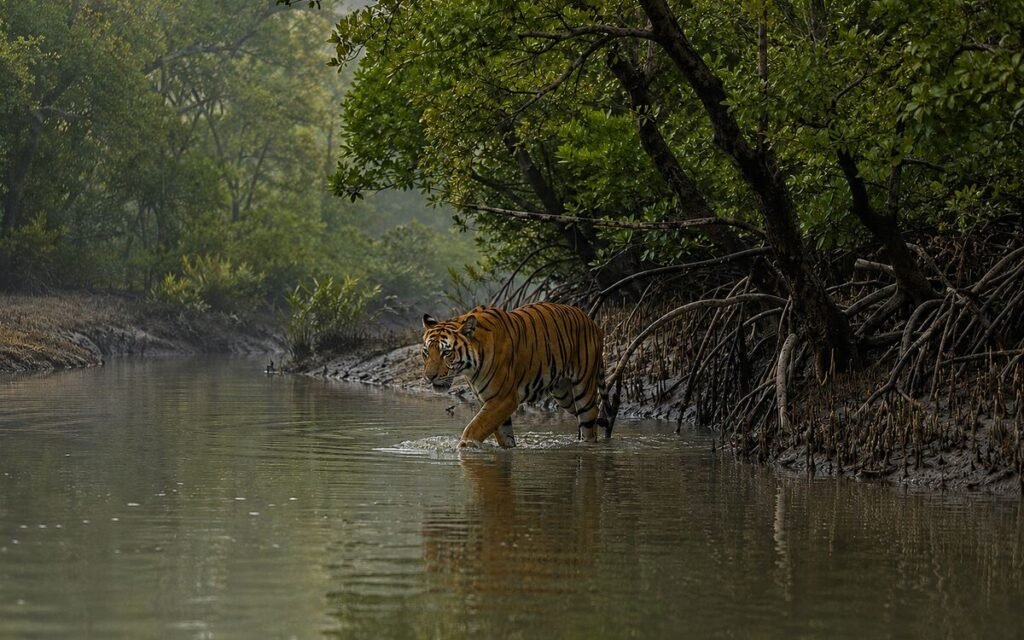
The Sundarbans is like nowhere else in India — a vast, watery wilderness where the Ganges, Brahmaputra and Meghna rivers empty into the Bay of Bengal in a labyrinth of mangrove islands and tidal channels. Shared between India and Bangladesh and protected as a UNESCO World Heritage Site, it’s the largest mangrove forest on earth and the only one where tigers have learned to swim between islands and hunt in the salt marsh. You explore it slowly, by boat, drifting past mudbanks and watchtowers — and even if the tiger stays hidden, as it usually does, the sheer wild atmosphere of the place is unforgettable.
Why visit the Sundarbans
A one-of-a-kind ecosystem
Nowhere else combines mangrove forest, tidal rivers and open sea on this scale. The Sundarbans is a living, shifting landscape of islands that appear and vanish with the tide, sustaining a food chain found nowhere else in India.
The Royal Bengal tiger
This is the land of the swimming tiger — famously elusive and rarely seen, but ever-present in the guides’ stories and the forest’s tense, watchful quiet. Sightings are rare and never guaranteed, which makes them all the more electric.
Slow travel by boat
There are no roads in the core forest. You move by launch and country boat through narrow creeks, past crocodiles basking on mudbanks and kingfishers flashing between the roots — a rare chance to travel at the pace of the tide.
When to go to the Sundarbans
November to February is the best time — cool, dry and comfortable, with animals more active and calmer water for boating. March to mid-June gets hot and humid but can improve your odds of spotting wildlife near the water, though the heat is punishing. The monsoon (mid-June to September) brings heavy rain, rough water and limited access, and many operators pause trips. Whenever you go, tides govern everything, so build your plans around your operator’s boat schedule.
Top things to do in the Sundarbans
Boat safari through the creeksDo not miss
The heart of any Sundarbans trip: cruising the tidal channels by motor launch and smaller country boat, scanning the mudbanks for tigers, crocodiles, deer and monitor lizards. Hours slip by as the mangroves close in and open out around you.
Sajnekhali watchtower & interpretation centreDo not miss
The usual first stop, with a mangrove interpretation centre, a crocodile and turtle enclosure, and a watchtower over a waterhole where deer and wild boar gather. A good primer before you head deeper into the forest.
Sudhanyakhali watchtower
Perhaps the best-known watchtower for wildlife, overlooking a sweetwater pond and open ground where tigers are most often (if still rarely) sighted. Patience and quiet are everything here.
Dobanki canopy walk
A raised walkway strung above the mangroves lets you look down into the forest and out over a waterhole — a different, elevated perspective on this water-bound world.
Birdwatching in the mangroves
The Sundarbans is a birder’s paradise — kingfishers of several kinds, herons, egrets, raptors and, in winter, migratory waterfowl. Even non-birders find the constant flashes of colour mesmerising.
A village stop on the fringe islands
Many trips include a visit to a fringe village to see daily life on the forest’s edge — honey collection, crab fishing and folk performances of the Bonbibi legend, the forest goddess local communities revere.
What to eat in the Sundarbans
Bengali fish thali
Most trips are full-board, and meals on the launch are simple, fresh Bengali home cooking — rice, dal, seasonal vegetables and river fish curry, eaten as the mangroves slide past.
Crab & prawn
The delta is famous for its crab and tiger prawns; many packages serve them fresh, and they’re a highlight for seafood lovers.
Nolen gur (in winter)
If you visit in winter, look for sweets made with nolen gur (date-palm jaggery), a seasonal Bengal specialty.
Carry snacks & water
Options in the forest are limited to what your operator provides, so bring your own water, snacks and any specific dietary items.
Where to stay in the Sundarbans
Live-aboard launches
Many trips are spent largely on the boat itself, with basic cabins — the most immersive way to be on the water at dawn and dusk.
Island lodges
Resorts on fringe islands like Gosaba, Pakhiralay and Dayapur offer simple rooms, gardens and a base for daily boat safaris.
Village homestays
A handful of community homestays give a closer look at delta life and support local families — comfortable if basic.
All-inclusive tours
Most visitors book a 2–3 day package covering transfers, boat, permits, guide and meals — by far the easiest way to visit.
How to get to the Sundarbans & around
From Kolkata: the Sundarbans is around 100 km south, but the last stretch is slow. Most people drive (about 3–4 hours) to the jetty at Godkhali, near Gosaba, then transfer to a boat. By train: you can take a local train to Canning and continue by road and boat. Permits & guides: entering the tiger reserve requires permits and a registered guide — almost always arranged as part of a tour package, which is the simplest option. Getting around: once you’re in, everything is by boat; there are no roads in the core forest.
Combine your trip with
Kolkata
Most Sundarbans trips start and end in Kolkata — pair the mangroves with a couple of days of city heritage and food.
Gosaba & Bali Island
The gateway islands have their own quiet charm, with cycle-rickshaw rides, brick paths and the Bonbibi temples.
Bird migration season
Time a winter visit for peak migratory birdlife across the delta — a big draw for birdwatchers.
Bangladesh side
The larger part of the Sundarbans lies in Bangladesh and is visited separately, on its own permits and tours.
A simple 2-day Sundarbans plan
Into the forest
Drive from Kolkata to Godkhali, board your boat and cruise to Sajnekhali for the interpretation centre and watchtower. Spend the afternoon on the creeks, then settle in at your lodge or on board for the night.
Full day
Creeks & watchtowers
A full day of boating deeper into the reserve — Sudhanyakhali and Dobanki watchtowers, quiet channels and birdlife — with a village stop before the long transfer back to Kolkata.
Full day
Practical tips that actually help
Manage your expectations on tigers: sightings are rare, so treat the ecosystem, the birds and the boat time as the real reward. Book a reputable operator — permits, guides and safety matter here. Carry binoculars, sun protection, insect repellent and cash. Move quietly at the watchtowers, and never leave the boat except at designated points. Winter mornings are cold on the water, so bring a warm layer.
Mistakes first-time visitors make
Coming purely to “see a tiger” and leaving disappointed — the odds are genuinely low. Trying to do it as a rushed day trip from Kolkata, which wastes most of your time in transit. Visiting in the monsoon, when access and weather are poor. Skipping the guide and permits (they’re mandatory in the reserve). And forgetting that tides, not clocks, dictate the whole itinerary.
Sundarbans FAQs
How many days do you need for the Sundarbans?
Two to three days is ideal — enough for a full day (or more) of boat safaris across the main watchtowers and creeks, plus the travel time to and from Kolkata. A day trip is possible but leaves almost no time in the forest itself.
Will I see a tiger in the Sundarbans?
Possibly, but don’t count on it. The Royal Bengal tigers here are shy and superbly camouflaged in dense mangrove, so sightings are rare even for regular visitors. Most people come for the extraordinary ecosystem, the boat safaris and the birdlife, and treat a tiger as a rare bonus.
What is the best time to visit the Sundarbans?
November to February — cool, dry and comfortable, with the calmest water and the most active wildlife. Summer is very hot and humid, and the monsoon brings rough conditions and limited access.
How do I reach the Sundarbans?
Most visitors drive about 3–4 hours from Kolkata to the jetty at Godkhali (near Gosaba), then transfer to a boat. You can also take a train towards Canning and continue by road and boat. Entering the reserve needs permits and a registered guide, usually arranged through a tour.
Do I need a permit for the Sundarbans?
Yes — entering the tiger reserve requires permits and a registered guide. These are almost always handled for you as part of a tour package, which is the easiest way to visit.
Is the Sundarbans safe to visit?
Yes, on an organised tour with a registered guide and licensed boat. You stay on the boat or at designated points and never wander into the forest, which keeps risks low. Follow your guide’s instructions at all times.
Related guides
West Bengal Travel Guide
Darjeeling’s tea hills, the Sundarbans, Kolkata and Tagore’s countryside — the whole state, and how to plan it.
Kolkata Travel Guide
The City of Joy — Victoria Memorial, Howrah Bridge, College Street and the best street food in India.
Written by Ashvinee Nagle
I travel India slowly and write it down honestly - practical guides and real itineraries from someone who lives here.
About Ashvinee →Plan your India trip with us
Get one short, honest India travel guide a week — plus a free 7-day Rajasthan itinerary to start.
Free. Unsubscribe any time.