
Festival guide · Kolkata
Durga Puja in Kolkata 2026: a slow pandal-hopping plan that beats the crowds
Five days, thousands of pandals and a city that forgets to sleep — the 2026 dates, the neighbourhoods worth your nights, and the dawn trick that makes it all bearable.
- Eastern India
- Festival
- 4 days
- Main days17–21 OctShashthi to Dashami
- Quietest evenings15–16 OctBefore the official start
- Time needed4 days2 if you pick carefully
- Best hours5–9 amBig pandals nearly empty
The short version
The main days in 2026 are Saturday 17 October (Shashthi) to Wednesday 21 October (Vijaya Dashami), with Mahalaya on 10 October. Stay near a Blue Line metro station, see one neighbourhood per night rather than the whole city, and do your big-name pandals between 5 and 9 am, when they are nearly empty. Visit Kumartuli in the days before, and keep Dashami morning for sindoor khela at an old family puja.
Why Kolkata for Durga Puja
Durga Puja in Kolkata is not a festival you attend. It is a city you move through. For five days almost every neighbourhood builds a temporary temple, the pandal, around its own idol of Durga. Some are faithful, gold-and-clay traditional; others are full-scale art installations that took a year to design. The whole city goes out at night to see as many as it can.
Done badly, it is ten hours of barricades and shoulder-to-shoulder queues. Done slowly, it is one of the great experiences in India.
Scale
Thousands of pujas
Around three thousand community pujas, a few hundred of them with serious budgets and year-long design teams.
Heritage
On UNESCO’s list
Durga Puja in Kolkata was added to the Intangible Cultural Heritage of Humanity in 2021.
Open
Everyone walks in
Community pujas are free to enter and famously welcoming, whatever your faith or where you are from.
Durga Puja 2026 dates
The Puja follows the lunar calendar, so the dates move every year. For 2026, Kolkata’s calendar gives the following.
- Sat 10 OctMahalayaThe season begins. Much of Bengal still wakes before dawn for the old Mahishasuramardini radio recital.
- Sat 17 OctShashthiBodhon: the goddess is welcomed and the idols are unveiled.
- Sun 18 OctSaptamiKola Bou, a banana plant dressed as a bride, is bathed in the river at dawn.
- Mon 19 OctAshtamiMorning anjali, the candle-lit Sandhi Puja, and Kumari Puja at Belur Math.
- Tue 20 OctNavamiThe biggest night of the five.
- Wed 21 OctVijaya DashamiSindoor khela, then the idols go to the river.
Why then
Many of the big pandals now open two or three days before Shashthi. You get the art and the lights without the crush.
What you miss
The rituals. Bodhon, anjali and Sandhi Puja all happen later in the week.
Best for
The famous theme pandals, which are the hardest to see once the main days begin.
Why then
The heart of it: morning rituals at every puja, dhak drummers, and nights that run until dawn.
What it costs
From about 7 pm to 2 am the whole city is out, and queues for the big names run into hours.
Best for
Neighbourhood pujas in the evening, and famous pandals at dawn.
How the five days actually work
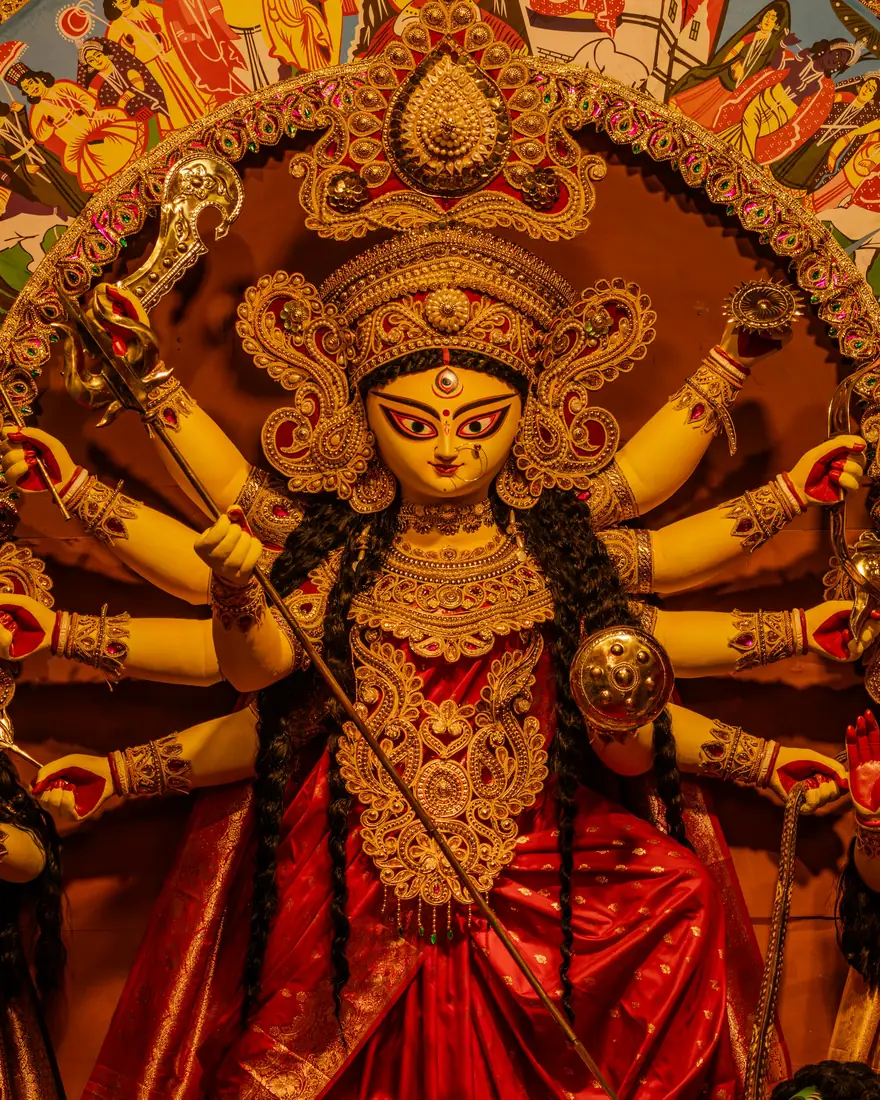
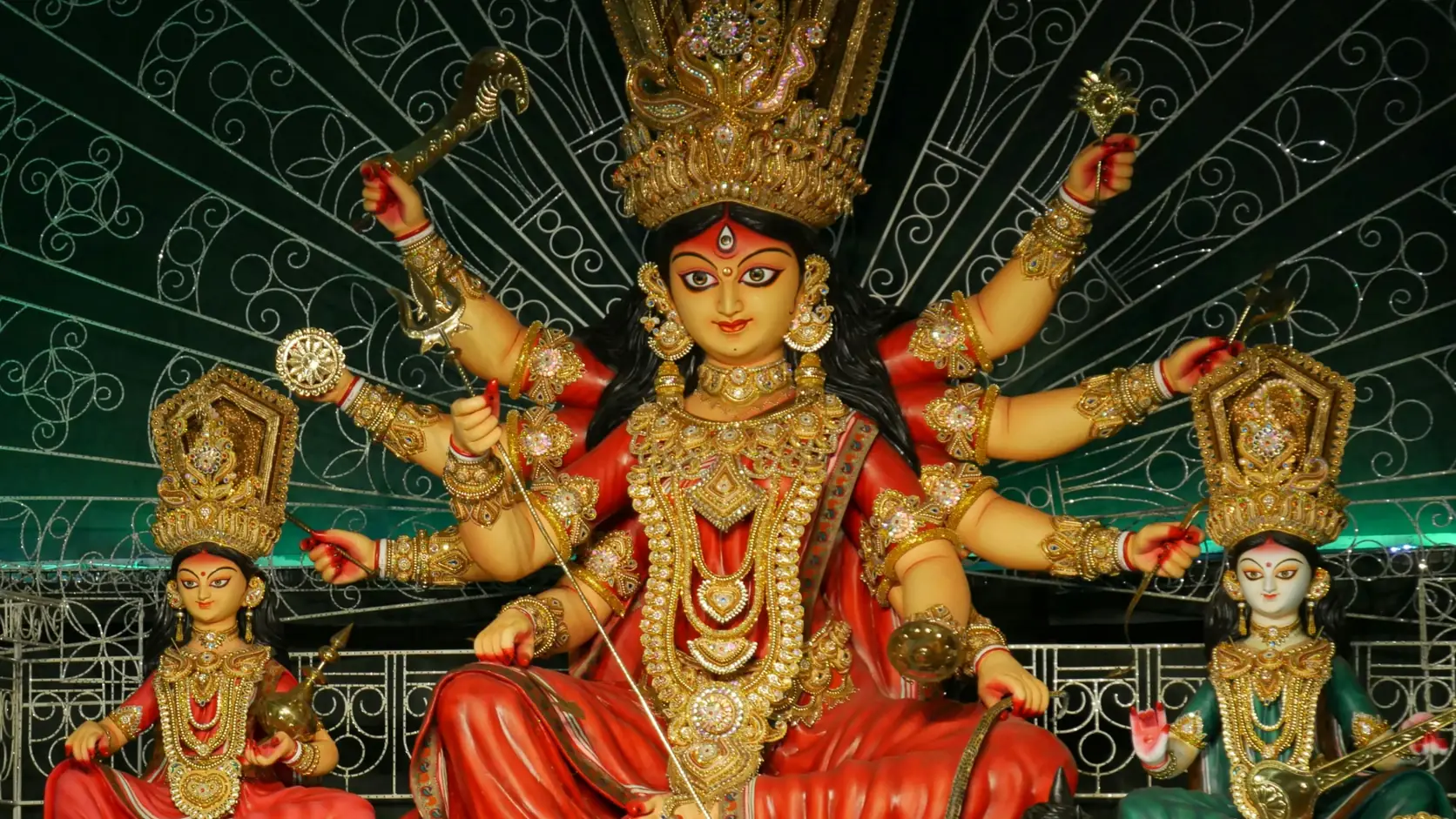
Every idol tells the same story. Durga, ten-armed and riding a lion, is killing the buffalo demon Mahishasura. With her are her four children: Lakshmi and Ganesh on one side, Saraswati and Kartik on the other. The traditional ekchala style puts all five figures under one arched frame; the theme pandals reinterpret everything around them. Once you know the cast, you start noticing how each neighbourhood tells the same story differently, and that is what makes pandal-hopping addictive rather than repetitive.
Mahalaya to Shashthi
The welcome
The eyes are painted onto the idols, the idols travel to their pandals, and on Shashthi evening they are unveiled.
Saptami to Navami
The heart
Anjali (flower offerings) on Ashtami, the Sandhi Puja where Ashtami meets Navami, and the longest nights.
Dashami
The farewell
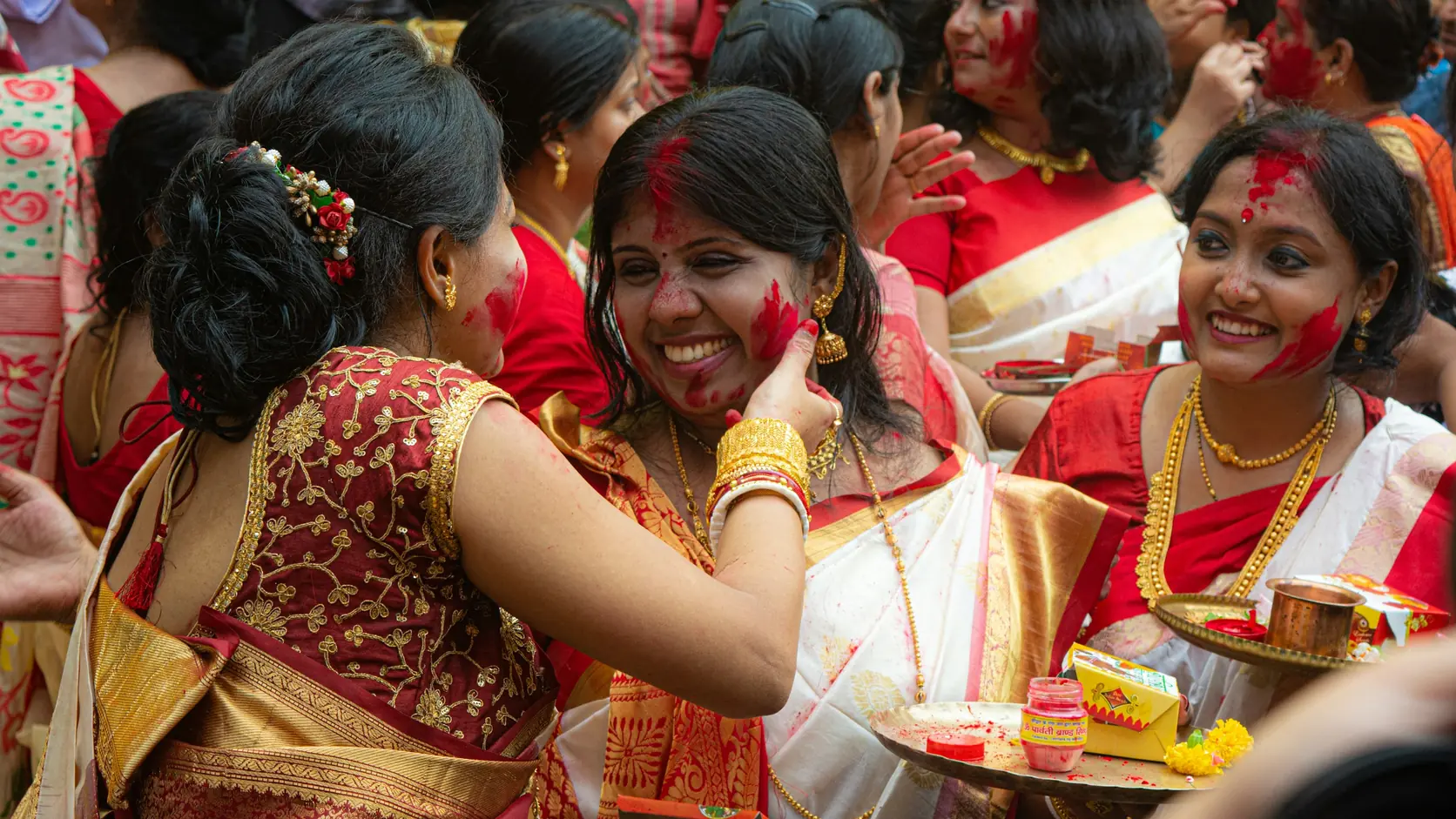
Married women smear each other with vermilion in sindoor khela, then the idols are carried to the Hooghly.
Worth knowing
It is a religious festival first and a spectacle second. Take your shoes off where asked, don’t climb on barricades for photos, and step aside for anyone who is there to pray.
Before the Puja: Kumartuli
If you reach Kolkata before Mahalaya, go to Kumartuli first. It is the potters’ quarter in north Kolkata, a knot of narrow lanes near the river where most of the city’s idols are shaped from straw, bamboo and river clay. In the last two or three weeks before the Puja, every workshop is full of half-finished goddesses: bare clay faces, arms drying in rows, artisans painting eyes by bulb-light late into the night.
- Go on a weekday morning and walk slowly. These are working studios in their busiest weeks of the year.
- Ask before photographing inside a workshop. Some artisans understandably say no.
- Pair it with the ghats a few minutes away and a sandesh from one of north Kolkata’s old sweet shops. My Kolkata travel guide covers the rest of that side of the city.
Where to go, area by area
You cannot see every puja, and trying is how people end up exhausted and grumpy by Ashtami. Think in clusters. The club names below are well established; the themes change every year, and Kolkata’s newspapers publish maps and shortlists in the week before Shashthi.
- 01
North Kolkata: the old city
The traditional heart of the Puja, and the one to prioritise if you only have one night. Bagbazar Sarbojanin, by the river, is one of the oldest community pujas in the city and known for its classic idol. Kumartuli Park and Ahiritola are a short walk away. Shobhabazar Rajbari, whose family has held its puja since 1757, is the best-known bonedi bari (old family) puja, held in a courtyard rather than a pandal.
- Metro: Shobhabazar Sutanuti
- 3–4 hr on foot
- Dawn or Dashami
- 02
Central Kolkata: the big theme pandals
Where the scale gets spectacular. Mohammad Ali Park and Santosh Mitra Square (Lebutala Park) are known for large, ambitious installations. College Square lights up its lake so the whole pandal reflects in the water, one of the loveliest sights of the Puja after dark.
- Metro: MG Road / Central
- 2–3 hr
- Before Shashthi
- 03
South Kolkata: the walkable cluster
The easiest area on foot, because the famous pujas sit close together. Around Gariahat and Rashbehari: Ekdalia Evergreen, Singhi Park, Hindustan Park, Tridhara Sammilani and Deshapriya Park. A little further west, Chetla Agrani and Suruchi Sangha in New Alipore, known for pandals themed on different Indian states.
- Metro: Kalighat / Rabindra Sarobar
- 3–4 hr
- Before 7 pm
- 04
Salt Lake and Lake Town
Sreebhumi Sporting Club in Lake Town draws some of the biggest crowds of the whole Puja. The Salt Lake block pujas are more spread out and more relaxed. Worth it if you are staying near the airport or in New Town; otherwise, skip it on a short trip.
- Cab or auto from Dum Dum
- 2–3 hr
- Avoid Navami
The slow rule
One neighbourhood a night, on foot, is worth more than twelve pandals seen from a car window.
— Travel India
Beating the crowds
From Saptami to Navami, police barricades turn the busiest roads into one-way corridors you cannot easily leave. Three things change the experience completely.
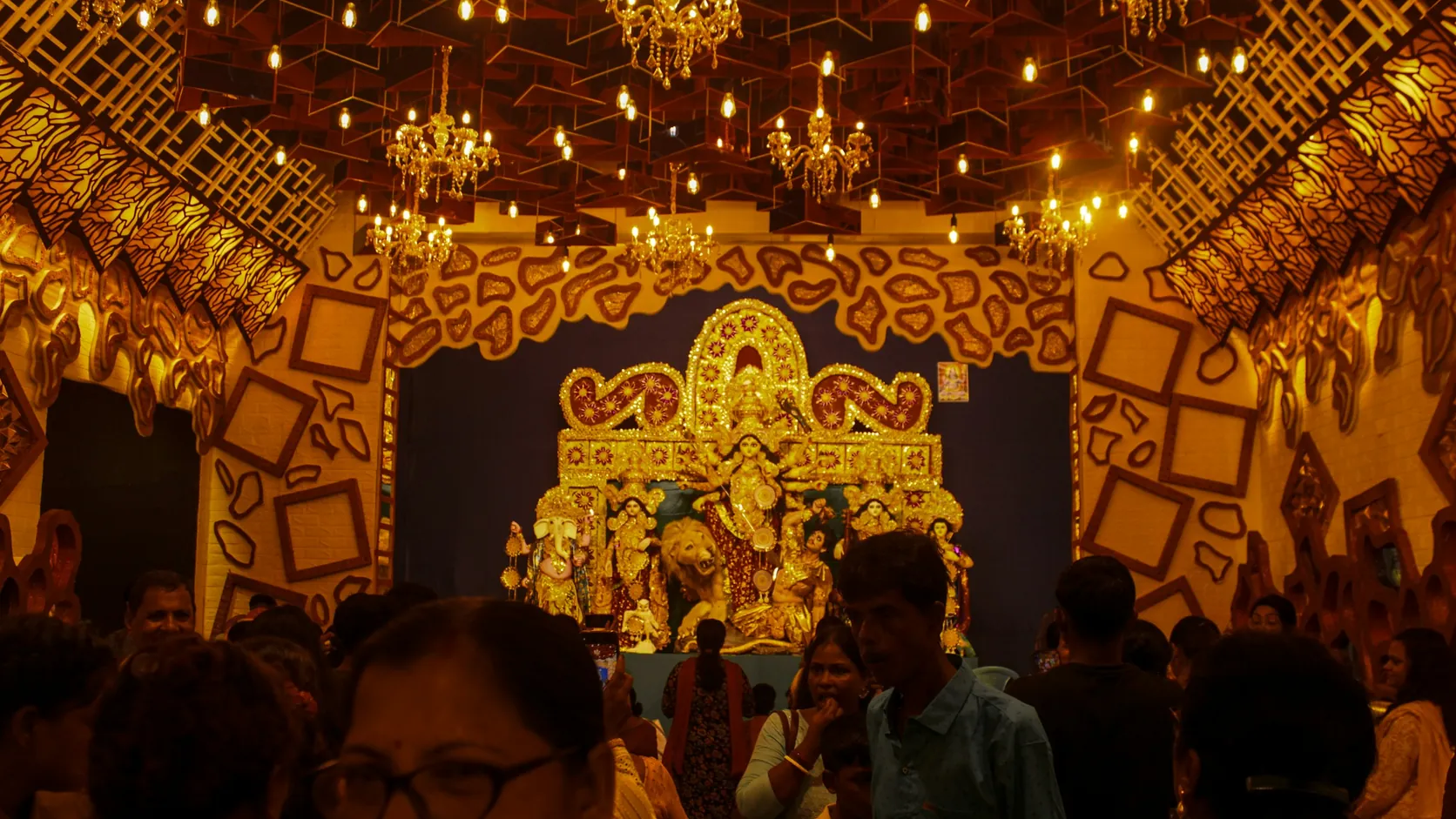
- Go at dawn. Many pandals stay open through the night. Between 5 and 9 am you can walk straight in, the light is soft, and the only other people are locals at their morning prayers. This is how I would see every famous pandal.
- Go early in the week. Chaturthi and Panchami evenings (15 and 16 October) have the pandals and the lights without the peak crush.
- Spend the evenings at a para puja. The small neighbourhood pujas are where the festival really happens after dark: dhak drummers, dhunuchi dancing with clay incense burners, and adda over tea. Pick one near your stay and just stay put.
Getting around
Roads close, cabs surge and parking is impossible, so plan around the metro and your feet.
- MetroBlue Line, north–southRuns past most clusters, and has run through the night on the main Puja days in recent years. Check the 2026 timetable closer to the date.
- Walk10–15 km a nightThe real way to pandal-hop. Shoes matter more than anything else you pack.
- CabsBefore 5 pm onlyUseful between areas in the day. After that, surge pricing and closures make them slow.
- ArriveCCU, Howrah or SealdahPeak season: book flights and trains early.
What to eat
Puja is also Kolkata’s biggest food week. Stalls appear outside every major pandal and restaurants run special menus.
- Bhog. Khichuri, labra (mixed vegetables), chutney and payesh, cooked as an offering and shared out. Some community pujas serve it to visitors on Ashtami — ask politely at a neighbourhood puja.
- Street food. Phuchka, egg rolls, fish fry, mughlai paratha and ghugni. Eat where the queue is longest and the oil looks freshest.
- The classics. Kathi rolls at Nizam’s near New Market, fish kabiraji at Mitra Cafe in Shobhabazar, and a Kolkata biryani, potato included, from one of the old names.
- Sweets. Sandesh and rosogolla from the old family sweet shops — Balaram Mullick & Radharaman Mullick, Bhim Chandra Nag, Nakur. Mishti is not optional during Puja.
Where to stay
Book now. Puja week is the most expensive week of the year for Kolkata hotels. Location matters more than luxury: stay a short walk from a Blue Line station and you can come back to rest between the dawn and night sessions, which is the whole secret to lasting five days.
- CentralPark Street and EsplanadeWell connected, lots of food. The practical default.
- SouthKalighat to GariahatPuts you inside the walkable pandal cluster.
- NorthHeritage homestaysThe most atmospheric, close to Kumartuli and the bonedi baris. Fewest rooms, so book first.
- EastNew Town and RajarhatModern and good value, but far from the old city once the roads close.
A slow four-day plan
The pattern is the same every day: out early, rest in the afternoon, out again in the evening, and never more than one area per session.
- Day 1Panchami or Shashthi · 16–17 OctHead out around 5 pm to Mohammad Ali Park, Santosh Mitra Square and College Square while crowds are still manageable. Stay for College Square lit up after dark.
- Day 2Saptami · Sun 18 OctLeave by 5 am for the Bagbazar ghats to watch the Kola Bou bathed, then walk Bagbazar, Kumartuli Park, Ahiritola and Shobhabazar Rajbari. Sleep through the afternoon; evening at a para puja.
- Day 3Ashtami · Mon 19 OctMorning anjali at a neighbourhood puja. For Kumari Puja at Belur Math, go very early. From 4 pm, walk the south cluster from Chetla and Suruchi Sangha to Gariahat.
- Day 4Navami and Dashami · 20–21 OctGive Navami night to dhunuchi and dhak at a para puja. Dashami morning: sindoor khela at a bonedi bari; evening, follow a procession to the ghats at a respectful distance.
After Dashami
A few days later, the city’s award-winning idols are paraded at the Durga Puja Carnival on Red Road before immersion. Entry is by pass and the date is announced by the state, so most visitors watch it on television — and that is fine.
Practical tips that actually help
- Wear shoes you can walk 15 km in. Comfortable slip-ons help at pandals that ask you to remove footwear.
- Keep your phone in a front pocket. Pickpockets work the crowds. Carry a small cross-body bag rather than a backpack.
- Carry cash in small notes. UPI is everywhere, but mobile networks jam in dense crowds. ₹1,500–2,000 covers food and autos.
- October is still warm and humid. Expect the high 20s to low 30s °C and the odd late shower. Water, a small umbrella, a spare T-shirt.
- Agree a meeting point. Groups get separated in the barricade queues. Pick a landmark before you go in.
- Respect sindoor khela. It is traditionally for married women. Many pujas now welcome everyone, but join only if you are invited.
- Stay on in Bengal. The week after Puja is lovely for Shantiniketan or the terracotta temples of Bishnupur, both easy from Kolkata.
FAQs about Durga Puja in Kolkata
When is Durga Puja 2026 in Kolkata?
The main days are 17 October (Shashthi) to 21 October (Vijaya Dashami), with Mahalaya on 10 October. Saptami is 18 October, Ashtami 19 October and Navami 20 October. Many big pandals open to visitors a couple of days before Shashthi.
Which day is best for pandal hopping?
For the least crowding, Chaturthi or Panchami evening (15–16 October), or dawn on any day. For atmosphere, Ashtami is the most important ritual day. Navami night is the busiest, and is better spent at a local puja than in queues for famous ones.
How many days do I need?
Four is the sweet spot: one night each for central, north and south Kolkata, plus Dashami. With two days, pick north Kolkata at dawn and one evening cluster, and accept that you will miss things. Everyone does.
Is Durga Puja in Kolkata safe for tourists and solo women?
Broadly, yes. The streets are full of families all night and there is heavy police presence. The real risks are crowd crush at the most famous pandals and pickpocketing. Avoid peak hours at the biggest names, keep valuables minimal and share your plan with someone.
Can non-Hindus and foreign visitors join in?
Yes. Durga Puja is famously open and visitors of every background walk the pandals. Be respectful at the altar, remove shoes where asked, and ask before photographing people during rituals.
Do I need tickets for the pandals?
No. Community pujas are free to enter. Some very popular pandals run separate queues or passes at peak times, and the Red Road carnival is by invitation or pass.
Plan with us
Planning a trip around Durga Puja?
I help travellers plan slow, well-paced India trips that get the timing right — including festival trips like this one, and routes that carry on to Darjeeling, the Sundarbans or Shantiniketan. Free 48-hour reply.
Plan my India trip →
Written by Ashvinee Nagle
I travel India slowly and write it down honestly - practical guides and real itineraries from someone who lives here.
About Ashvinee →Plan your India trip with us
Get one short, honest India travel guide a week — plus a free 7-day Rajasthan itinerary to start.
Free. Unsubscribe any time.