
Travel to Sivasagar: A First-Timer’s Guide to the Ahom Capital
An honest, no-fluff guide to Sivasagar — the Rang Ghar and Talatal Ghar, the great temple tanks and Shiva Dol, the UNESCO Charaideo maidams, when to go, and how to add six centuries of Ahom history to a wider Assam trip.
Sivasagar was the capital of the Ahom kingdom, the dynasty that ruled Assam for nearly six hundred years and famously held off the Mughals. What survives is remarkable: the oval Rang Ghar, one of Asia’s oldest amphitheatres; the multi-storey Talatal Ghar palace with its hidden lower floors; and a trio of vast man-made tanks ringed by temples, including the towering Shiva Dol. A short drive away, the royal burial mounds of Charaideo — the Ahom maidams — were inscribed as a UNESCO World Heritage Site in 2024. For anyone interested in India beyond the usual Mughal-and-Rajput story, Sivasagar is a revelation. It’s an easy, uncrowded stop of a day or two on the way through upper Assam.
Sivasagar is the old capital of the Ahom kingdom, which ruled Assam for six centuries. See the oval Rang Ghar amphitheatre, the multi-storey Talatal Ghar palace, and the great temple tanks crowned by Shiva Dol, then drive out to the UNESCO-listed royal burial mounds (maidams) of Charaideo. It’s a compact, uncrowded heritage stop of a day or two, an easy addition to a wider Assam trip through the tea country and Kaziranga.
Why visit Sivasagar
Three reasons Sivasagar deserves a stop that most itineraries skip.
Six centuries of Ahom rule
The Ahoms ruled Assam for nearly 600 years and repelled repeated Mughal invasions — a chapter of Indian history most visitors never hear. Their capital brings it vividly to life.
Monuments you’ll see nowhere else
The oval Rang Ghar, the layered Talatal Ghar and the towering Shiva Dol are architecturally unlike anything in the rest of India — a distinct tradition well worth seeing.
A new UNESCO site
The Charaideo maidams — the pyramid-like royal burial mounds of the Ahom kings — were inscribed as a World Heritage Site in 2024, adding a compelling reason to make the trip.
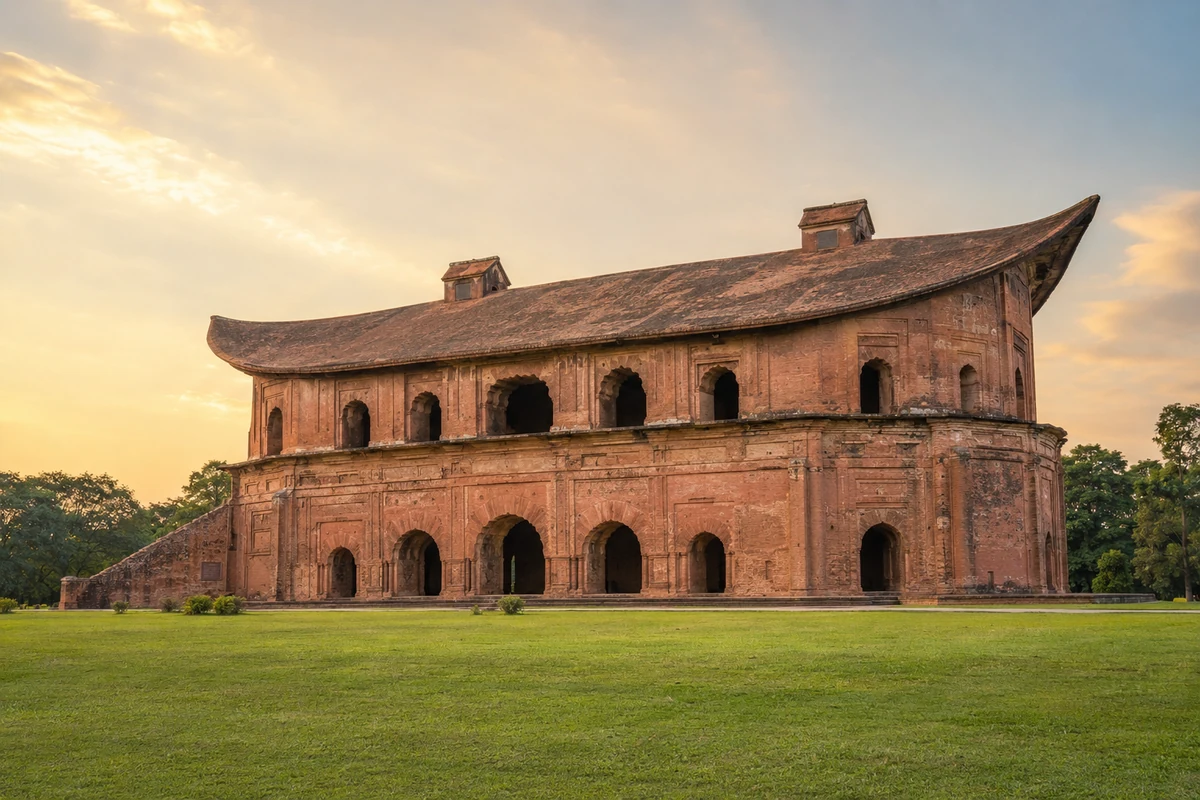
The Rang Ghar, one of Asia’s oldest surviving amphitheatres, built by the Ahom kings of Sivasagar.
When to go
October to March (the sweet spot): cool, dry and comfortable for walking between the monuments and tanks. Clearly the best window for a Sivasagar visit.
Winter (clearest light): the cool months give crisp, pleasant days ideal for photography around the tanks and temples, with the fewest weather interruptions.
April to May (hot): upper Assam warms up; sightseeing is still possible but best done in the mornings and late afternoons.
June to September (monsoon): heavy rain makes the region green but can disrupt travel; the open-air monuments are less enjoyable in the wet.
Sivasagar’s sights are mostly open-air monuments and tanks, so the weather matters — the cool, dry months from October to March are far more comfortable than the heat or the monsoon. The Charaideo maidams are a short drive out of town, so factor that in if you want to include the UNESCO site.
Top things to do in Sivasagar
From an oval royal amphitheatre to pyramid-like burial mounds, here is what fills a day or two.
Rang Ghar
The oval, two-storey Rang Ghar is one of Asia’s oldest surviving amphitheatres, from which the Ahom kings watched games and buffalo fights. Its distinctive shape and roof make it the emblem of Sivasagar.
Talatal Ghar & Kareng Ghar
The great Ahom palace rises several storeys above ground (Kareng Ghar) and, famously, extends into hidden lower floors (Talatal Ghar) once linked by secret tunnels. The largest surviving Ahom structure.
Sivasagar tank & Shiva Dol
The huge Borpukhuri tank sits above the surrounding land, ringed by temples including Shiva Dol, said to be among the tallest Shiva temples in India. The heart of the town, and lovely at dusk.
Charaideo maidams
A short drive away, the pyramid-like royal burial mounds of the Ahom kings — inscribed by UNESCO in 2024 — sit in quiet green grounds. A moving, uncrowded site and the region’s newest heritage draw.
Joysagar & Gaurisagar
Beyond the main tank lie Joysagar — among the largest man-made tanks in India — and Gaurisagar, each ringed by its own cluster of Ahom-era temples. Peaceful stops for anyone with extra time.
Ahom-era temples
The town and its surroundings are dotted with distinctive dol temples from the Ahom period, many still in worship. Together they show a temple architecture found nowhere else in India.
What to eat in Sivasagar
Sivasagar is a small town with honest local food — Assamese thalis and river fish rather than a dining scene.
Assamese thali
Rice, dal, greens, khar, a sour tenga and fish or meat — the reliable, fresh local meal, best at a simple dedicated eatery.
Masor tenga
The classic Assamese sour fish curry, light and tangy — the dish to try if you order just one thing.
Duck & pigeon curry
Upper Assam is known for rich duck and pigeon preparations, often festive — worth seeking out beyond the everyday thali.
Pitha & fresh tea
Rice-flour pithas, jaggery sweets and endless cups of strong Assam tea round off a day among the monuments.
Sivasagar is a small town, so keep expectations simple and seek out a dedicated Assamese eatery for the best thali and river fish. Carry water for the open-air monuments, especially in the warmer months.
Where to stay
This is a modest town with practical rather than luxurious hotels — comfortable mid-range options and budget guesthouses, all close to the main sights.
Mid-range town hotels
Comfortable, reliable hotels in the town centre put you within reach of the tank, Shiva Dol and the monuments. The practical traveller’s pick.
Guesthouses & lodges
Simple guesthouses and lodges keep costs low while staying close to the sights — fine for a short heritage stop.
Stay in the tea country
For more atmosphere, base at a heritage tea bungalow toward Jorhat and day-trip to Sivasagar — combining tea country with Ahom history.
How to get to Sivasagar & around
Sivasagar sits in upper Assam, easily reached by road from Jorhat and on the way through to the far east of the state.
Sivasagar pairs naturally with Jorhat and the tea country, about an hour and a half away, so many travellers day-trip or stop over between the two. Hire a car or auto for the day to link the town monuments with the Charaideo maidams out of town.
A simple 1–2 day plan
The town monuments in a day, with Charaideo and the outer tanks if you have a second.
The Ahom capital
See the Rang Ghar and Talatal Ghar at Rangpur, then the Sivasagar tank and Shiva Dol in town, ending by the water at dusk.
Charaideo & the tanks
Drive out to the UNESCO Charaideo maidams, then visit Joysagar and Gaurisagar — before continuing to Jorhat and the tea country.
Practical tips that actually help
Come in the cool season
The monuments are open-air — October to March is far more comfortable than the heat.
Hire a car for the day
A car or auto lets you link the town sights with Charaideo out of town efficiently.
Pair it with Jorhat
Sivasagar and the Jorhat tea country combine neatly — do them together.
Don’t miss Charaideo
The new UNESCO maidams are the region’s highlight — build in time for the drive.
Carry water
Shade is limited around the tanks and monuments — bring water, especially when warm.
Learn the story first
A little Ahom history beforehand makes the monuments far more rewarding.
Mistakes first-time visitors make
- Skipping Sivasagar entirely. Most itineraries miss it — and miss one of India’s most distinctive histories.
- Leaving out Charaideo. The UNESCO maidams are the highlight; don’t stop at the town monuments alone.
- Coming in peak heat. The open-air sites are punishing at midday in summer — stick to the cool season or early hours.
- Rushing through without context. Without a little Ahom history the monuments can feel abstract — read up first.
Planning Assam beyond Sivasagar?
Sivasagar pairs naturally with the Jorhat tea country and the river island of Majuli, with Kaziranga’s rhinos an easy drive west. Tell me your dates and pace, and I’ll map an Assam route that works in the Ahom capital and its monuments.
Plan my Assam trip →Sivasagar FAQs
Who were the Ahoms and why does Sivasagar matter?
The Ahoms ruled Assam for nearly six hundred years, from the 13th to the 19th century, and famously repelled repeated Mughal invasions. Sivasagar was their capital, and its monuments — the Rang Ghar, Talatal Ghar and temple tanks — are the finest surviving record of that dynasty.
How many days do you need in Sivasagar?
One day covers the main town monuments — Rang Ghar, Talatal Ghar and the Sivasagar tank with Shiva Dol. A second day lets you add the UNESCO Charaideo maidams and the outer tanks of Joysagar and Gaurisagar.
What are the Charaideo maidams?
The Charaideo maidams are the pyramid-like royal burial mounds of the Ahom kings, a short drive from Sivasagar. They were inscribed as a UNESCO World Heritage Site in 2024 and are the region’s newest and most compelling heritage draw.
How do I get to Sivasagar?
Sivasagar is in upper Assam, about an hour and a half by road from Jorhat, which has the nearest airport; Dibrugarh airport is a little further. The nearby railhead is Simaluguri. Most travellers combine it with the Jorhat tea country.
Is Sivasagar worth visiting?
Yes, particularly for anyone interested in history beyond the usual Mughal and Rajput story. Its Ahom monuments are architecturally unique, the new UNESCO maidams add real weight, and it’s an easy, uncrowded stop on a wider Assam trip.
Related guides
Keep planning your Assam trip with these:
Assam Travel Guide
Kaziranga, the Brahmaputra, Majuli, tea country and the Ahom monuments — how to string an Assam trip together.
Plan my Assam trip
Share your dates, pace and starting city, and I’ll suggest a Guwahati–Kaziranga–Majuli route that fits.

Written by Ashvinee Nagle
I travel India slowly and write it down honestly - practical guides and real itineraries from someone who lives here.
About Ashvinee →Plan your India trip with us
Get one short, honest India travel guide a week — plus a free 7-day Rajasthan itinerary to start.
Free. Unsubscribe any time.